
Nugeunah Literacy Café: A Path Towards the Taste of Humanity
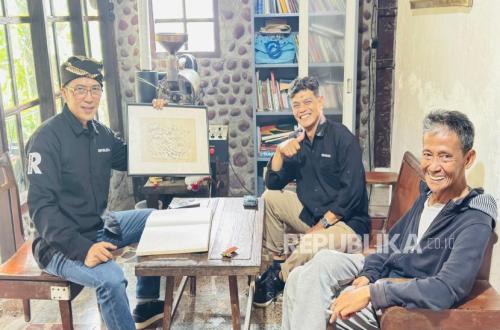
At dawn the soft cluck of roosters slices the stillness of Pamoyanan Village. The air is cool on the slopes of Cicalengka, seeping through dense foliage, carrying the scent of damp earth and the faint aroma of freshly roasted coffee.
In the corner of Panenjoan Village, Cicalangka District, Bandung Regency, time seems to slow, allowing exhausted souls a moment of rest in the embrace of the subconscious rhythms of the land.
This is where Kedai Literasi Nugeunah has stood since 2023. A hidden oasis, perhaps little touched by the clatter of social media, yet containing profound spiritual and intellectual depth.
Nugeunah, in Sundanese, means something that is comfortable and calming; a place of easy, free thought. It is a contemplative space, a small cultural laboratory born from the restlessness of a man named Nundang Rundagi (65).
A man whose name is known in the worlds of visual arts and literature in Indonesia. He is the fourth son of the late Ajip Rosidi, the legendary writer and protector of Sundanese culture. Inheriting his father’s intellectual fire and love of humanity, Nundang chose a quiet path to assert his own existence.
Even with a wide circle of friendships—from prominent artists to influential politicians and central-government officials—he chose to establish Nugeunah far from the glare of the capital. He built it in Pamoyanan, a tranquil village that seems designed to draw a hard line between the clatter of pragmatism and the essential serenity.
Through this café, Nundang wants to show that art, culture, and his own person still exist. And he needs witnesses to attest to their existence. If that is its orientation, then Kedai Literasi Nugeunah is not a commercial venture.
“We are here, alive, and we want this existence to be told by those who come and pause here,” Nundang said in a relaxed chat with the Republika team, framed by puffs of coffee steam from Colombian Arabica.
For Nundang, Nugeunah is a means of proving to himself that his father’s intellectual heritage did not merely remain an inscription of the past, but continues to flow and transform into new energy that drives today’s generations.
Entering Kedai Literasi Nugeunah feels like stepping into a time machine that is also an intimate art gallery. Visitors’ eyes are immediately drawn to the brushwork of a magic touch. Not exact replicas, but original paintings by prominent Indonesian artists such as Affandi and Nashar, hung with grace.
The presence of these maestro’s works provides an aesthetic vibration, harmoniously paired with rows of wooden shelves holding hundreds of books. The collection is largely history and culture, with a special emphasis on Sundanese cultural treasures—ancient chronicles, anthropological notes, and Ajip Rosidi’s literary works preserved for anyone thirsting for knowledge. While leafing through pages of the past, visitors can order a cup of coffee—Arabica or Robusta—from some of the finest estates across the archipelago.
From the gentle acidity of West Java Arabica to the bold bitterness of Sumatra Robusta, flavours mingle to celebrate Indonesia’s diversity. The fusion of coffee aroma, old books, and the brushstrokes of Affandi creates a strongly spiritual atmosphere. The lush trees surrounding the café act as a natural insulator, damping the noise of the outside world and drawing visitors into a deep sense of taste and feeling.
Courage in the Face of the Times
In the midst of global concerns about the future of Gen Z and Gen Alpha, increasingly alienated by screens and shallow digital interactions, Kedai Literasi Nugeunah offers an antidote. The space is deliberately designed to reignite creativity and social sensitivity among younger generations.
Under the shade of the Pamoyanan trees, young people gather not to scroll passively through the online world but to test ideas. Activities flow freely, without dogmatic boundaries, ranging from book discussions and exercises to stimulate critical thinking, to painting sessions, poetry readings, and mini theatre performances.
Nugeunah bears witness to sharp minds engaging not to tear each other down, but to fill each other in. “There is no debate here, only mutual enrichment,” says Nundang.
All these dialectics converge on a single foundational premise: a humanity steeped in love. Here too, there is anxiety that future generations will lose empathy and their cultural roots.
Nugeunah proves that when the right space is provided—one that values reason as well as sensitivity—young people will grow into empowered, critical individuals who remain grounded. And this is aided by the transfer of ideas and paradigms from Generation X to Generation Z and Alpha.
The sun begins its descent over Cicalengka, casting golden light through the branches. Kedai Literasi Nugeunah remains true to its precious quiet. Not many know of this place, and perhaps that silence is what preserves its energy.
Nugeunah does not need publicity to prove its existence, measured by views. Like the history of wind and soil, its presence will continue to spread through word of mouth, recalled by warm memories of those who have sat there, sipped coffee, and rediscovered their own lost souls.
In Kampung Pamoyanan, under the witness of a calm universe, Kedai Literasi Nugeunah will carry on…