
Nuclear Powers’ Arsenals Shrink as China Emerges as a Growing Threat
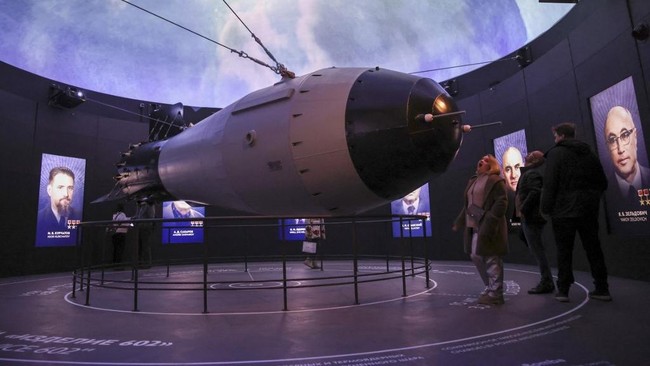
The global balance of nuclear power has shifted significantly over the past two decades. The United States and Russia have cut thousands of nuclear warheads, while several Asian countries have expanded their arsenals.
According to data from the Federation of American Scientists (FAS), the total military stockpile of nuclear warheads across nine countries fell by about 37%, from 15,499 in 2006 to 9,745 in 2026.
Despite the decline, Russia and the US continue to dominate global nuclear power, together holding around 83% of the world’s military nuclear warheads.
China, by contrast, recorded a significant expansion, increasing its nuclear arsenal by 164% over 20 years. India and Pakistan also saw sharp rises.
The data covers warheads deployed or held in military stockpiles, but excludes retired weapons awaiting dismantlement.
Russia overtakes US, but both remain dominant
In 2006, the US had 7,853 nuclear warheads in its military stockpile, more than Russia’s 6,643.
Two decades later, the positions had reversed. Russia had the world’s largest military nuclear stockpile in 2026, with about 4,400 warheads, while the US ranked second with 3,700.
This means the US stockpile shrank by about 53%, while Russia’s fell by around 34% compared with 2006.
The decline reflects nuclear disarmament efforts after the end of the Cold War, including several strategic arms control agreements between the two countries.
Nevertheless, Russia and the US remain overwhelmingly dominant. Each has a far larger military stockpile than China, which ranks third.
Uncertainty has also increased since the New START nuclear arms control treaty expired on 5 February 2026. Its end removed the last legal limits on the number of strategic nuclear weapons deployed by the two countries.
This has raised concerns about the future of nuclear arms control, particularly if strategic competition between major powers intensifies again.
China’s arsenal grows 164%, surpassing France and the UK
While the US and Russia reduced their arsenals, China accelerated the development of its nuclear capabilities.
FAS estimates that China’s nuclear warhead count rose from 235 in 2006 to 620 in 2026, an increase of about 164%.
That growth put China ahead of France and the UK as the country with the world’s third-largest military stockpile of nuclear warheads.
By comparison, France had about 290 warheads in 2026, down from 350 in 2006. The UK’s stockpile fell from 245 to 225.
China’s expansion has coincided with the modernisation of its weapons systems, including the construction of intercontinental ballistic missile launch facilities and the development of submarine-based nuclear launch capabilities.
According to FAS, China is building about 320 silos for solid-fuel missiles at three locations, as well as 30 additional silos for liquid-fuel missiles.
China also operates six nuclear-powered submarines capable of carrying ballistic missiles, strengthening its strategic capabilities at sea.
These developments indicate that the global nuclear balance is beginning to shift, although China’s stockpile remains far smaller than those of Russia and the US.
India and Pakistan also expand their arsenals
Stockpile growth has not been limited to China. India and Pakistan have also increased their weapons capabilities over the past two decades.
India’s nuclear warhead count rose from 43 in 2006 to about 190 in 2026, an increase of nearly 342%.
Pakistan’s stockpile increased from 50 to 170 warheads, a rise of 240%.
These increases have taken place amid long-standing security tensions between the two countries. India is also increasingly factoring China’s military development into its strategic planning.
North Korea has also become a country with a nuclear arsenal. Although reliable estimates for 2006 are unavailable, FAS estimates that it had about 60 assembled nuclear warheads in 2026.
Israel is estimated to have 90 warheads, up from about 80 in 2006.
These developments show that while the world’s overall nuclear stockpile has shrunk, modernisation and expansion are continuing in several countries.
Nuclear competition continues to shadow global security
Changes in nuclear stockpiles over the past 20 years reveal two trends unfolding at the same time.
The US and Russia have substantially reduced their arsenals, while China, India, Pakistan and North Korea have expanded their nuclear capabilities.
These shifts could affect geopolitical relations, defence budget priorities and regional security stability.
Economically, rising military competition could spur investment in defence technology and security infrastructure. However, higher defence spending could also increase fiscal pressure and leave less room in budgets for other development needs.
With New START having expired and several Asian countries strengthening their nuclear capabilities, the challenge of global arms control has become more complex.
The overall decline in warhead numbers does not necessarily mean that the risk of nuclear conflict has fallen, particularly as strategic competition between countries continues to evolve.
Nuclear power generation also increases
Beyond military uses, nuclear technology is also being used to meet global electricity needs.
International Energy Agency (IEA) data show that global nuclear electricity generation increased between 2023 and 2025, with major contributions from the Americas, Europe and Asia-Pacific.
The rise has been driven by growing electricity demand, efforts to reduce reliance on fossil fuels and carbon-emissions targets. The IEA’s 2025 report says nuclear power plants can provide a stable electricity supply with low operational carbon emissions.
Several countries have also extended the operating lives of existing reactors and built new facilities to strengthen energy security.
However, using nuclear technology to generate electricity is different from developing nuclear weapons. An increase in nuclear electricity production does not mean a country is also expanding its nuclear arsenal.
Source: jawawa.id (https://jawawa.id/newsitem/nuclear-powers-arsenals-shrink-as-china-emerges-as-a-growing-threat-1794113437)
Originally published by CNBC Indonesia (https://www.cnbcindonesia.com/research/20261108074853-128-783256/raja-senjata-nuklir-dunia-mulai-keok-china-jadi-ancaman), translated from Indonesian