
Nuclear Polytechnic Possesses Research Reactor, BRIN: Yogyakarta is a Place to Strengthen Competence
The presence of research reactor facilities and a nuclear education ecosystem in Yogyakarta provides the region with significant experience in developing nuclear technology. However, this does not necessarily mean that Yogyakarta will be the site for the construction of a Nuclear Power Plant (PLTN).
The Head of the National Research and Innovation Agency (BRIN), Professor Arif Satria, emphasised that the government has not yet determined a location for the construction of a PLTN. He noted that the development of nuclear power plants remains part of the government’s long-term agenda.
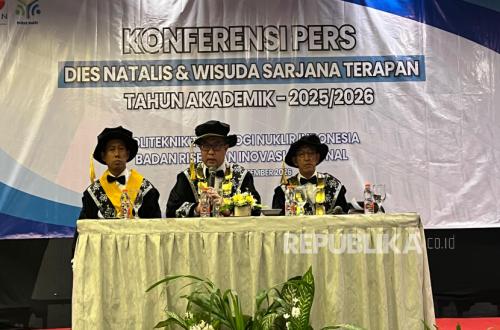
“Regarding nuclear development, I believe we have not yet decided on the location; for the PLTN, the location has not been decided,” said Arif following his keynote speech at the 5th Open Senate Session for the Graduation of Applied Bachelors at the Indonesian Nuclear Technology Polytechnic (Poltek Nuklir) in Yogyakarta, Wednesday (9/9/2026).
Although the location remains undecided, the government is beginning to increase its focus on the development of nuclear technology. BRIN is even preparing a larger budget allocation for 2027 for research and the development of nuclear infrastructure.
Arif stated that this development is not only aimed at the energy sector but also at health and food security. These three sectors are considered to have great potential for the utilisation of nuclear technology.
“These are the three fields we will budget for, and it is precisely through these three fields that we will increase the research budget in the field of nuclear technology,” he revealed.
According to Arif, infrastructure development is one of the areas that will be strengthened. The government hopes that the initial stages of infrastructure reinforcement can be undertaken in 2027, allowing the use of nuclear technology to expand across various sectors.
Arif mentioned that the presence of Poltek Nuklir in Yogyakarta serves as essential capital for preparing the human resources required for future technological development. In addition to being an educational centre, Yogyakarta also possesses research reactor facilities.
“There is one thing far more important than the technology itself, which is the humans who master it,” he said.
“In Jogja, we have reactor laboratories. Jogja is a place for learning to strengthen our competence in nuclear research,” said Arif.
However, the issue of nuclear development is not solely related to technological readiness and technical expertise. Public acceptance is also a challenge that must be addressed before nuclear technology is expanded more widely, particularly in the energy sector.
Arif assessed that public education is a vital part of the nuclear development agenda. Public understanding regarding the benefits and the mechanics of nuclear technology needs to be strengthened so that nuclear power is not always perceived as something foreign or frightening.
“The most important thing for us now is how to educate the public about nuclear technology,” he said.
Efforts to introduce nuclear technology to the public are also being undertaken by Poltek Nuklir through student projects. One such project is a prototype of a PLTN teaching model, which is currently located in the campus corridor.
The Acting Director of Poltek Nuklir, Dr Zainal Arief, explained that the prototype will eventually be donated to the Yogyakarta City Government to be placed at Taman Pintar. The tool is expected to serve as a learning medium for the public to understand how a PLTN operates.
“The prototype can currently be seen in the corridor area; we plan to donate it to the Provincial Government at Taman Pintar to educate the public on how a PLTN works,” said Zainal.
Zainal explained that the creation of the prototype is part of the implementation of the transformative learning method at Poltek Nuklir. Students do not only receive theoretical instruction but are also directed to work on group projects to find solutions to real-world problems.
“This includes our transformative learning process, which we have integrated into the curriculum. One way is by providing special projects where they must work in groups, collaborate, communicate, and identify problems that require solutions,” he said.
Regarding the curriculum, Poltek Nuklir is also adjusting competencies to follow the needs of nuclear technology developments. Six specialisations are being prepared: energy; industry for analysis and radiation; health through nuclear medical instrumentation; accelerator technology; radioisotope and radiopharmaceutical production; and the nuclear fuel process.
“This means that in our three study programmes, there are specialisations related to future nuclear needs: first, energy; second, industry for analysis and radiation; and third, health through nuclear medical instrumentation. The fourth is related to accelerators,” said Zainal.
He continued that the other two fields are radioisotope and radiopharmaceutical production, and the nuclear fuel process. These competencies are prepared to meet the needs of nuclear technology utilisation in the energy, health, and industrial sectors.
Furthermore, Zainal stated that in 2026, Poltek Nuklir graduated 104 Applied Bachelors from three study programmes: Nuclear Technochemistry, Electronic Instrumentation, and Electromechanics. Of these, 78 graduates achieved ‘cum laude’ honours.
All graduates have been equipped with specific industrial competency certifications. Additionally, 100 per cent of the graduates have completed practical work in various strategic industries and research centres. This preparation is expected to ensure graduates are ready to meet industrial needs and support the national nuclear technology development agenda.
“In addition to producing excellent human resources, students are also expected to be adaptive and able to adjust to changes, both in the professional world and in society,” he concluded.
Source: jawawa.id (https://jawawa.id/newsitem/nuclear-polytechnic-possesses-research-reactor-brin-yogyakarta-is-a-place-to-strengthen-competence-1789185329)
Originally published by Republika (https://rejogja.republika.co.id/berita/tl8dux291/poltek-nuklir-punya-reaktor-riset-brin-yogyakarta-tempat-memperkuat-kompetensi), translated from Indonesian