
NTT Shaken by 2,119 Aftershocks Ranging from M1.3 to M6.2, BMKG Issues Warning
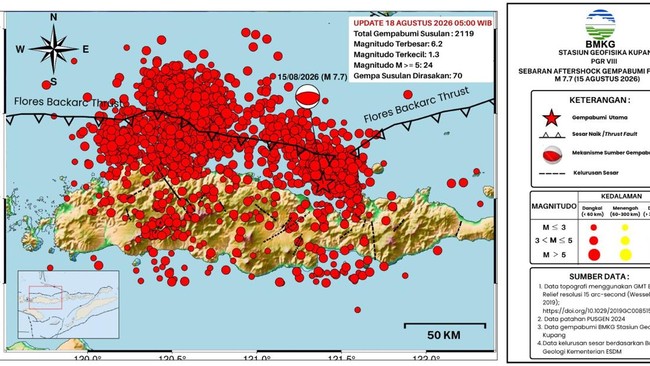
The Meteorology, Climatology and Geophysics Agency (BMKG) has recorded 2,119 aftershocks as of 05.00 WIB on Tuesday (18/8/2026), following the M7.7 earthquake that struck the Flores region of East Nusa Tenggara (NTT) on Saturday, 15 August 2026 at 04.58 WIB. BMKG confirmed that the shallow earthquake, caused by tectonic activity in the Flores Back-Arc with a thrust fault mechanism, triggered a tsunami in surrounding areas.
Director of Earthquakes and Tsunamis at BMKG Wijayanto stated that the aftershock magnitudes ranged from M1.3 to M6.2. Among the thousands of aftershocks, 24 events exceeded M5 and 70 were felt by residents. “Based on preliminary data, these aftershocks will end in the next 3-4 weeks,” Wijayanto said in Jakarta on Tuesday (18/8/2026).
“BMKG will continue to monitor aftershock activity and provide regular updates to stakeholders and the public. Therefore, the public is urged to obtain official BMKG information through verified communication channels such as the @/infoBMKG social media account,” he stressed.
Wijayanto explained that when the M7.7 earthquake occurred last Saturday, BMKG issued an Early Warning 1 just 2 minutes and 16 seconds after the earthquake, with a SIAGA (Alert) threat status of 0.5 to 3 metres and Waspada (Caution) status of less than 0.5 metres. Affected areas included North Manggarai, North Ngada, Ende, East Flores and Jeneponto under Alert status, while East Flores, Bima, Dompu and Wajo were under Caution status.
Tide gauge observations showed that the earthquake triggered a tsunami at 16 locations across four provinces: NTT, NTB, South Sulawesi and Southeast Sulawesi. The highest tsunami height was recorded at Pota, East Manggarai, NTT at 05.03 WIB (1.605 metres), while the lowest was at Bakalang, Alor, NTT at 05.41 WIB (0.14 metres). “The Tsunami Early Warning was declared over at 07.30 WIB, or 2 hours 31 minutes and 37 seconds after the earthquake,” he said.
“Based on preliminary monitoring results and field information, the M7.7 Flores earthquake caused 53 fatalities and 137 injuries. Damage was reported in several areas, particularly West Manggarai, Manggarai, East Manggarai and Sikka, Maumere, with damage levels varying from light to severe,” Wijayanto explained.
BMKG has deployed a joint team from its headquarters and regional units to conduct a damaging earthquake survey. This includes macroseismic surveys, microtremor and MASW measurements to determine soil characteristics and response to shaking, aftershock monitoring, and verification of tsunami impacts in the field. “This survey aims to support post-disaster recovery and reconstruction while serving as a basis for post-earthquake microzonation mapping, evaluation of affected areas, and the formulation of safer mitigation and reconstruction recommendations,” he said.
“Priority areas focus on regions with moderate to severe damage, compared with locations that experienced relatively little damage,” Wijayanto added. BMKG is also conducting public outreach and education for affected communities to provide proper understanding and help calm residents in dealing with post-earthquake conditions. “The public is also urged to avoid buildings that are cracked or damaged by the earthquake and to remain alert for ongoing aftershocks,” he stressed.
Meanwhile, psychosocial recovery efforts for displaced residents continue during the emergency response period in Sikka Regency, East Nusa Tenggara. In addition to meeting basic needs, evacuees at the Samador Sports Hall are receiving psychosocial support through trauma healing activities and a mobile library from the Sikka Regency Archives and Library Office on Tuesday (18/8/2026).
“The mobile library provides various reading materials that children can use to fill their time while maintaining learning and play activities during their stay at the shelter,” said Acting Head of the BNPB Data, Information and Disaster Communication Centre Berton SP Panjaitan in a statement. “In addition to reading, children also participate in trauma healing activities packaged in an interactive and enjoyable way. Various activities such as educational games, storytelling, singing and group activities are conducted to help children express their feelings and reduce anxiety and stress caused by the disaster situation,” he said.