
NTT Earthquake Update: Patients Undergo Emergency Surgery at Field Hospital
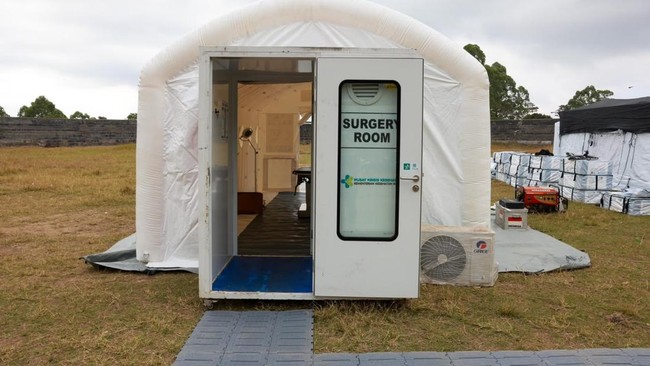
Health services for victims of the magnitude 7.7 earthquake in East Nusa Tenggara (NTT) continue to operate despite damage to a number of health facilities. Several patients have had to be treated in emergency tents, while a field hospital with an operating theatre is being prepared to handle victims requiring medical procedures.
Health Minister Budi Gunadi Sadikin said a field hospital is being built at Golo Dukal Stadium in Manggarai Regency to support services at Ruteng Regional General Hospital (RSUD Ruteng), which was affected by the earthquake. The facility is equipped with patient tents and a sterile operating theatre, and is targeted to have at least 100 beds.
“We have installed five tents here. Four are for patients, each able to accommodate 20 patients, and one is specifically for the operating theatre because the room is sterile and can be isolated. We hope it will begin operating tomorrow,” Budi said during a site visit, as quoted on Tuesday (19/8/2026).
The Ministry of Health has also prepared a dedicated tent for the emergency department (IGD). Inpatient capacity will be increased gradually to at least 100 beds. Additional tents are currently being sent from Bali to strengthen health services at the disaster site.
“We will add more so that there are at least 100 inpatient beds. We are sending additional tents from Bali,” he said.
The presence of an operating theatre is a priority because the earthquake caused damage to the RSUD Ruteng building. As a result, services for patients, including those requiring surgery, are temporarily being carried out in emergency tents outside the hospital building.
Budi said the field hospital is needed so that doctors can perform operations safely without having to wait for the main hospital building to become functional again.
“Because the hospital is currently unsafe to use, we are building a field hospital. There, doctors will be able to perform operations properly,” Budi said.
The operating theatre at the field hospital is designed as a sterile room that can be isolated to maintain patient safety and prevent infection. The facility will be equipped with surgical lights, an operating table, and an area for bringing in and preparing medical equipment. Before use, the room will undergo cleaning and sterilisation.
“This is the operating theatre. It will be sterilised later. This room is sterile and can be isolated. Facilities like this were previously used during the disasters in Sumedang and Aceh,” he explained.
The facility is particularly needed to treat victims with trauma and fractures caused by being struck by collapsing buildings. While visiting RSUD Ruteng, Budi also reviewed the condition of Yosef, a 12-year-old boy who suffered a fractured femur after his neighbour’s house collapsed due to the earthquake.
“If he is not operated on, he could be permanently disabled. He would not be able to play football again. Yet he loves playing football and wants to become a national team player,” Budi said.
Budi confirmed that Yosef is being treated by a team of orthopaedic specialists mobilised to strengthen services at RSUD Ruteng. He said fracture and trauma cases are among the most common health problems found after the earthquake, making the presence of orthopaedic specialists essential.
“We thank our colleagues from the hospitals who have come to help. There are teams from Sardjito, Ben Mboi, Hasanuddin University, and Dr. Soetomo Hospital specifically assisting at RSUD Ruteng. These orthopaedic doctors have been willing to help heal patients who need treatment,” Budi said.
A field hospital is also being established at Aeramo Regional General Hospital in Nagekeo Regency. The two emergency facilities are being built to ensure medical services remain available while supporting the recovery of health facilities after the magnitude 7.7 earthquake that struck NTT on Saturday (15/8/2026).
“We will replicate this field hospital not only in Ruteng but also in Nagekeo,” Budi said.
To strengthen services, the Ministry of Health has deployed health workers with various competencies. The team consists of two orthopaedic specialists, one general surgeon, two anaesthesiology specialists, one general practitioner, as well as nurses specialising in emergency care, anaesthesia, and operating theatre.
Medical personnel come from a number of health facilities, including from Kupang, Wahidin Hospital Makassar, Leimena Hospital Ambon, and Ben Mboi Hospital Kupang, with support from a reserve team from Kariadi Hospital. The Emergency Medical Team (EMT) also brought priority logistics, including vaccines, one Emergency Kit unit, 2,000 masks, 1,000 HS NS infusion bags, and 400 pairs of medical gloves.
Budi stressed that post-earthquake health handling must not be centred only at hospitals. Health workers and volunteers will also be deployed to sweep community health centres (puskesmas) and villages in affected areas. The move aims to find victims who need medical treatment but have not yet accessed services, including those who need to be treated or referred to hospital immediately.
“We really need to send volunteer teams to all puskesmas in North Flores to sweep all villages clean, identifying which patients must be treated immediately and referred to hospital,” Budi said.
The Ministry of Health also continues to coordinate with regional governments, hospitals, puskesmas, universities, and health worker networks to maintain services for communities affected by the earthquake. The mobilisation of specialist doctors, construction of field hospitals, and health sweeps down to village level are the government’s focus to accelerate the recovery of health services after the disaster.