
NTB Ranks 4th Highest in Indonesia for Disasters, 10 Regions Threatened by Drought
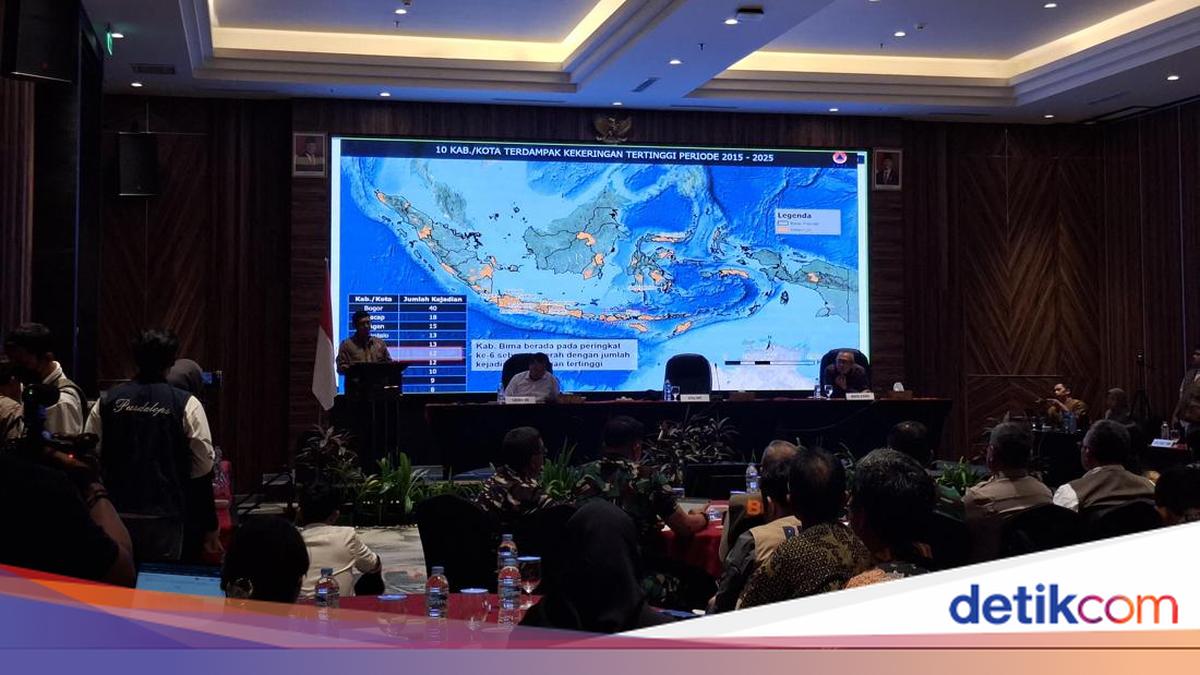
West Nusa Tenggara (NTB) is classified as a region with a high risk of disasters over the period from 2015 to 2025. According to data from the National Disaster Management Agency (BNPB) over the last 10 years, Bumi Gora was struck by 61 disasters. This figure places it below West Java, Central Java, and East Java.
Head of the BNPB, Lieutenant General TNI Suharyanto, stated that the high disaster risk in NTB is supported by its geographical location. In fact, out of 514 regencies and cities in Indonesia, not a single area has a low disaster risk.
“If we talk about Indonesia’s geographical location, NTB is the 4th highest in Indonesia. That is already very high,” Suharyanto said during a Regional Disaster Coordination Meeting with 10 NTB regional heads in Mataram.
Based on the data, Bima Regency has been the area in Bumi Gora most frequently hit by disasters over the last 10 years, with 12 recorded disaster events. “So I hope the Governor will conduct disaster risk mapping in his region,” Suharyanto requested.
Furthermore, all areas in NTB are in the yellow category for drought disaster risk threats. More severely, 50 sub-districts are already experiencing drought in NTB. “Forest and land fires in NTB are relatively fewer. NTB and NTT always have high forest fires, but they are not priority areas because they are not peatlands,” Suharyanto said.
Suharyanto claimed that handling drought in Bumi Gora is relatively easier. Weather modification can be carried out in NTB, and the forest contours are not overly concerning. “That is why the President’s instruction only lists six provinces as priorities for forest and land fires because they are difficult to extinguish, located in Sumatra and Kalimantan,” Suharyanto stressed.
Suharyanto requested that all regional heads in NTB conduct disaster risk assessments to reduce the risk of casualties. This risk assessment is important because rehabilitation and reconstruction costs are far greater. From BNPB data, all areas in NTB fall into the medium and high-risk categories for drought disasters. Four areas are in the medium-risk category: Mataram City, West Lombok, North Lombok, and Central Lombok. The remaining areas are in the high-risk category.
NTB Governor Lalu Muhamad Iqbal highlighted the condition of forests in Dompu and Bima. The rate of forest degradation in these two areas is quite high, which also causes a high risk of disasters. “So we must stop being firefighters. The problem in Dompu and Bima is the damaged forests. We will discuss in depth with the Regents of Bima and Dompu to jointly restore the forests there,” Iqbal said.
Iqbal stated that forest restoration in the two regions must be carried out immediately. Otherwise, any type of aid in the two areas will be depleted en route. “Disasters there are already on the calendar. So we must work together on reforestation. This must be noted,” Iqbal explained.
The NTB Provincial Government has requested central assistance to build 106 boreholes due to the threat of drought disasters caused by El Nino in Bumi Gora. The Meteorology, Climatology, and Geophysics Agency (BMKG) has predicted that the extreme weather phenomenon in NTB will last for 10 months.
Head of the NTB Regional Disaster Management Agency (BPBD), Sadimin, explained that the estimated cost to build one borehole point ranges from IDR 300 million to IDR 350 million. This means the total budget required for 106 points reaches approximately IDR 31.8 billion. This budget figure could even swell if the drilling location has abundant water reserves requiring a larger distribution network installation.
Although proposing 106 points based on data from extremely poor villages, the former Head of the NTB Public Works and Spatial Planning (PUPR) Office noted that the real needs in the field will be re-verified. This is because not all extremely poor villages lack water, and not all dry areas have groundwater reserves. “It is not certain that extreme poverty means no water. Even if not extremely poor, sometimes there is no water either,” Sadimin said after the meeting.