
NTB Plant Pest Control Officer Promotes Bio Apotek Tanaman Innovation to Cut Farmers’ Production Costs
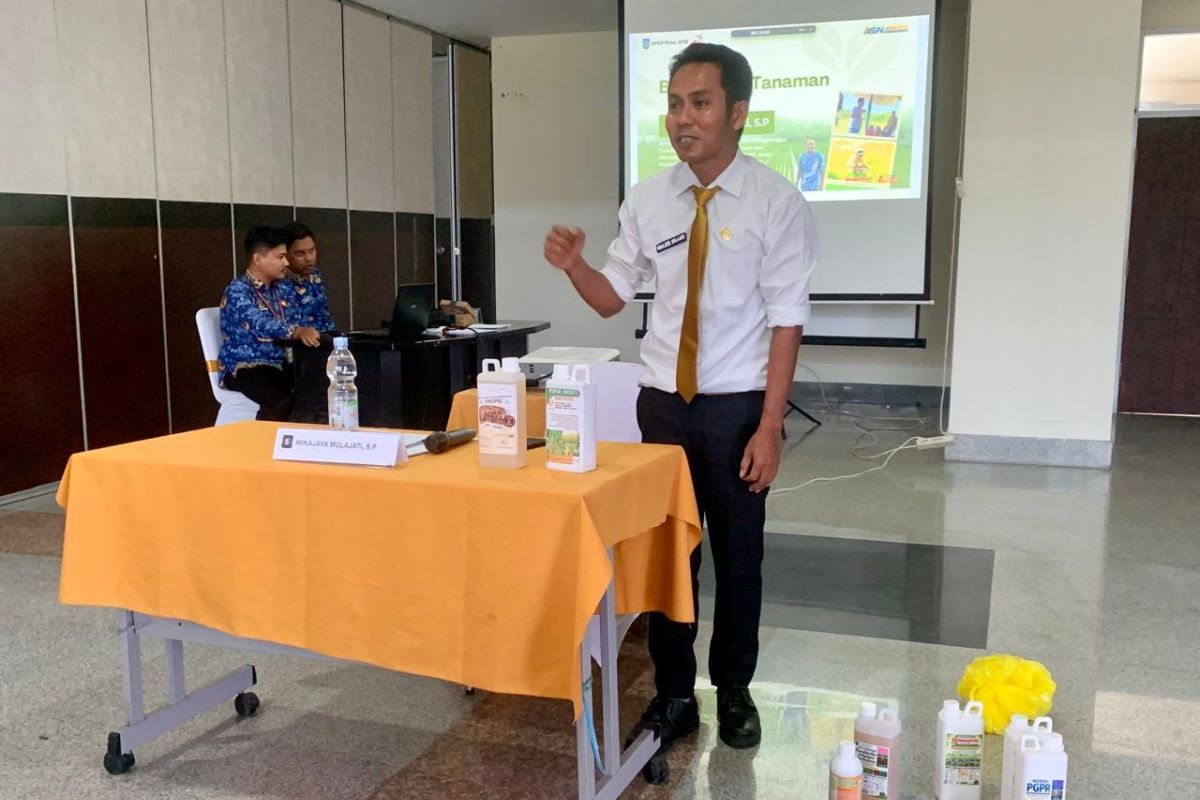
Mataram (ANTARA) – Wikajaya Mulajati, a junior plant pest control officer at the West Nusa Tenggara (NTB) Provincial Agriculture and Food Security Office, is encouraging farmers to adopt the Bio Apotek Tanaman innovation to reduce reliance on chemical pesticides and lower production costs.
Wikajaya presented the idea during a presentation and interview session for the 2026 NTB Civil Servants Awards in Mataram on Tuesday.
The innovation offers an approach to managing plant pests and diseases by using natural materials and biological control agents that farmers can produce themselves.
Wikajaya explained that reliance on chemical pesticides was one of the challenges facing agriculture in NTB. Improper and excessive pesticide use could cause pests to become resistant and harm human health and the environment.
In his presentation, he said attacks by brown planthoppers and rice blast disease in North Lombok Regency rose by 30 per cent in 2025 compared with the previous year, according to data from the Narmada Plant Protection Laboratory (LPHP Narmada).
The situation underscored the need for more effective, economical and sustainable pest-control methods that make better use of local resources.
Under the Bio Apotek Tanaman concept, farmers are encouraged to produce botanical pesticides and biological control agents themselves. These are cheaper, easy to make and environmentally friendly.
Plants that can be used to make botanical pesticides include neem, soursop, citronella, papaya and tobacco. The biological control agents being developed include Trichoderma, Paenibacillus polymyxa, Metarhizium and Plant Growth-Promoting Rhizobacteria (PGPR).
The innovation has been implemented through the production of botanical pesticides and biological control agents at LPHP Narmada in collaboration with farmer groups, with total output reaching 600 litres.
Technical training on making botanical pesticides and propagating biological control agents has also been held for 11 farmer groups. Bio Apotek Tanaman was piloted with one group and subsequently taken forward through a field school involving 30 farmers.
Trial results showed that 15 members of the farmer group had adopted the approach. Its use was reported to have cut production costs by up to 40 per cent, while reducing populations of pests and diseases such as brown planthoppers and rice blast by as much as 60 per cent.
As well as lowering costs and reducing pest and disease pressure, the innovation was reported to have increased harvests by about 0.5 to 0.8 tonnes per hectare and raised farmers’ profits by up to 40 per cent.
Wikajaya hopes the innovation can be expanded, with the NTB Provincial Agricultural Plant Protection Centre (BPTP) becoming a learning hub and a centre for developing Bio Apotek Tanaman for farmer groups.
He also aims to link its future development with tourism through agro-educational tourism, creating added value for the region while supporting sustainable agriculture.
“Prevent, observe, control appropriately, harvest sustainably” is the principle behind the innovation, which seeks to safeguard agricultural productivity and support food security in NTB.
Source: jawawa.id (https://jawawa.id/newsitem/ntb-plant-pest-control-officer-promotes-bio-apotek-tanaman-innovation-to-cut-farmers-production-costs-1794297110)
Originally published by Antara (Indonesian) (https://www.antaranews.com/berita/5843775/popt-ntb-dorong-inovasi-bio-apotek-tanaman-tekan-biaya-produksi-petani), translated from Indonesian