
Notes from China: Nationalism Is More Than a Memory
Beijing (ANTARA) – A photograph of Indonesia’s founding father Sukarno speaking warmly with Mao Zedong, then China’s president, and Premier Zhou Enlai is displayed in one corner of the Indonesian Embassy in Beijing.
The photograph was taken during President Sukarno’s first visit to China, in October 1956, a year after the Asian-African Conference (AAC) on 19 April 1955.
At the AAC, attended by 29 countries, Sukarno urged the leaders present not to dwell on past bitterness, but to look firmly towards the future.
“Let us remember that there is no gift from God more beautiful than life and freedom. Let us remember that the dignity of all humanity will continue to diminish as long as there is a nation, or part of a nation, that is not free,” Sukarno said from the podium.
He also said humanity’s highest purpose was to free people from the shackles of fear, those that demean human dignity, and poverty; and to free them from physical, spiritual and intellectual constraints that had held back the development of much of humanity for too long.
In his speech, Zhou Enlai said peace could be maintained only through mutual respect for the territorial integrity and sovereignty of every country. Any violation of a country’s sovereignty or territory, or interference in its domestic affairs, would inevitably endanger peace.
“If countries guarantee that they will not interfere in one another’s domestic affairs, their peoples will be able to choose their own political systems and ways of life according to their wishes,” Zhou said.
The leaders of the time shared a determination to make their countries and peoples independent, sovereign and dignified at home and abroad, giving their citizens a sense of pride.
Djauhari Oratmangun, Indonesia’s Ambassador to China and Mongolia, sees this pride—known as nationalism—as a force that can motivate people to act in their country’s interests.
“There was once a survey asking, ‘What makes you proud of your country?’ There were eight answers, and the first six were related to nationalism, such as pride in history and people. The seventh was an economic reason. To me, that means nationalism and love of country are what drive economic growth,” Djauhari said.
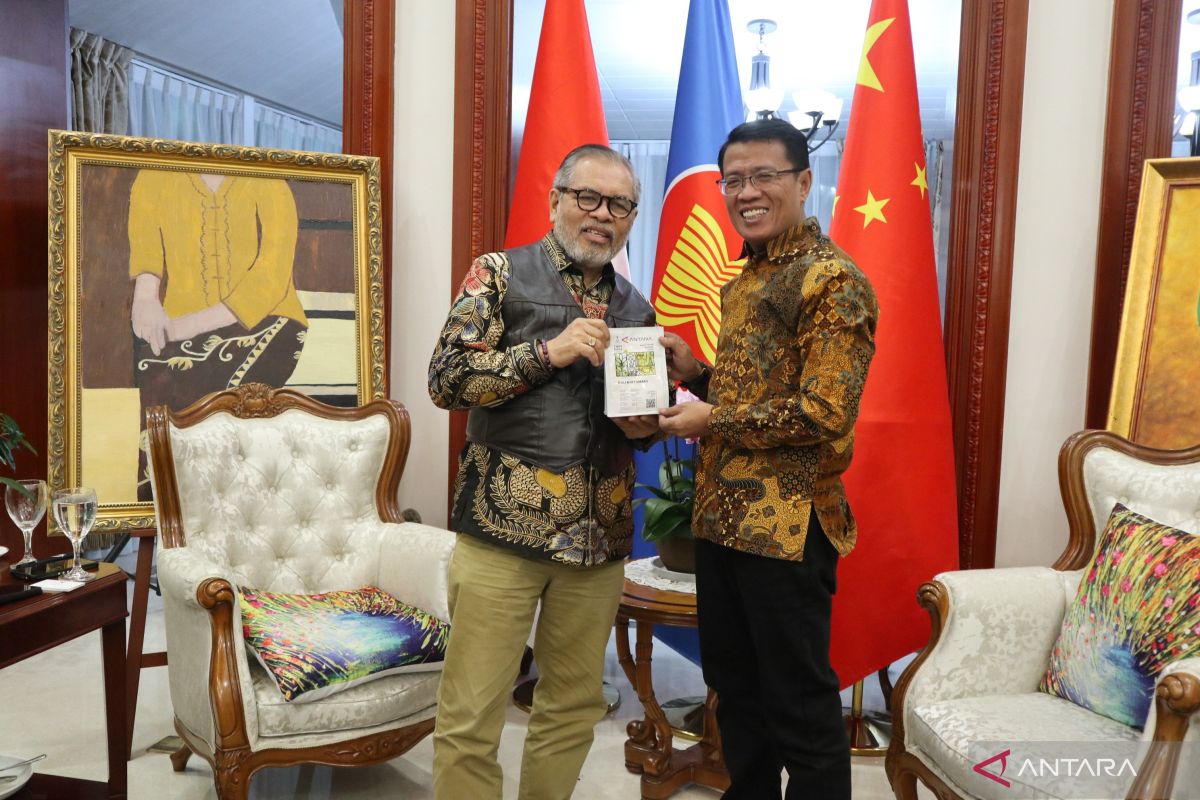
He made the remarks in a conversation with Abdul Hakim, president director of the National News Agency ANTARA, during Hakim’s visit to the Indonesian Embassy in Beijing on Sunday (8 November).
“My message to students is that they should always nurture a love for their country. We call it nationalism. That then creates a desire to contribute to the country’s progress,” Ambassador Djauhari added.
He said countries including the United States, China and, more recently, neighbouring Vietnam had sent young people abroad to study before they returned to help develop their countries.
However, Djauhari said, love of country also needed to be supported by the right narrative and accurate data.
ANTARA, the national news agency established in 1937, had an advantage in this regard because it held a data archive documenting the country’s history, including the period before independence, Djauhari said.
With technological advances, including artificial intelligence (AI), historical data could be compiled to create a comprehensive narrative about Indonesia.
“AI can help compile this data so that, in the future, if someone asks what Indonesia is, what its industries are like, how communities or villages are developing, or where to invest, they can use ANTARA data gathered by its journalists across Indonesia,” Djauhari said.
Although some people believe AI can, or is already beginning to, replace journalists, Djauhari said he remained confident in the work of journalism.
“I strongly believe in journalists’ creativity. Sometimes journalists think one step ahead of most people. Their reports are also always highly inspiring, but of course they must keep pace with technological developments,” he said.
The times may change, but the principles of journalism do not. Journalists still have the same task: gathering facts, verifying them and conveying the information to the public. The tools change over time, but the principles remain the same.
Tools, including AI, do not replace journalistic standards. Instead, they must meet those standards if they are to retain the public’s trust.
Djauhari therefore encouraged ANTARA journalists to understand the times and anticipate where they are heading, including by adapting to technological advances.
China is now one of the leading centres of technological development, and the Indonesian government has recommended several of its top universities as study destinations for Indonesian students awarded scholarships.
One of China’s highest-ranked universities is Tsinghua University, ranked 11th in the world and first nationally in the Times Higher Education (THE) 2027 rankings. It excels in fields including artificial intelligence, computer science, engineering, chemical engineering and materials science.
Tsinghua is also a destination for recipients of the Garuda Scholarship, a higher-education programme launched by the Indonesian government in 2025 for high-achieving students seeking undergraduate or four-year diploma courses at leading universities worldwide.
The Garuda Scholarship covers all education and operational costs, including tuition, registration, books, transport, visas, health insurance, living allowances, arrival costs and emergency expenses. It is available to prospective students who meet the criteria, including academic or non-academic achievement, passing the selection test and choosing a field aligned with the programme’s priorities.
One Garuda Scholarship recipient at Tsinghua is 19-year-old Elang Bagaskara Putra, who is studying mechanical engineering at Zijing College.
“I was used to solving maths problems with formulas and numbers already provided, but at Tsinghua students have to understand the basic concepts and theories before they can solve problems. I find that quite challenging,” Elang said in an interview with Abdul Hakim.
He said lecturers sometimes delivered material very briefly, requiring students to study and understand it independently.
“The main challenge is probably time management because there are a lot of assignments, and I am also involved in an organisation, the Indonesian Students Association in Beijing,” Elang said.
That has not stopped him from pursuing his work while studying at Tsinghua.
As Mochtar Lubis wrote in his novel Maut dan Cinta (Death and Love, 1977): “We must learn to look after ourselves. Just think how far our nation lags behind in so many fields. Education is one of the important things in achieving progress.”
The nationalism embodied by Sukarno, Ambassador Djauhari Oratmangun and Elang is ultimately a nationalism expressed through work and achievement, not merely memory.
Source: jawawa.id (https://jawawa.id/newsitem/notes-from-china-nationalism-is-more-than-a-memory-1794358284)
Originally published by Antara (Indonesian) (https://www.antaranews.com/berita/5845563/catatan-dari-china-nasionalisme-bukan-sekadar-ingatan), translated from Indonesian