
Not Salt: Why BMKG Is Scattering Dry Ice Over Forest and Land Fires
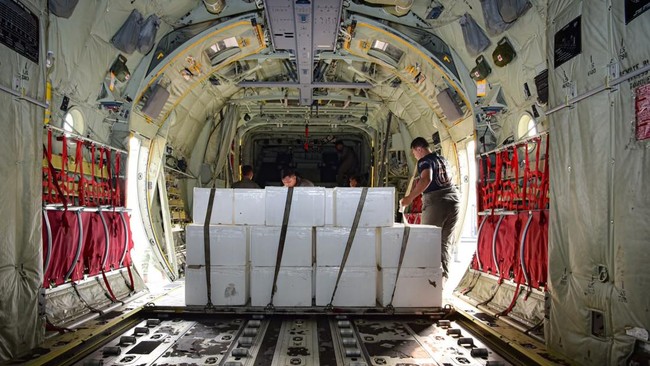
Jakarta, CNBC Indonesia — Indonesia’s Meteorology, Climatology and Geophysics Agency (BMKG) has explained why it is using dry ice in efforts to tackle forest and land fires in several parts of the country.
BMKG Weather Modification Operations Director Budi Harsyo said dry ice was chosen to stabilise the atmospheric temperature profile and disperse harmful particles in fire smoke.
“We need to make clear that the purpose of using dry ice as a seeding material is not to produce rain, but to stabilise the temperature profile in the atmosphere so that the smoke becomes less concentrated, although it does not disappear,” Budi said at a press conference on the latest developments in disasters in Indonesia, broadcast on the National Disaster Management Agency’s (BNPB) YouTube channel on Friday (23 October 2026).
During a temperature inversion, warmer air sits above colder air near the surface. This inhibits vertical air movement, causing smoke and pollutants to accumulate in the lower atmosphere.
Dry ice, or solid carbon dioxide, is dispersed from aircraft into the targeted atmospheric layer. As it sublimates directly from a solid into a gas, the cold dry ice absorbs heat from its surroundings. This local cooling is expected to alter atmospheric stability and help promote vertical mixing of the air.
If atmospheric conditions are favourable, the inversion layer may weaken, allowing smoke that was previously trapped to rise and disperse.
“Dry ice works by dispersing solid carbon dioxide from aircraft into the atmospheric inversion layer. Salt (NaCl), meanwhile, is seeded into clouds and can produce rain by helping water droplets form and grow,” Budi explained.
Dry ice is used when an inversion layer is trapping smoke and there are few suitable clouds for rain seeding. Salt (NaCl) is used when monitoring indicates that clouds are likely to support rain formation.
The dry-ice method is intended to help smoke rise and spread, potentially reducing concentrations near the surface. Salt, by contrast, is intended to increase rainfall, which can help wet land affected by forest and land fires.
“Alongside the efforts of teams fighting the fires on the ground and helicopter water-bombing, the inversion layer has opened up and visibility has improved. Particulate levels have also improved because concentrations have fallen, with some particles dispersed vertically upwards, bringing the PM2.5 index down,” he said.
BMKG hopes the fires can be brought under control so that people can resume their normal activities.
“We ask all Indonesians to pray that the forest and land fires in South Sumatra and Kalimantan can be brought under control,” he concluded.
Previously, BMKG chief Teuku Faisal Fathani said dry-ice seeding was one tactical measure for addressing atmospheric conditions that hinder the dispersal of smoke.
In some conditions, very dense smoke from forest and land fires becomes trapped in the atmosphere near the surface, at heights of 6,000–7,000 feet or even higher.
BMKG Deputy for Weather Modification Tri Handoko Seto said the inversion layer acts like a lid, restricting vertical air movement.
To address this, the Weather Modification Operation (OMC) accurately disperses dry ice from aircraft above the inversion layer. Sublimation of the dry ice triggers cooling and a sudden drop in temperature, helping to reopen convective air flows.
“This allows smoke to rise vertically and disperse into the atmosphere. It also increases the chances of cloud growth, which can then be targeted for seeding as part of the OMC,” Seto said, according to a statement on BMKG’s official website on Friday (23 October 2026).
Source: jawawa.id (https://jawawa.id/newsitem/not-salt-why-bmkg-is-scattering-dry-ice-over-forest-and-land-fires-1792763427)
Originally published by CNBC Indonesia (https://www.cnbcindonesia.com/news/20261023190556-4-779038/bukan-garam-ini-alasan-bmkg-tabur-dry-ice-di-langit-atas-karhutla), translated from Indonesian