
Not Just Self-Sufficiency: Indonesia Aims for Food Sovereignty by 2029
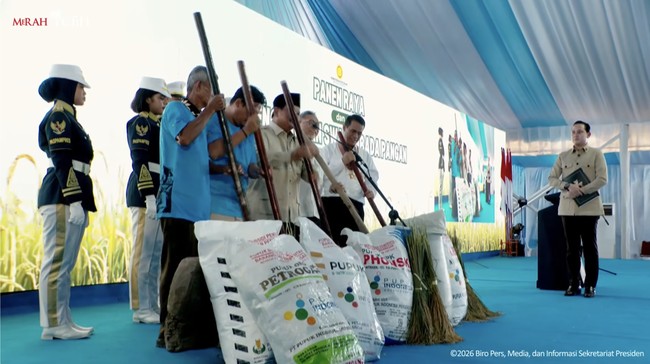
The Coordinating Ministry for Food Affairs (Kemenko Pangan) has affirmed that Indonesia must achieve food sovereignty by 2029. This means that in a relatively short time, Indonesia must be able to meet its food needs independently. Deputy for Coordinating Food and Agricultural Enterprises at Kemenko Pangan, Widiastuti, stated that this target requires support from various parties, including ministries and agencies (K/L) as well as corporations. At the same time, the government also aims to realise the vision of Golden Indonesia 2045. “So the process still needs to be done together; coordination and cooperation are very much needed. Indonesia has great potential as an agrarian country with abundant natural resources. It’s proven by several Koes Plus songs, like how even bamboo planted can become a treasure or wealth,” said Widiastuti in the CNBC Indonesia Coffee Morning programme themed Securing Indonesia’s Food Sovereignty through Value Chain and Financing Amid Global Disruption at Parle, Senayan, on Tuesday (28/4/2026). From there, Widiastuti stressed the importance of elaboration from various parties. This is so that the benefits of Indonesia’s food product wealth can be felt by the entire society, including farmers. Considering that so far, increases in food production have not fully corresponded to improvements in farmers’ welfare. “Well, this also becomes a concern, because when farmers as direct actors do not have guaranteed or improved welfare, automatically they might experience a decline in productivity,” she explained. Therefore, one step taken by the government to assist work while improving farmers’ welfare is through regulatory improvements. This is implemented by issuing Presidential Instruction (Inpres) No. 3 of 2025 to regulate the transfer of civil servant (ASN) agricultural extension workers from regional governments (Pemda) to the Ministry of Agriculture within a maximum of one year. The presence of this Inpres is aimed at realising the ideal of one village having one agricultural extension worker. These extension workers are tasked with assisting farmers to increase their productivity. Of course, the extension workers also play a role in helping farmers utilise more modern agricultural technology. “Well, there is how the extension workers carry out assistance to make it more optimal, and that can be centralised under one command or one direction, namely at the centre,” Widiastuti emphasised.