
Not Just Random Bombing! Here's Why the US is Attacking Iran's Ports and Bridges
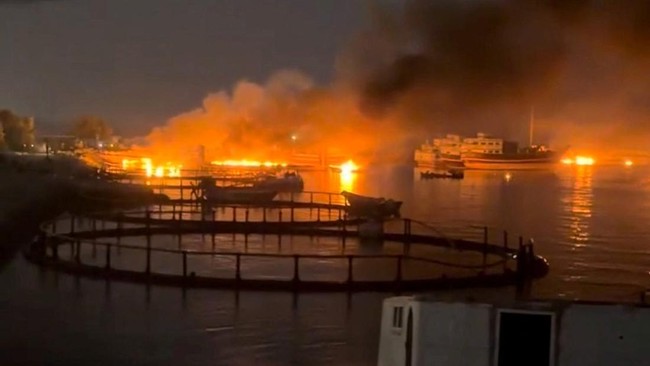
Jakarta, CNBC Indonesia – United States President Donald Trump has again threatened to expand attacks against Iran, targeting the country’s critical infrastructure.
Trump said every Iranian attack on a ship in the Strait of Hormuz would be answered with the destruction of a bridge or power plant. The threat also applies to facilities around Tehran.
“Each time the Islamic Republic of Iran fires upon a ship in the Strait of Hormuz, the United States will bomb and destroy one bridge or power plant,” Trump wrote on Truth Social, as quoted by Reuters on Wednesday (22/7/2026).
Trump’s threat comes as US targets have begun to widen. Beyond command centres, missiles, drones and air defences, Washington is also striking bridges, railways, airports, communications networks and water facilities.
Most of these strikes are directed at southern Iran, particularly Hormozgan Province and areas around the Strait of Hormuz.
The southern focus is not without reason. Iran’s south is the meeting point of military strength, trade routes, oil exports, and Iran’s ability to disrupt shipping in the Strait of Hormuz.
Southern Iran is not merely a coastal region. It is the area that gives Tehran its greatest bargaining power against the US and the Gulf states.
Southern Iran as the Centre of Tehran’s Leverage
Geographically, Iran’s south stretches along the Persian Gulf to the Gulf of Oman. Between these two waters lies the Strait of Hormuz, the narrow passage through which ships from the Gulf’s energy-producing countries pass.
Iran controls the entire northern side of the strait. This position allows Tehran to monitor vessels moving from the Persian Gulf towards the Arabian Sea and the Indian Ocean.
Iran’s strength in the region is centred on Bandar Abbas, the capital of Hormozgan Province, which faces Hormuz directly.
Bandar Abbas is home to Iran’s regular navy as well as the naval fleet of the Islamic Revolutionary Guard Corps (IRGC). Both forces form the backbone of Iran’s maritime operations.
From Bandar Abbas and surrounding coastal areas, Iran can deploy warships, armed fast boats, anti-ship missiles, drones, radar, and maritime surveillance equipment.
Qeshm Island and several other islands near Hormuz also give Iran positions from which to monitor shipping lanes at close range. This is why US strikes have repeatedly targeted Bandar Abbas, Qeshm, Sirik, Jask, and Bandar-e Lengeh.
Washington wants to reduce Iran’s ability to detect ships, launch attacks from the coast, and sustain operations around the strait.
As long as these capabilities remain functional, Iran can still disrupt commercial vessels and raise the risks of navigation through Hormuz, even if its military capabilities elsewhere have weakened.
The importance of southern Iran does not stop at naval power.
Bandar Abbas is also one of the country’s main trade gateways. Ports in the area connect Iran to international trade routes and serve as entry points for goods heading to the interior.
The Strait of Hormuz is also Iran’s main energy export route. More than 90% of the country’s crude oil exports previously passed through these waters, according to Al Jazeera.
This gives southern Iran a dual function. The region underpins Tehran’s ability to pressure global shipping while serving as a vital channel for state revenue.
If naval bases are damaged, Iran’s ability to disrupt ships will diminish. If ports and transport routes are cut, trade and the delivery of goods will also be disrupted.
The US can ultimately pressure Iran’s military and economic strength through the same region.
Bridges as the Lifeline of Supply
US strikes on numerous bridges are also linked to the south’s position as the centre of Iran’s operations.
Bandar Abbas and coastal cities cannot sustain military operations on locally available equipment alone. Troops, missiles, drones, ammunition, fuel and spare parts must still be shipped from central Iran.
These deliveries depend on highways, bridges, railways and airports connecting the interior to the coast.
Therefore, the US does not need to destroy all of Iran’s bases to weaken operations around Hormuz. Cutting the routes to those bases can also hamper Tehran’s ability to maintain its strength.
At least six bridges in Hormozgan Province have been hit. These bridges lie on the Bandar Abbas-Khamir-Lar route, the Kahurestan-Lar route, the Bandar Khamir-Keshar-Bandar Abbas route, as well as the Latidan and Maroo areas.
These routes connect Bandar Abbas with surrounding cities and then link to central Iran.
Mark Hilborne, a senior lecturer at the School of Security Studies at King’s College London, said bridges are targeted because of their important role in Iran’s military logistics.
“Bridges are vital to logistics and military operations. Striking them will weaken Iran’s ability to disrupt shipping in the strait and to sustain its operations,” said Hilborne, quoted by Al Jazeera.
Damage to bridges does not immediately halt all of Iran’s movements. However, troops and equipment must be diverted to routes that are longer, narrower, or have smaller capacity.
Deliveries become slower and more expensive. Iran’s ability to replace damaged weapons or resupply forces on the coast also weakens.
The attack pattern is evident from the locations struck along Iran’s southern coast.
Explosions have been reported in Bandar Abbas, Ahvaz, Qeshm, Bushehr, Dashti, Bostan, Sirik, and Bandar-e Lengeh.
Bandar Abbas is among the hardest-hit areas. The Kahurestan bridge, residential areas, rail facilities and communications towers were reported struck.
Iranian media said two people were killed and eight others injured. Strikes on communications towers also caused power outages in surrounding areas.
Iranshahr Airport in the southeast also suffered damage and blackouts. Elsewhere, a bottled drinking water facility in Dehloran and the heavy water facility at Khondab were targeted.
Health facilities have also been affected. More than 200 patients had to be evacuated from Baghaei Specialist Hospital after strikes on Ahvaz left the hospital unable to operate.
The choice of targets shows the US is attacking three layers at once.
Iran’s combat capabilities, such as command centres, air defences, missiles, drones, radar, and maritime forces.
Their supporting networks, such as bridges, railways, airports, communications, and electricity.
The economic activity sustaining Iran through ports, oil trade, and goods delivery routes.
Strengthening the Blockade Against Iran
The air campaign also runs in parallel with the naval blockade reimposed by the US.
Washington is restricting vessels heading to or leaving Iranian ports. At the same time, air strikes are disrupting routes carrying goods and equipment to the coast.
Iran’s ports are being squeezed from two directions. Ships face obstacles entering by sea, while goods and equipment from the interior struggle to reach the ports.
One bridge struck in north-eastern Iran is also part of a trade corridor connected to China’s Belt and Road Initiative.
That route has helped Iran sustain oil trade amid sanctions. The same corridor is also suspected of being used to bring in key components for Iran’s weapons programme.
Hilborne believes US strikes are primarily aimed at tightening the naval blockade, weakening military logistics, and increasing pressure for Iran to accept a deal.
Southern Iran was chosen because pressure on the region can directly disrupt the sources of Tehran’s military power as well as its trade flows.
The expansion of strikes towards bridges, airports, water facilities, food storage sites and electricity networks has raised speculation that the US is paving the way for a ground operation.
Alex Alfirraz Scheers, a London-based military analyst, believes the widening of targets could be an early stage of preparation for a limited operation to seize strategic points on Iran’s coast.
Roads, airports, ports, communications networks, and water and electricity supplies are indeed critical facilities if forces intend to enter and control a territory.
However, a ground operation is not yet the most likely scenario.
Simon Mabon, professor of international relations at Lancaster University, believes a land invasion would be highly risky and could drag the US into a far wider war.
According to Mabon, the current strikes are more likely intended to increase pressure on Tehran and force it back to the negotiating table.
Strikes on civilian facilities may also not turn the Iranian population against the government. Such steps could instead reinforce Tehran’s narrative that Washington is deliberately adding to the suffering of Iranian citizens.
Southern Iran has ultimately become a target because it is the most complete concentration of power Tehran possesses. There lie naval bases, coastal radar, supply routes, trading ports, and access to the Strait of Hormuz.
If the south weakens, Iran will find it harder to sustain operations in Hormuz, send supplies to the coast, and keep trade flowing. This is why US strikes continue to be directed at the region.