
Not Just on Earth: US and China Vie for Supremacy in Space
Jakarta, CNBC Indonesia — Competition among major powers to master space technology is intensifying. China is one of the countries accelerating its ambitions, increasing the frequency of rocket launches, building its own space station and aiming to send astronauts to the Moon before 2030.
Most recently, Beijing sent a Pakistani citizen into space aboard the Shenzhou-24 mission on Wednesday (25 November 2026). The mission made history for Pakistan and demonstrated China’s efforts to expand international cooperation in its space programme.
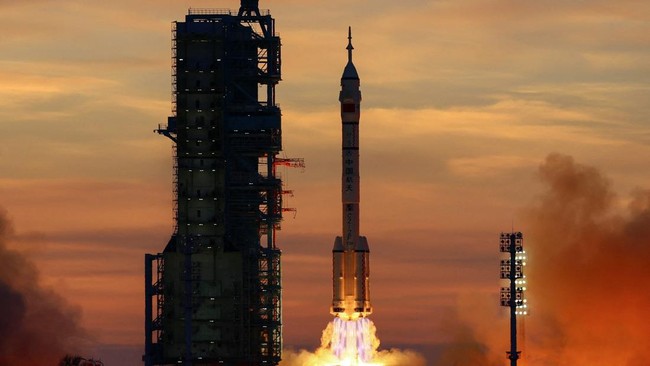
The Shenzhou-24 spacecraft, carrying three astronauts, lifted off aboard a Long March-2F rocket from the Jiuquan Satellite Launch Centre in China at 08:18 local time. It subsequently docked successfully with China’s Tiangong space station.
One of the crew, Muhammad Zeeshan Ali, is the first Pakistani to travel into orbit and the first foreign national to visit Tiangong.
Ali, a 40-year-old Pakistan Air Force pilot, is serving as a payload specialist responsible for conducting scientific experiments rather than operating the spacecraft. He will stay at the space station for five to 10 days, shorter than the six-month mission undertaken by the two Chinese astronauts.
Before the flight, Ali completed seven months of training in Beijing. He also studied Mandarin and Chinese culture as part of his preparation.
During the mission, Ali will carry out four research projects. These include developing graphene-based composite materials for radiation protection, self-healing carbon fibre, studying how quinoa seeds respond to space conditions, and cultivating microalgae and cyanobacteria to support oxygen regeneration and food production.
Pakistan’s involvement is more than a diplomatic symbol. China and Pakistan have developed space cooperation that includes launching Pakistani satellites on Chinese rockets, a joint satellite navigation system and the development of a Pakistani rover expected to take part in a Chinese lunar mission around 2028.
The two countries are also strengthening economic ties through the Belt and Road Initiative (BRI). Pakistani Prime Minister Shehbaz Sharif described Ali’s flight as a journey representing Pakistan’s 240 million people and as evidence of the close relationship between the two countries.
The US still leads as China pursues more rocket launches
The Shenzhou-24 mission is part of China’s increasingly intensive space activity. Rocket launch frequency is one indicator of a country’s capacity to develop its space programme.
According to Flight Atlas data up to 25 November 2026, there had been 277 attempted orbital rocket launches worldwide that year. The United States recorded 160 launches, while China ranked second with 84.
The US and China were well ahead of other countries. Russia recorded 16 launches, France five, Japan and India four each, and Italy two.
The United States accounted for about 58% of global activity, while China represented around 30%. Together, they made up nearly 88% of all attempted orbital launches during the period.
The figures show how concentrated rocket launch activity is in the two countries. Orbital launches enable countries to put satellites into space for communications, navigation and Earth observation, as well as to support space exploration missions.
China uses various Long March rockets to support its national space programme. They are used to launch satellites, crewed spacecraft and the components needed to build its space station.
Competition is also reflected in the cumulative number of launches over time. The United States and Russia still have much larger totals, having developed their space programmes since the early days of the space race.
Flight Atlas data dating back to 1957 records 3,091 attempted orbital launches by Russia and the Soviet Union. The United States is next with 2,546, while China has recorded 818.
Russia and the Soviet Union account for about 41.5% of the historical total. The United States represents 34.2%, while China accounts for around 11%.
China’s historical launch total is lower than those of the other two countries. However, its annual launch activity has risen in recent years.
China recorded 68 orbital launches in 2024, rising to 92 in 2025. As of 25 November 2026, it had carried out 84 launches.
This increased activity is part of China’s development of space infrastructure. More launches provide the capacity to operate satellites, deliver supplies and conduct scientific missions on a sustained basis.
The race to the Moon heats up again
Space competition extends beyond launching satellites and building space stations. The United States and China now have a more distant goal: sending humans back to the surface of the Moon.
Through its Artemis programme, the United States is targeting an astronaut landing on the Moon in early 2028 with the Artemis IV mission. The programme is also intended to establish a sustained human presence around and on the lunar surface.
China aims to send astronauts to the Moon before 2030. Beijing is developing the Long March-10 rocket, the Mengzhou crewed spacecraft and the Lanyue lunar lander to support the mission.
India has similar ambitions. Under its Space Vision 2047, the Indian government aims to land an astronaut on the Moon by 2040.
The differing timelines show that lunar exploration is no longer solely an American project. China and India are also preparing the technology and infrastructure needed to conduct crewed missions independently.
China also plans to build an International Lunar Research Station with Russia. The initial phase of the research facility is targeted to begin construction in the Moon’s south polar region in 2035.
The competition has scientific and technological dimensions. Countries capable of sending humans to the Moon need to develop heavy-lift rockets, crewed spacecraft, landing systems, astronaut protection and life-support technologies for extreme environments.
These technologies would also provide a foundation for more distant exploration, including possible crewed missions to Mars.
Tiangong: China’s alternative amid the world’s reliance on the ISS
Alongside the race to the Moon, China is building space infrastructure through its Tiangong space station.
The station, whose name means “Heavenly Palace”, has been fully operational since late 2022. Construction began in April 2021 with the launch of the Tianhe module, the astronauts’ main living quarters.
The other two modules, Wentian and Mengtian, were launched in 2022 to support scientific research.
Tiangong is designed to accommodate three astronauts under normal conditions and up to six during crew rotations. China aims to conduct more than 1,000 scientific experiments during the station’s planned operational life of at least 10 years.
Tiangong’s construction is also linked to limits on China’s cooperation with the United States. Beijing cannot participate in the International Space Station (ISS) through NASA because of US legal restrictions.
China consequently developed its own space station. Beijing now promotes Tiangong as a centre for international cooperation as the NASA-led ISS could approach retirement around 2030. The two stations differ considerably in scale.
The ISS has a pressurised volume of about 1,005 cubic metres, far larger than Tiangong’s approximately 340 cubic metres. The ISS has a mass of around 419.7 tonnes, while Tiangong’s three main modules have a combined mass of about 69 tonnes.
The stations also have different crew capacities. The ISS generally accommodates seven astronauts, while Tiangong is designed for three under normal conditions.
Although smaller, Tiangong is an important facility for China to conduct research in microgravity, test life-support technologies and carry out long-duration crewed missions.
China is also seeking to make the station a platform for cooperation with other countries. Pakistan’s participation in Shenzhou-24 is one early example of efforts to broaden international involvement.
The race to the Moon and the development of space stations will be important elements in the next phase of competition: not only who can reach space, but who can sustain a human presence, conduct research and build long-term partnerships.
Source: jawawa.id (https://jawawa.id/newsitem/not-just-on-earth-us-and-china-vie-for-supremacy-in-space-1795701033)
Originally published by CNBC Indonesia (https://www.cnbcindonesia.com/research/20261126161651-128-788822/bukan-cuma-di-bumi-as-china-kini-berebut-takhta-penguasa-luar-angkasa), translated from Indonesian