
Not Just France: Four Other European Countries Hit by Unrest
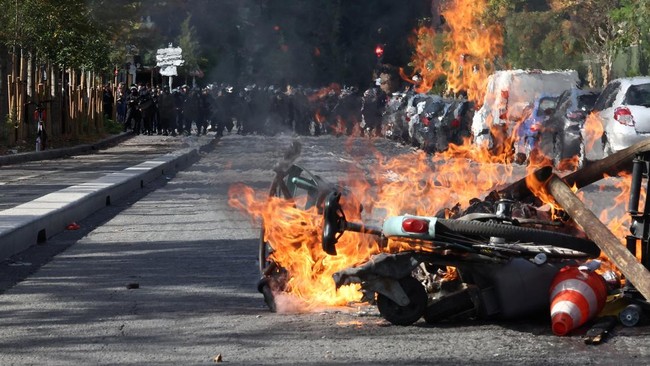
Jakarta, CNBC Indonesia — A wave of demonstrations over the high cost of living, the housing crisis, poor public services and allegations of corruption has swept several European countries. Alongside France, riots and protests have also taken place in Albania, Italy and Belgium, while Portugal has been shaken by large demonstrations over economic pressures and housing.
The protests point to growing public dissatisfaction with economic conditions and government policies. However, levels of violence have varied: clashes with police and looting have been reported in Albania, Italy and Belgium, whereas demonstrations in Portugal covered in news reports have been peaceful.
Here is a round-up of the protests and unrest in Albania, Italy, Belgium and Portugal, compiled by CNBC Indonesia from various sources on Monday (19 October 2026).
1. Albania: Anti-corruption protests lead to clashes
Albanian Prime Minister Edi Rama is facing mounting pressure after student-led demonstrations continued for six consecutive days. Protesters are demanding his resignation, amid anger over alleged government corruption, a lack of jobs and poor education standards.
Protests in the capital, Tirana, and several other cities escalated into clashes. Demonstrators set fire to government buildings and banks, smashed shop windows and pulled up paving stones to throw at police.
On Sunday (18 October 2026), thousands gathered again outside the Ministry of Education and threw stones at officers, who responded with tear gas, water cannon and rubber bullets.
Rama has rejected calls to resign, insisting the demonstrations threaten not his government but Albania’s ambition to join the European Union (EU).
“What is being challenged is not me, not the government, not the governing majority or the party that won the election, but a path and a mission,” Rama said in a Facebook livestream, as quoted by Reuters.
The European Commission condemned the violence in Tirana and other cities but continued to support people’s right to demonstrate peacefully. Police said 388 people had been charged with criminal offences related to the protests, while dozens of officers and demonstrators were reported injured. Albania is aiming to join the EU by 2030.
2. Italy: Police confront protesters as shops are looted
Unrest has also broken out in Italy, as protests against the high cost of living and poor public services have spread to several cities. On Sunday, police clashed with demonstrators in Milan, who threw stones, smashed shop windows and set bins alight around Piazza Duomo in the city centre.
Riot police used tear gas and water cannon to disperse the crowds. More than 60 demonstrators were taken to police stations for further questioning, sources familiar with the investigation told Reuters.
Similar clashes took place the previous day in Milan, Bologna, Brescia, Bergamo and Turin, with 28 people arrested.
The events echoed unrest in neighbouring France, where hundreds of thousands of people took to the streets to protest rising living costs and declining public-service quality. The demonstrations in Italy form part of a wave of protests highlighting the economic pressures felt by people across Europe.
Italian Prime Minister Giorgia Meloni condemned the violence. Her government scheduled a meeting for Monday to discuss how to handle the situation, as it prepares for next year’s election.
3. Belgium: Cost-of-living protests turn disorderly
In Belgium, demonstrations against the cost of living also led to clashes between crowds and police. Protests took place in Brussels and Liège on Saturday (17 October 2026), with officers using tear gas and water cannon to disperse groups of demonstrators.
In the Bourse district of Brussels, police fired tear gas after some young people threw bottles and other objects at officers.
Belgian Interior Minister Bernard Quintin strongly condemned the violence. “This is no longer simply a demonstration,” he wrote on social media on Saturday. He described the incidents as “pure, organised and repeated violence, aimed at destabilising our society”, and pledged to take the necessary steps to restore order.
Earlier, secondary-school pupils in Belgium had also staged demonstrations over rising education costs. The action took place amid student protests in France over teacher shortages, poor school facilities and overcrowded classrooms.
Meanwhile, unrest in France has also put media workers at risk. A Euronews crew covering a demonstration in Paris was reportedly attacked by a group suspected of looting a supermarket. Euronews correspondent Estelle Nilsson-Julien said her cameraman was hit and people tried to seize their microphones as they filmed the incident.
4. Portugal: People take to the streets over living costs and housing
Unlike in Albania, Italy and Belgium, demonstrations reported in Portugal on Saturday focused on economic and social demands and remained peaceful. Trade unions affiliated with the CGTP confederation, together with housing-rights groups, held demonstrations in Porto, Coimbra and Lisbon to call for higher wages, better pensions and adequate public services.
The protests were prompted by rising prices for basic goods and fuel, as well as increasingly unaffordable housing. A CGTP spokesperson told SIC Notícias that the higher cost of living had made everyday necessities extremely expensive. CGTP Secretary-General Tiago Oliveira also highlighted soaring house prices and deteriorating public services.
In Porto, demonstrators marched from Praça da Batalha to Praça D. João I. Pedro Manuel, one of the protest organisers, said the movement was supported by people from a range of backgrounds and was not institutionally affiliated with any particular political party. He described the demonstrations as a rejection of abuses of power and a prolonged crisis.
Housing demands were a major focus of the protests. Portuguese Left Bloc figure José Manuel Pureza said people wanted to discuss the right to decent housing, including tenants’ struggles with rising rents and families increasingly burdened by mortgage repayments. While recognising the demonstrators’ demands as legitimate, Lisbon’s mayor urged that all protests remain within the law.
Source: jawawa.id (https://jawawa.id/newsitem/not-just-france-four-other-european-countries-hit-by-unrest-1792374619)
Originally published by CNBC Indonesia (https://www.cnbcindonesia.com/news/20261019074359-4-777306/bukan-hanya-prancis-4-negara-eropa-ini-juga-chaos-dihantam-kerusuhan), translated from Indonesian