
Not Just Building Clean Energy, This Is the Big Task of Industrial Decarbonisation
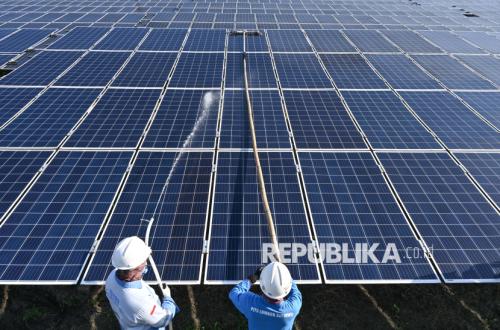
The government is being urged to clarify the direction of industrial decarbonisation in the 2026-2035 National Energy General Plan (RUEN). This clarity is needed so that clean energy targets can be translated into policies, investments, and projects that operate in the industrial sector.
National Energy Council (DEN) member Satya Widya Yudha said RUEN needs to have a mechanism that can adjust national energy targets to developments in energy demand. According to Satya, the increase in clean energy supply needs to be followed by demand growth so that the capacity built has clear users. “We must not only talk about the supply side, we push it, we build it, there must be confirmed demand,” Satya said in a dialogue titled “Locking in Industrial Decarbonisation in the National Energy General Plan” in Jakarta, Thursday (27/8/2026), based on a press release.
The target of developing 100 gigawatt peak (GWp) of solar power plants pushed by President Prabowo Subianto, Satya continued, can become an acceleration in RUEN without changing the base scenario that has been prepared.
Meanwhile, Director of Legal Affairs at the Center of Economic and Law Studies (CELIOS) Zakiul Fikri assessed that another main challenge is ensuring that the decarbonisation plan can be implemented. “What I actually want to convey is that we need to close the gap between planning and implementation,” Zakiul said.
According to him, RUEN also needs to determine industrial sector priorities because each sector has different characteristics and levels of transition difficulty. “RUEN should also determine the priority scale of which industries are to be decarbonised,” he said.
Zakiul added that the success of decarbonisation is not sufficiently measured by the renewable energy capacity built. The reduction in fossil energy use by industry also needs to be an indicator. “Decarbonisation is not enough from how many gigawatts of renewable energy are built for use in the industrial sector, but is also measured by how much emissions from industrial fossil energy use actually decrease,” he said.
From a regulatory perspective, Associate Principal of the Energy Shift Institute Ahmad Zuhdi Dwi Kusuma assessed that RUEN needs to become a strong foundation for its derivative policies. According to him, regulatory certainty is important to provide clarity for long-term energy investment. “The derivative regulations should also be improved. Do not let RUEN be rushed while the regulations are still overlapping until we do not know which one should actually be the reference,” he said.
Ahmad also assessed that clean energy financing is available globally. However, regulatory certainty and an investment climate are needed so that these funds can enter renewable energy projects at competitive costs.
Meanwhile, a representative from the Sustainability and Social Impact/Contribution Division of the Indonesian Food and Beverage Producers Association (GAPMMI) Agus Nurudin said industry is ready to follow the direction of decarbonisation policy. However, the cost consequences of the transition still need to be taken into account so that the competitiveness of industry and society is maintained. “We should pursue something progressive. Progressive but within a corridor where the economic figures are also considered. The social implications,” Agus said.
Thus, the 2026-2035 RUEN is expected not only to set decarbonisation targets, but also to provide clear implementation direction through regulatory harmonisation, investment certainty, financing support, and the determination of priority sectors.
Source: jawawa.id (https://jawawa.id/newsitem/not-just-building-clean-energy-this-is-the-big-task-of-industrial-decarbonisation-1788011558)
Originally published by Republika (https://ekonomi.republika.co.id/berita/tkfrcx416/bukan-hanya-bangun-energi-bersih-ini-pr-besar-dekarbonisasi-industri), translated from Indonesian