
Not Just About Mining: How Freeport Contributes to Indonesia's Economy
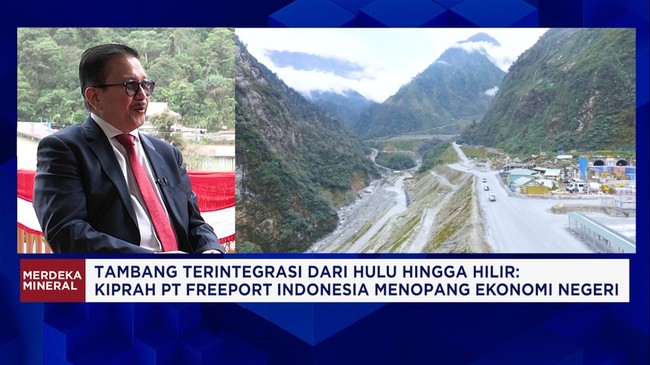
PT Freeport Indonesia (PTFI) continues to demonstrate its commitment to supporting the national economy through tax payments, dividends, royalties and other levies to the state. So what is the evidence?
PT Freeport Indonesia President Director Tony Wenas said 2026 will be a challenging year for PTFI because the company is still in a recovery period following the wet mudslide incident at the Grasberg Block Cave (GBC) underground mine that occurred in 2025.
Amid the production recovery process, PTFI has ensured that operations continue and the company’s contribution to the state will keep flowing, with a value of tens of billions of US dollars since 1973. For 2025 alone, Freeport Indonesia contributed more than US$4.7 billion, or around Rp75 trillion.
“Last year alone we contributed more than US$4.7 billion to the state, around Rp75 trillion, in the form of taxes, dividends, royalties and other levies. Some was paid directly to the central government and some directly to the regions,” he said on Closing Bell, CNBC Indonesia, Thursday (20/08/2026).
These payments are part of PTFI’s commitment to continue producing safely and sustainably while supporting the welfare and economy of the regions and local communities. However, because the company is still in a recovery phase, PTFI’s contribution to the state in 2026 is estimated at around Rp47 trillion, with contributions targeted to grow again to Rp120 trillion per year starting in 2028.
The increase in contributions can be achieved when PTFI’s operational target reaches 100% in 2028. Alongside that, PTFI could contribute more than US$7 billion, or the equivalent of Rp100 trillion, to the state each year.
In addition, he continued, PTFI is strengthening coordination with the Mimika Regency Government and the Central Papua Provincial Government to synergise various programmes aimed at advancing the economy, health, social and cultural affairs, infrastructure and MSMEs. Examples include free medical treatment and quality education programmes for local communities, which can improve living standards in Mimika Regency. This is borne out by the fact that Mimika Regency’s Human Development Index (HDI) reached 77.25, higher than the national HDI.
Furthermore, PTFI disburses local investment funds worth US$100 million every year for regional needs. The investment is provided in the form of programmes running until 2041, with a focus on education, health, the economy, social affairs, sports and culture.
Tony said these programmes are not determined solely by PTFI as the organiser. In principle, PTFI also seeks input from local communities about which programmes they would like to see prioritised and which suit the needs of the area. From there, PTFI reviews the proposed programmes.
“For example, the Sekolah Asrama Taruna Papua boarding school. It is not impossible that we will build another Sekolah Asrama Taruna Papua. The students there receive free nutritious meals five times a day — morning, afternoon and evening, plus two snacks — and the kitchen is on site,” he said.
PTFI also stressed that the company regularly coordinates with the government. This is done to ensure there is no overlap between PTFI and government programmes, because the programmes are intended not for the company but for local communities.
Not to be left out, PTFI continues to recover and strengthen its safety systems following the 2025 wet material incident. A number of projects, including the construction of drifts, tunnels and pump systems to remove wet material from the open pit, are being carried out by the company and are targeted to operate in stages until the end of 2027.
“So this is expected to significantly reduce the amount of wet material at the bottom of the pit that was the source of the previous incident,” he concluded.