
Not Iran or China, Trump Calls This Country the Worst in the World
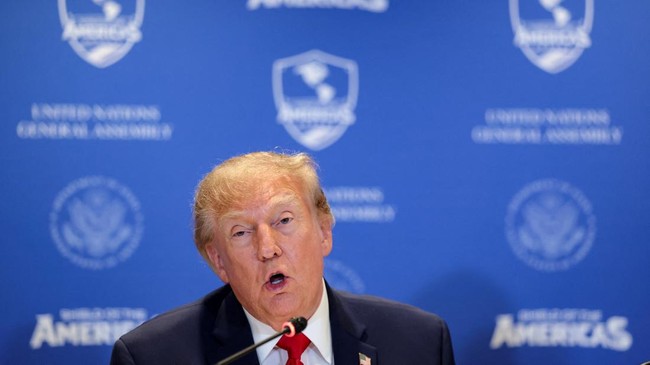
US President Donald Trump has intensified his sharp rhetoric against Canada, labelling the neighbouring nation as one of the worst in the world amidst an escalating trade war.
According to Newsweek on Tuesday (29/09/2026), tensions peaked after Trump imposed a 50 per cent tariff on Canadian goods valued at approximately US$28 billion (Rp498.4 trillion) last month. This aggressive manoeuvre was met with an equal response from Canadian Prime Minister Mark Carney.
Speaking to reporters in the Oval Office, Trump accused Canada—which is the US’s second-largest trading partner after Mexico—of treating Washington very unfairly. The President highlighted steep tariffs on US agricultural products and claimed Canadian leaders felt entitled to everything.
“They want to make a deal with us,” he said.
“They call us all the time. The problem is, they have treated the United States very unfairly. They have been one of the worst countries in the world. We deal with China, we deal with people, we make good deals, but Canada is actually very difficult to deal with, and they are imposing tariffs of 400% and more on our farmers. They are taking advantage of us. They feel entitled.”
Trump’s claims refer to Canada’s dairy product tariff regime, where imports above a certain quota level can face tariffs exceeding 200 per cent.
However, Philippe Charlebois, spokesperson for the Canadian Dairy Commission, previously asserted that no US dairy products have faced such high tariffs so far, as US exports remain within the access limits negotiated under the US-Mexico-Canada Agreement (USMCA).
Beyond tariff issues, Trump also argued that Canada is heavily dependent on the US economy without offering much in return. He noted that the US has provided various forms of support, ranging from military cooperation to icebreakers. Trump insisted that the US does not need Canada’s resources at all.
“We will win everything. We are even making Lake Ontario an American Lake now. Canada will come and say, ‘Sir, we are very sorry.’ I think a deal will be made, but it must be a fair deal,” he asserted.
This escalation of conflict with Washington has prompted Canada to overhaul its trade axis. A few days prior, PM Carney supported the idea of Canada becoming the first associate member of the European Union (EU) to deepen economic ties and ensure no single country can dominate the Canadian market.
European Commission President Ursula von der Leyen also openly invited Canada to collaborate on this discourse during her speech in Strasbourg on 16 September.
Although associate membership is not currently regulated under EU agreements and the bloc has historically rejected flexible partnership categories, Carney emphasised that his country is not seeking full membership.
“What we are looking for, and will begin to discuss, is a unique alliance between Canada and the European Union,” said Carney.
“We share the same values, we have the same priorities, and we have very complementary strengths.”
The clarity of Canada’s strategic pivot towards Europe is projected to become more evident at the EU-Canada summit at the end of October, which is expected to yield new agreements and partnerships. Beyond Europe, Canada is also rushing to pursue a trade pact with India and improve its relations with China.
A recent deal with Beijing has lowered tariffs on Canadian canola and opened the country’s market to several Chinese electric vehicles (EV).
“Partners work with Canada because Canada is predictable, reliable, and principled in a world that is anything but,” said Carney.
“We have a strategy that, I believe, has made our country stronger, but we have only just begun.”
Responding to these dynamics, Todd Belt, a professor of political management at George Washington University, assessed that the White House never predicted such fierce resistance from Canada.
“Donald Trump underestimated Carney’s determination,” said Belt.
“He may think that because he [Carney] has just taken office, he will be able to boss him around. And that is not happening.”
Belt also revealed that Trump failed to anticipate Canada’s retaliatory tactics, which involve designing counter-attacks on politically strategic areas.
“Canadians will respond in the same way, and they will do so in a way where they deliberately target contested Senate seats,” he said, referring to crucial states such as Michigan, Ohio, and Alaska.
Belt warned that US trade dominance and influence could vanish instantly if Canada ultimately succeeds in replacing the US market by forging strong ties with new trading partners.
Source: jawawa.id (https://jawawa.id/newsitem/not-iran-or-china-trump-calls-this-country-the-worst-in-the-world-1790664822)
Originally published by CNBC Indonesia (https://www.cnbcindonesia.com/news/20260929094524-4-771663/bukan-iran-atau-china-trump-sebut-negara-ini-terburuk-di-dunia), translated from Indonesian