
Not Gold: This Is the World’s Mining Giant, with Production Exceeding 2.6 Billion Tonnes
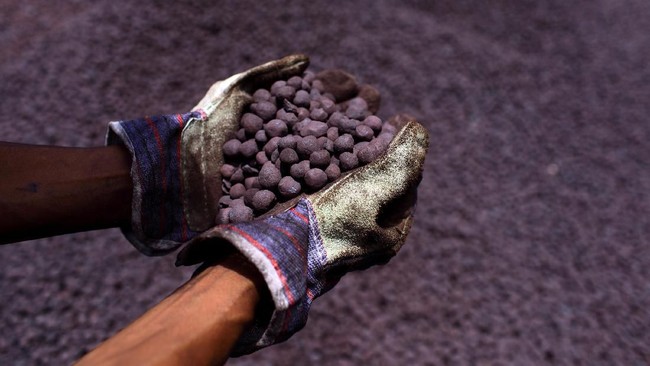
Jakarta, CNBC Indonesia — Global metal production in 2025 demonstrated the scale of industrial demand for a range of minerals, from iron ore produced in billions of tonnes to specialised metals mined in quantities of just tens of tonnes for advanced technologies.
Differences in production volumes reflect the strategic role of each commodity in the modern economy, whether in construction and transport or in electric vehicles, batteries and electronic devices. Although produced in far smaller quantities, specialised metals remain important to technological development and the global energy transition.
The world mined around 2.8 billion tonnes of metal commodities in 2025. Iron ore was by far the largest, at about 2.6 billion tonnes, or around 93 per cent of the total across 35 recorded commodities.
The scale of iron ore production reflects demand from the steel industry, which supplies the construction of buildings and bridges, as well as vehicles, machinery and transport infrastructure.
Meanwhile, several metals produced in much smaller volumes are becoming increasingly important to the battery, electric vehicle and electronics industries.
According to the US Geological Survey (USGS) publication Mineral Commodity Summaries 2026, production of 35 metal commodities in 2025 totalled about 2.8 billion tonnes. The figure covers commodities measured on different bases, including the weight of ore and concentrates, metal content and smelter output.
Iron ore far outstrips other metals
Iron ore was the largest commodity by production volume, reaching around 2.6 billion tonnes in 2025. That was more than 35 times the output of primary aluminium, which ranked second at about 74 million tonnes.
After iron ore, aluminium and chromium ore and concentrates were the largest commodities, at 74 million tonnes and 51 million tonnes respectively. Copper followed at 23 million tonnes, then manganese at 20 million tonnes and zinc at 13 million tonnes.
The high output of these metals is linked to industrial and infrastructure demand. Aluminium is widely used in construction, vehicles, packaging and electricity networks, while chromium is an important ingredient in stainless steel because it improves resistance to corrosion.
By contrast, some commodities used in modern technologies are produced in far smaller quantities, yet their role is growing in the development of batteries, electric vehicles, wind turbines and electronic devices.
In 2025, production of rare earth elements reached about 390,000 tonnes. Cobalt and lithium output stood at 310,000 tonnes and 290,000 tonnes respectively. Lithium production more than tripled from about 82,500 tonnes in 2020.
Lithium is a key material in rechargeable batteries, while cobalt is used in several types of battery chemistry. Rare earth elements such as neodymium and praseodymium are needed to make permanent magnets for electric motors and wind turbines.
Production volume does not determine economic value
The difference in scale is also evident among precious metals. Gold production was only about 3,300 tonnes in 2025, far below silver at 26,000 tonnes and copper at 23 million tonnes.
Despite its relatively low volume, gold has high economic value because of its scarcity and its use in jewellery, investment and technology. Platinum and palladium show a similar pattern: production was about 170 tonnes and 190 tonnes respectively, but both are important in vehicle catalysts and various industrial processes.
The volume of a mined commodity therefore does not necessarily reflect its economic value or strategic importance. Iron ore dominates by production quantity, while metals such as lithium, cobalt and rare earth elements are central to technological development.
The production figures should also be read with differences in measurement in mind. Iron ore and chromium are measured by the weight of ore or concentrates, while some other commodities are measured by their metal content.
Source: jawawa.id (https://jawawa.id/newsitem/not-gold-this-is-the-worlds-mining-giant-with-production-exceeding-2-6-billion-tonnes-1793357557)
Originally published by CNBC Indonesia (https://www.cnbcindonesia.com/research/20261030170958-128-781025/bukan-emas-ini-raja-tambang-dunia-produksinya-tembus-26-miliar-ton), translated from Indonesian