
Not Gen Z or Gen Alpha: This Generation Are the Financial Kings of Indonesia
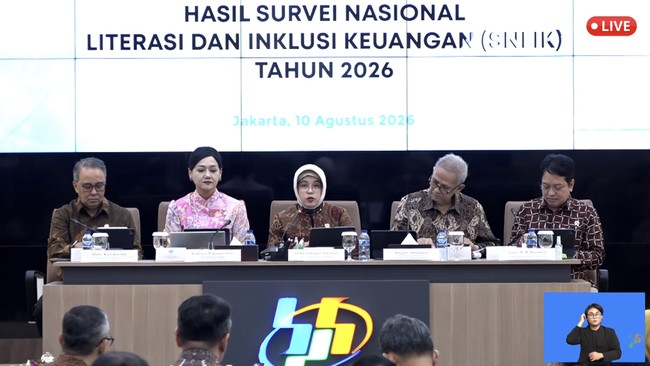
The 2026 National Survey on Financial Literacy and Inclusion (SNLIK), conducted by Statistics Indonesia (BPS) in collaboration with the Financial Services Authority (OJK) and the Indonesia Deposit Insurance Corporation (LPS), has revealed that the national financial literacy index reached 69.57%. This figure represents an increase of 2.93 percentage points compared to 66.64% in 2025. Meanwhile, the financial inclusion index rose to 93.61% from 92.74%.
According to the SNLIK 2026 results, the financial literacy index in rural areas saw a significant jump of 4.55 percentage points, while the urban index increased by 1.54 percentage points. In terms of gender, financial inclusion indices for women and men were nearly balanced, with the literacy index for men recorded at 69.61% and for women at 69.54%.
Head of BPS Amalia Adininggar Widyasanti stated that, based on the highest level of education attained, the financial literacy index increased across almost all groups, including those who never attended school or did not complete primary school, which rose by 1.46 percentage points to 45.23%. A slight contraction was observed among high school graduates, dipping by 0.02 percentage points to 79.17%. By age group, all cohorts experienced an increase, with the 26–35 age group emerging as the most financially literate. “It is evident that the productive age group, specifically those aged 26–35, has the highest literacy rate at 78.70%,” she said. In contrast, the 15–17 and 51–79 age groups remained below the national level, at 56.06% and 60.01% respectively. This indicates that half of the Gen Alpha and Gen Z age ranges have financial inclusion levels still below the national average.
Chair of the OJK Board of Commissioners, Friderica Widyasari Dewi, explained that the measurement standards strictly adhere to the guidelines set by the Organisation for Economic Co-operation and Development (OECD). This approach makes the literacy figures appear tighter and more conservative compared to measurements based solely on public awareness of financial products. “If we only measured whether people know about a product, the figure would be higher, but we truly have to meet five aspects, and that is in accordance with OECD standards. This differs from inclusion, where someone who has just one account anywhere is immediately counted as included,” she stressed.
Source: jawawa.id (https://jawawa.id/newsitem/not-gen-z-or-gen-alpha-this-generation-are-the-financial-kings-of-indonesia-1786420316)
Originally published by CNBC Indonesia (https://www.cnbcindonesia.com/market/20260811092707-17-758159/bukan-gen-z-gen-alpha-ini-generasi-yang-jadi-raja-keuangan-ri), translated from Indonesian