
Not Exports or Natural Resources – The Real Backbone of Indonesia's Economy
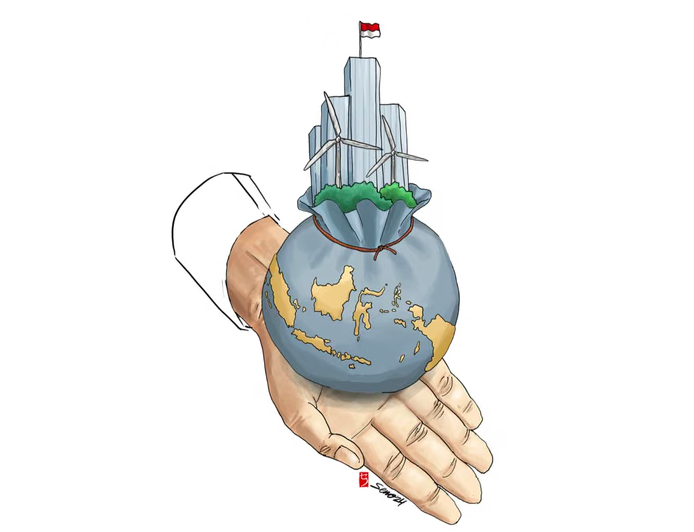
Head of the Central Statistics Agency (BPS), Amalia Adininggar Widyasanti, stated that Indonesia’s economic fundamentals remained robust in the first quarter of 2026, supported by household consumption, investment, and accelerated government spending.
“The economic fundamentals of Indonesia throughout the first quarter from January to March 2026 remain solid,” Amalia said in Jakarta on Tuesday.
BPS reported Indonesia’s economy grew 5.61% year-on-year in Q1 2026, driven by consumer activity, investment, and government fiscal stimulus early in the year.
Amalia explained that household consumption remained the primary growth driver, contributing over half of national economic output. “Household consumption indeed supports more than half of Indonesia’s economy during Q1 2026,” she said.
BPS noted household consumption grew 5.52%, contributing 54.38% to gross domestic product (GDP) and adding 2.94 percentage points to economic growth. According to Amalia, consumer purchasing power remained stable, bolstered by increased mobility during Ramadan and Eid.
She added that consumption growth was evident in heightened trade, transport, restaurant, hotel, and digital economy activities during the extended holiday period.
Besides household consumption, gross fixed capital formation (GFCF), or investment, grew 5.96% with a 28.29% contribution to GDP, adding 1.79 percentage points to Q1 2026 growth.
Amalia said investment growth was underpinned by higher demand for capital goods such as machinery, equipment, and vehicles to support production and business expansion. “Capital goods imports grew 14.27%, foreign direct investment (FDI) and domestic investment (PMDN) realisation was 7.2%, and government capital expenditure rose 36.7%,” she said.
Government consumption grew 21.81%, contributing 1.26 percentage points to national economic growth. Amalia noted that accelerated government spending early in the year was a key factor driving Q1 2026 growth.
“Typically, government expenditure is limited in the first quarter, but in Q1 2026, government stimulus policies led to higher budget spending under President Prabowo’s administration, making government outlays significantly larger than in previous quarters,” she explained.
She added that accelerated spending on goods and services, along with various government incentives, created a multiplier effect on economic activity earlier than in prior years.
On the sectoral front, transport and warehousing grew the fastest at 8.04%, followed by trade at 6.26%, manufacturing at 5.04%, and agriculture at 4.97% in Q1 2026.
Amalia stated that the growth in these sectors indicated domestic economic activity remained positive despite global uncertainties and a slowing world economy. (Ant/P-3)