
North Tapanuli Regency Media Publication Programme Under Scrutiny
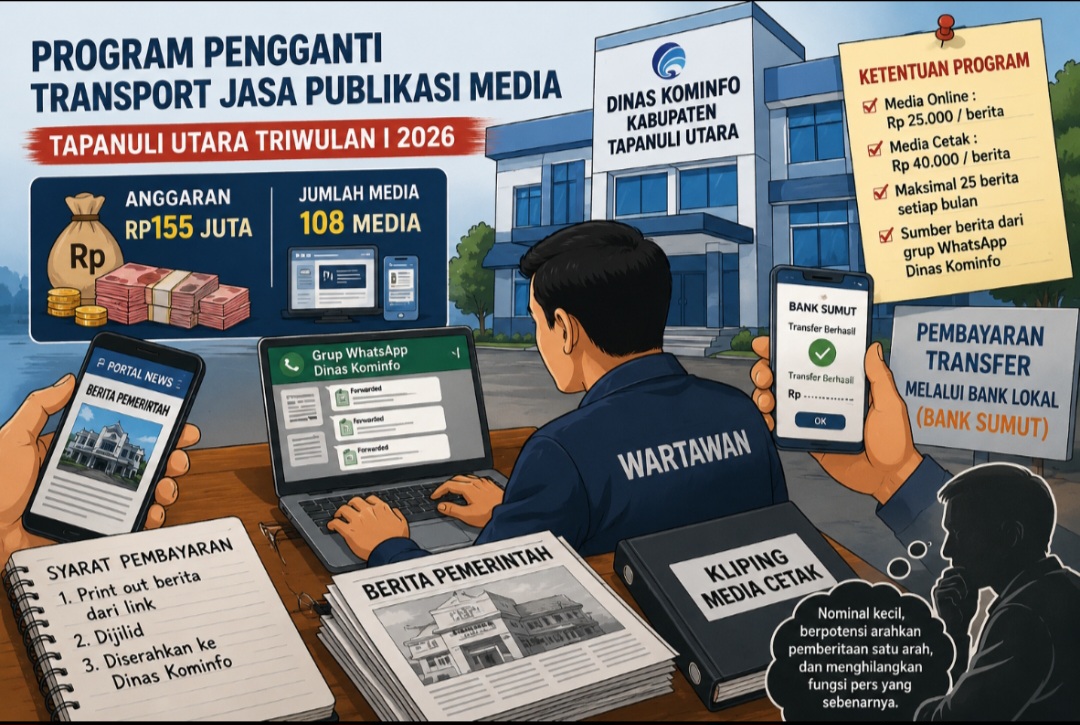
North Tapanuli Regency’s media publication transport replacement programme for Quarter I 2026 has drawn scrutiny. The programme, run by the North Tapanuli Regency’s Department of Communication and Informatics (Dinas Komunikasi dan Informatika), has been criticised for the relatively small payments and for its nomenclature, which is considered confusing and potentially undermining media independence.
Several journalists have described the term ‘replacement transport for media publication services’ as convoluted and liable to be interpreted as a pattern of relations steering reporting in a single direction. Such a development risks reducing the press’ function as an independent instrument of social control.
Volmer Silalahi, head of the Publications Section at the Dinas Komunikasi dan Informatika, said that 108 media outlets participated from January to March 2026. ‘A total of 108 media took part, with the absorbed budget amounting to Rp155 million,’ he said on Friday (22 May).
One journalist working in North Tapanuli said they participated and received payment for publications. ‘I too received money for the press releases,’ they said.
They explained that for online media each article is valued at Rp25,000, while for print media Rp40,000 per article. However, the total number of paid articles is capped at 25 per month. ‘The articles we publish are generally taken from the Dinas Kominfo’s WhatsApp group,’ he said.
As a condition for payment, journalists were required to print the published articles via the links to their respective media, then bind them and submit to the Dinas Kominfo. For print media, the evidence of publication was submitted as newspaper clippings, also bound.
Payments were made by bank transfer to each journalist’s account using a regional bank, namely Bank Sumut.
The programme elicited a range of responses from journalists in North Tapanuli, particularly regarding the publication partnership scheme, the payment rates, and the potential impact on media independence.