
North Maluku Governor Reveals Benefits of Nickel Downstreaming, Here's One of Them!
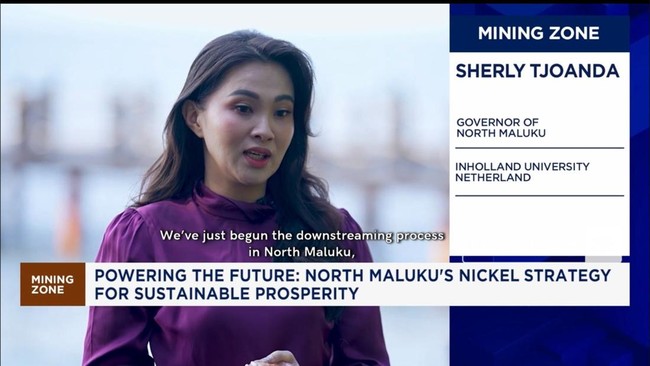
North Maluku Governor Sherly Tjoanda has spoken openly about the immense potential of downstreaming in her region. She stated that North Maluku’s economic growth in the first quarter of 2026 reached 19.6%, largely supported by downstreaming, particularly nickel.
"North Maluku is on a very strategic renewable energy map and has great potential, especially as it is still early days. Initially, it produced ferronickel, and now there is nickel sulphate for batteries. The potential going forward remains very large," Sherly told CNBC Indonesia.
She added that the multiplier effect from nickel downstreaming is also very significant. One example is the creation of 100,000 jobs and a very high economic turnover. However, a remaining challenge is that food supplies still come from outside North Maluku.
"Salaries are also very good, but the workforce is still not predominantly local North Maluku people. This remains a challenge, so that North Maluku’s human resources can be absorbed," she stressed.
Looking ahead, Sherly mentioned plans to improve education, especially vocational training, due to a missing link between education and the future industries in North Maluku. To support this, she said her administration will continue to collaborate with various top universities to create polytechnics with new study programmes suited for North Maluku’s future.
She also noted that her office will keep working with relevant ministries and business actors to incorporate curricula into vocational high schools and vocational schools so that skills can be acquired there and graduates are ready to work.
"Vocational education is our foundation for preparing human resources, thus preparing the workforce because this industry will remain large in the future. It is not just batteries for EVs, but there is still much other demand, and factories will increasingly be built in North Maluku," she detailed.
According to her, future human resource preparation cannot be done the old way; it must change very quickly, and industry players understand this best. Therefore, North Maluku is collaborating to ensure human resources match what is needed.
"We have started in all districts, but there is a priority scale that is ready in stages," Sherly said.
On another note, the nickel industry has been in North Maluku for nearly 20 years, yet healthcare in the province has not been good. However, she assured that North Maluku is heading towards improvement, especially with Type C hospitals, each with a total investment of Rp 150 billion, in East Halmahera, Sulat, and Taliabu in 2025.
In 2026, one will be built in Central Halmahera, meaning 10 regencies/cities will have 10 Type C hospitals with facilities capable of performing surgeries, dialysis, and treating premature babies.
"The remaining challenge is meeting the quota for doctor requirements, so we are collaborating with the Ministry of Health, providing scholarships for local children to be willing to work here, including CSR from companies to improve the quality of hospitals," Sherly concluded.
It is noted that North Maluku has the task of strengthening road and bridge connections, with a target of 550 kilometres of provincial roads before 2030, although a total of 1,900 kilometres of regency roads also await completion.
Source: jawawa.id (https://jawawa.id/newsitem/north-maluku-governor-reveals-benefits-of-nickel-downstreaming-heres-one-of-them-1781254278)
Originally published by CNBC Indonesia (https://www.cnbcindonesia.com/news/20260612144042-4-742373/gubernur-malut-ungkap-manfaat-hilirisasi-nikel-ini-salah-satunya), translated from Indonesian