
North Korea asserts nuclear status and pushes for regional stability
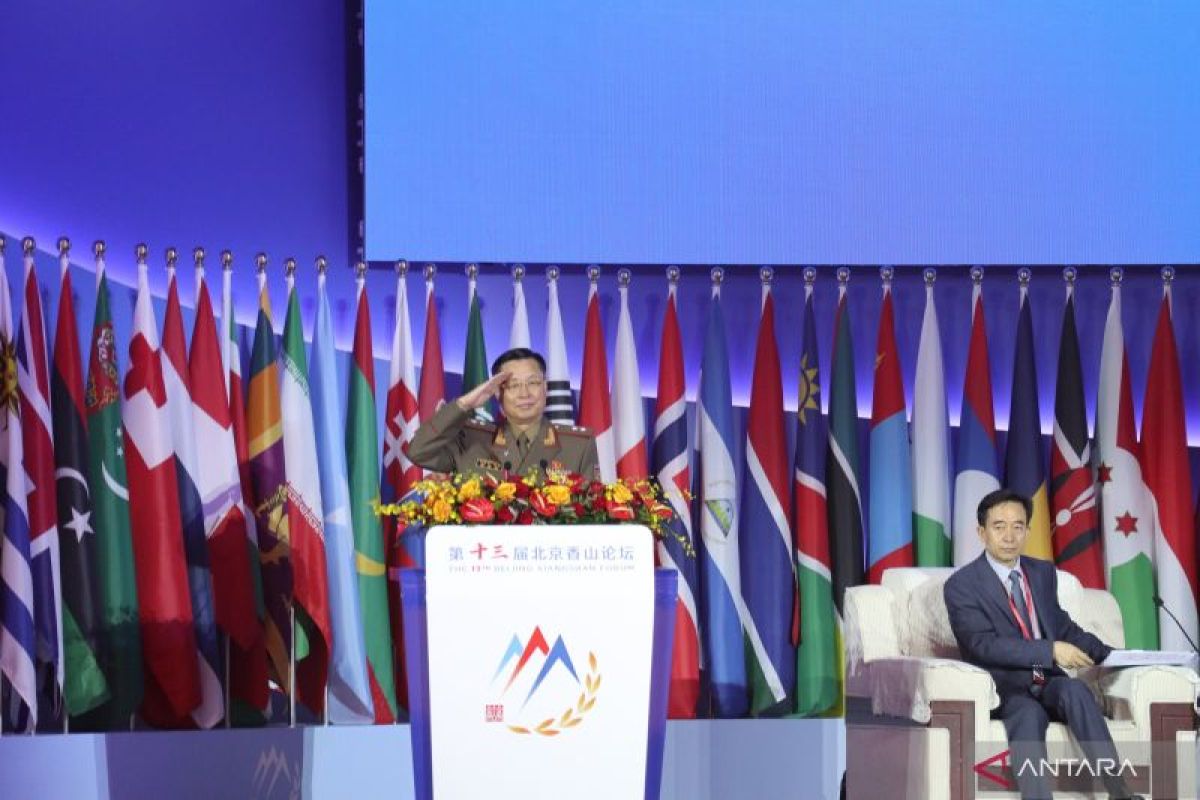
Beijing (ANTARA) - North Korean Deputy Defence Minister Lieutenant General Kim Kang Il has asserted that his country’s nuclear status is unalterable and has called on other parties to cease condemning Pyongyang’s defence policies.
“Our status as a nuclear-armed state, which has been enshrined in the constitution as the highest law of the state, is absolutely irreversible,” said Kim Kang Il during a panel session at the 2026 Beijing Xiangshan Forum in Beijing on Thursday.
Kim’s presence at the international security forum marks one of the relatively rare appearances of a high-ranking North Korean official abroad. His attendance comes as Pyongyang seeks to strengthen ties with China amidst tensions with Washington and its allies.
“Countries considered enemies, which hold the most hostile and fanatic intentions towards our state, must cease their condemnation of our legitimate and self-defensive defence policies and abandon the unrealistic illusion of denuclearisation,” Kim asserted.
Kim stated that as the threat of nuclear attacks from hostile powers against North Korea increases, and as confrontational measures through nuclear alliances intensify, so does his country’s need to expand and strengthen its nuclear deterrence as a self-defence effort.
“Based on the principle of ensuring security and maintaining peace through formidable strength, we will firmly maintain peace and stability on the Korean Peninsula and in the region,” Kim stated.
He requested that the international community accurately identify the root causes of rising tensions on the Korean Peninsula, its surrounding areas, and the wider Asia-Pacific region, and call for a collective stance to uphold international justice.
“Recently, the foundations of global peace and security have been severely shaken by brutal and unlimited geopolitical greed and the hegemonic ambitions of the United States and its follower powers. On the Korean Peninsula, an aggressive military bloc sharing nuclear capabilities continues to expand and strengthen,” Kim added.
Kim noted that various military exercises involving the hypothetical use of nuclear weapons are being conducted openly, which he deemed disruptive to regional peace and security.
“Specifically, the US has adopted a new nuclear strategy that emphasises increasing strike capabilities using tactical nuclear weapons to face potential regional conflicts, thereby developing its nuclear strength for use in actual combat,” Kim explained.
Kim also added that by exploiting the chaotic international situation, Japan and South Korea have fallen into what he termed “extreme subordination” to the US, aggressively increasing military strength with the aim of possessing nuclear weapons under US permission and encouragement.
“As a result, the transformation of the US-Japan-South Korea trilateral military cooperation framework into a nuclear alliance is becoming a reality. The Korean Peninsula cannot escape the vicious cycle of confrontation conducted by the US and its allies,” Kim said.
According to Kim, North Korea’s nuclear policy was adopted to accurately reflect national security needs in the face of both current and future threats.
“The efforts of countries considered enemies to continue increasing their nuclear strength provide sufficient reason for our republic to build a perfect nuclear shield, while further affirming the legitimacy and necessity of our nuclear strengthening policy,” he added.
However, he expressed that in the future, North Korea will continue to develop good and friendly relations with all nations that uphold justice and independence, and work together to oppose hegemonism and unilateralism to build a fair international order.
When asked by a participant regarding North Korea’s willingness to follow artificial intelligence regulations in the fields of defence and security, Kim stated that the development of North Korea’s national defence capabilities is self-defensive and aims to protect the dignity of the state and the happiness of the people from external threats.
“For that purpose, we possess and will continue to strengthen our national defence capabilities. North Korea continues to strengthen its self-defensive defence capabilities,” said Kim, who brought his own translator to the stage.
Kim also declined to answer a question regarding the possibility of a meeting between US President Donald Trump and North Korean leader Kim Jong Un, posed by a lecturer from Nanjing.
“Regarding this matter, I do not believe I am in a position to discuss whether such a summit could take place,” Kim replied briefly.
North Korea is known to have joined the Nuclear Non-Proliferation Treaty (NPT) in 1985 and began submitting to inspections by the International Atomic Energy Agency (IAEA) in 1992. IAEA inspections in 1992 found discrepancies between North Korea’s reports and inspection results, indicating unreported plutonium. Pyongyang refused special inspections, leading to a declaration of non-compliance in 1993.
In January 2003, North Korea announced its withdrawal from the NPT, prompting the IAEA to report the matter to the UN Security Council. Through the Six-Party Talks in 2005, North Korea expressed willingness to abandon its nuclear programme in exchange for economic assistance and security guarantees, but subsequently conducted its first nuclear test in October 2006, resulting in UN sanctions.