
Non-Muslim Graduate from NTT Experiences Tolerance and Inclusivity at UMJ
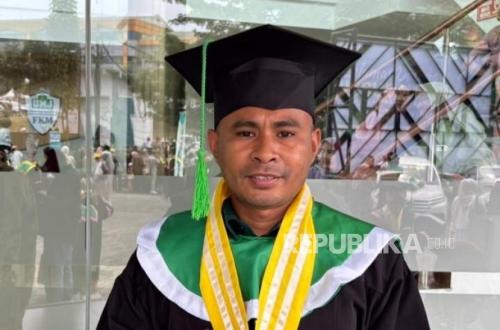
Amid Indonesia’s diversity, Universitas Muhammadiyah Jakarta (UMJ) has established itself as an open educational space welcoming all students regardless of religious background.
Several non-Muslim students have chosen to pursue education at UMJ due to its academic quality, inclusive campus environment, and values of tolerance embedded in daily campus life.
Wilfridus Kado, a Christian graduate from East Nusa Tenggara (NTT) from the Master’s programme in Educational Technology at UMJ’s Graduate School (SPs UMJ), selected the institution because of its accredited quality and reputation, and its curriculum highly relevant to contemporary needs.
Wilfridus explained that integrating technology into pedagogy is essential. UMJ offers an academic ecosystem supporting the development of digital competencies, supported by expert lecturers in their respective fields.
Additionally, UMJ’s flexibility and openness towards students from diverse backgrounds represented an added value that solidified his choice.
Tolerance at UMJ
From his first day of lectures, Wilfridus felt the Muhammadiyah campus valued human dignity and academic professionalism. Specifically at UMJ, there existed no barriers or discriminatory treatment; all students possessed equal rights and opportunities to learn, discuss, and develop.
“Tolerance at UMJ is not merely a slogan, but concrete action,” he stated.
UMJ provided freedom to explore academic ideas without concern regarding religious background. During group discussions or research compilation, what was evaluated was scientific objectivity and quality of thought.
“The space for dialogue between different faiths was wide open in a healthy manner, where differences were not viewed as a dividing factor, but as enriched perspectives,” he added.
Challenges in Studying
The challenges Wilfridus experienced were primarily cultural adaptation towards Islamic terminology and traditions often used in lecture introductions. However, this challenge posed no obstacle whatsoever.
“Fellow students and lecturers were highly inclusive and cheerfully explained matters, so the process of social and academic adaptation proceeded very naturally and quickly,” he explained.
This experience further strengthened Wilfridus’ conviction that Islamic faith-based educational institutions and Muhammadiyah campuses are capable of functioning as shelters for all segments of society. He viewed cross-background collaboration as the key to advancing national education.
Impression of Studying at UMJ
Wilfridus stated that studying at UMJ enhanced his capacity for strategic and practical thinking in designing digital ecosystems in schools. He learned how to integrate artificial intelligence (AI), manage learning management systems (LMS), and conduct impactful instructional development research.
“The professional network and mature perspective on diversity represent valuable assets I bring back to my home region,” he said.
According to him, Muhammadiyah strongly emphasised the ethos of progress—how to continuously innovate and avoid stagnation. This value strongly aligned with the spirit of Educational Technology. Additionally, the value of treating people with dignity regardless of ethnicity, race, or religion was genuinely felt in daily campus interactions.
Message for Prospective Students
Muhammadiyah campuses, such as UMJ, are educational institutions founded on trust, professionalism, and high inclusivity. Studying at UMJ provides a rare opportunity to broaden horizons, learn to genuinely nurture diversity, and gain superior quality education.
“Never doubt, because you will be evaluated based on your academic integrity and intellectual contribution, not based on your beliefs,” was his message.
Wilfridus hoped UMJ would continue to maintain and strengthen its commitment as an inclusive, humanistic, and progressive campus.
He hoped UMJ would continue to open spaces for cultural and academic dialogue bringing together students from diverse backgrounds, so that UMJ could continue serving as a laboratory of tolerance inspiring other campuses throughout Indonesia.