
Non-Concrete Block Pavement: Pondok Indah Footpath Replacement Uses Lightweight Brick Instead
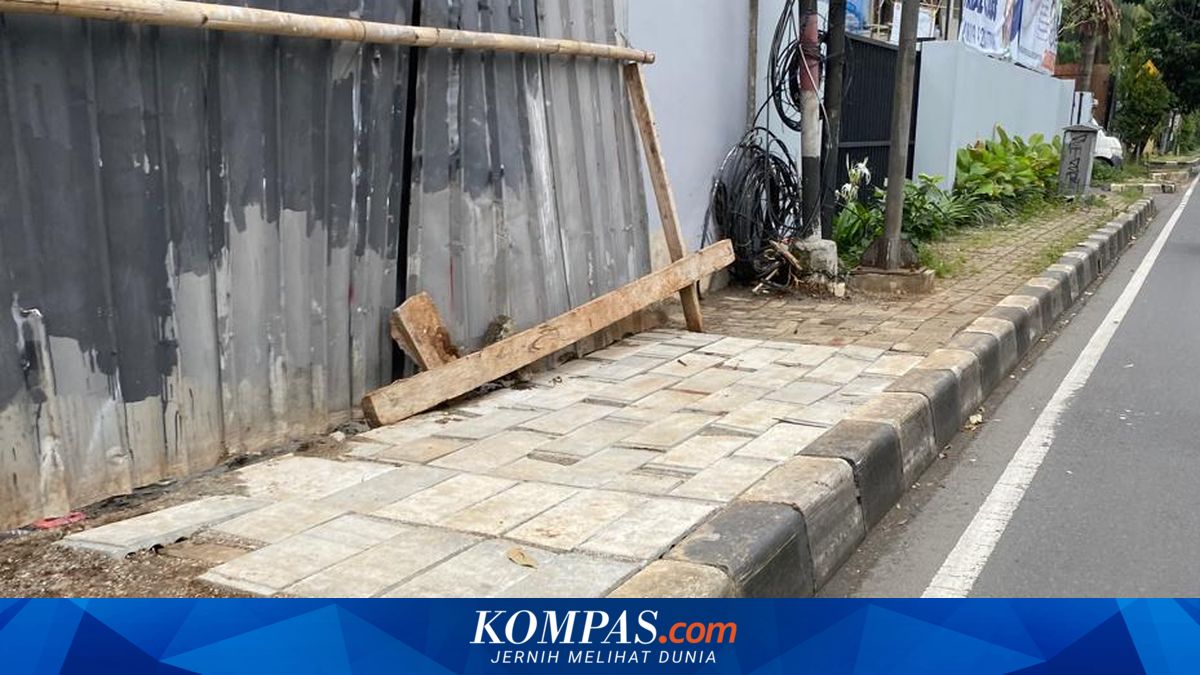
Jakarta, South Jakarta – The footpath in the Pondok Indah area has attracted attention following the unusual choice of materials used in its repair.
Rather than using paving blocks (konblok), the footpath has been installed with lightweight brick, commonly known as hebel.
An inspection by Kompas.com on site on Monday, 9 March 2026, revealed that the footpath appeared to have been newly laid with blocks that were inconsistently oriented. Some blocks were laid lengthwise whilst others were laid crosswise, resulting in an uneven pattern with misaligned directions.
The surface appears relatively flat with notably wide joints in several sections. On the left side of the footpath, a corrugated iron fence and a long wooden beam are visible placed atop the pavement. The right side of the footpath is bounded by the road where vehicles pass.
Several blocks also appeared uneven and slightly raised, creating an impression of imprecise installation.
Kebayoran Lama subdistrict head Mustofa confirmed that the material used in the footpath repair was indeed lightweight brick. “A field inspection has been conducted. The material used to replace the removed paving blocks is lightweight brick,” Mustofa said when contacted on Monday.
“We also enquired about the reasons for the replacement, as the original paving blocks were damaged during removal,” he added.
Nevertheless, Mustofa stated that the use of alternative material still allows the footpath to be utilised again by pedestrians. “Regarding the replacement of the old paving blocks with lightweight brick, both functionally and aesthetically the footpath is now level and can be used again by road users,” he explained.