
Nobel Laureate Kailash Satyarthi's Discussion Notes: When the People Are Powerless Amid the Fanfare of Democracy
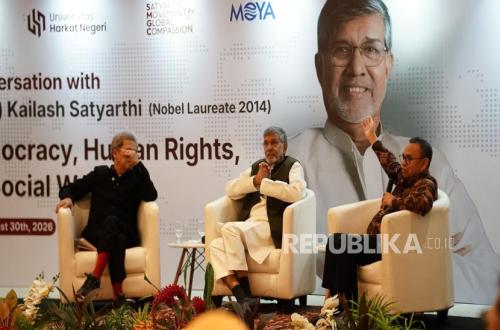
Elections are held regularly, the constitution contains a long list of citizens’ rights, yet millions of people continue to live without any bargaining power whatsoever vis-à-vis their state.
This is the situation dissected by Indian Nobel Peace Prize laureate Kailash Satyarthi before academics, lawyers, activists, and business people.
Satyarthi stressed that a right which cannot be used to hold the government to account is not a right.
“Rights must not stop as words on paper. When rights are seized, democracy shrinks. When accountability disappears, democracy sinks,” Satyarthi said in a discussion titled A Conversation with Kailash Satyarthi - Democracy, Human Rights, and Social Welfare, organised by Universitas Harkat Negeri in Jakarta on Sunday (30/8/2026).
He gave the example of a single mother who cannot afford to feed her child or prevent her daughter from being trafficked.
Such a woman does not understand the concept of democracy and does not know the language of human rights. All she asks for is one thing: that her child can eat and is not sold.
At that point, according to Satyarthi, democracy loses its meaning even though all its procedures are running normally.
Satyarthi highlighted the habit of treating democracy, human rights, and social welfare as three separate matters, handled by three different ministries and studied by three different groups of academics.
In fact, the three are interdependent, to the extent that failure in one area cancels out achievements in the other two.
The problem is also not resolved even when rights have been enshrined in the constitution. What matters, he said, is whether freedom of expression, freedom to dissent, and freedom to demand accountability are truly respected.
He pointed to the United States, the world’s oldest democracy, as proof that such shrinkage can happen anywhere, even in a country that claims to be the most democratic.