
No Payslips, Informal Workers Can Still Access Mortgages
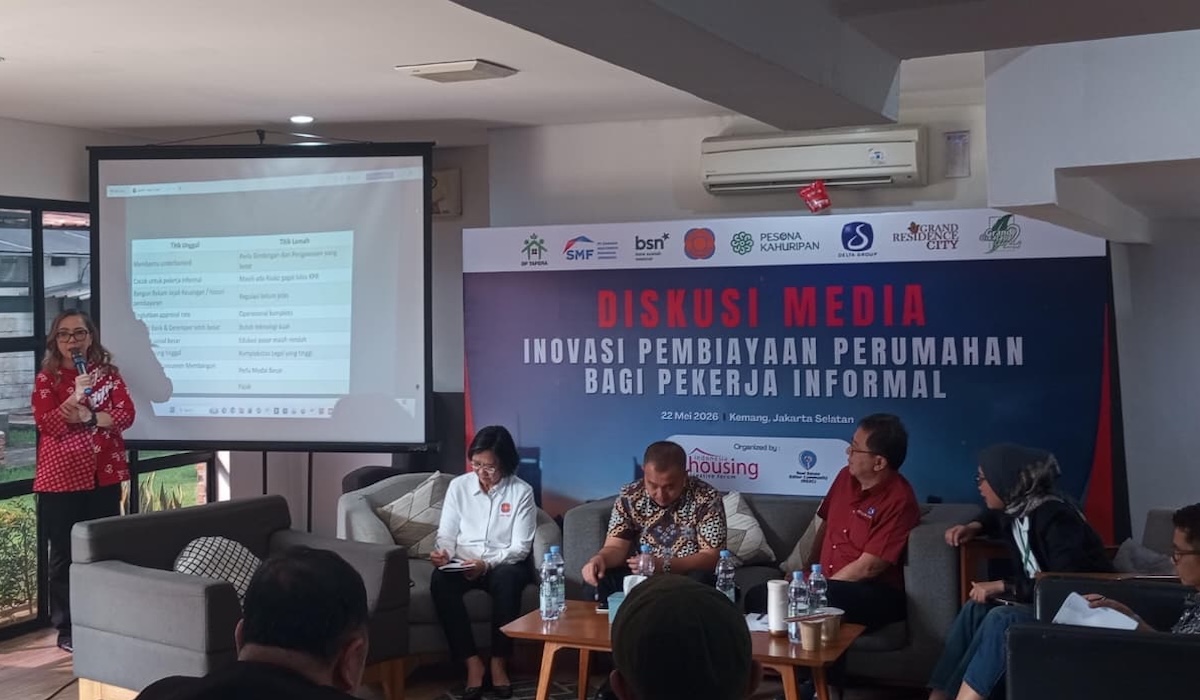
Rent-to-Own (RTO) schemes are being proposed as a bridge for informal workers to access mortgage financing (KPR), especially for those with irregular incomes who struggle to meet banking documentation requirements. Property expert and RTO aggregator Marine Novita said the main barrier for informal workers is not necessarily their ability to pay, but their inability to prove that capacity within traditional payment systems.
“The real issue for informal workers is not that they can’t afford a home, but that they can’t demonstrate that ability within the formal payment system,” Marine said during the Indonesia Housing Creative Forum in Jakarta on Friday.
Marine noted that the informal sector plays a significant role in Indonesia’s labor market, estimated to involve about 86 million people, or 60% of the total workforce. However, groups such as ride-hail drivers, micro, small and medium enterprises (MSMEs) traders, street merchants, and content creators frequently encounter hurdles when applying for a mortgage due to the lack of payslips or formal financial statements.
According to Marine, RTO can act as a transitional financing model before entering bank mortgage schemes. Under this model, prospective buyers can occupy the home as tenants and pay periodically over a defined period. These payments then form a financial track record, illustrating the consumer’s capacity and discipline before banks decide whether to approve the mortgage.
“Rent-to-Own is essentially an incubation period before the mortgage. During this incubation we can determine, for example, how long the bank needs to be confident in approving the mortgage—six months or 12 months,” Marine said.
Marine suggested an incubation period of six months for subsidised housing. She argued that this duration is sufficient to demonstrate the consumer’s payment discipline while safeguarding the property before its formal transfer to the mortgage scheme. For commercial housing, incubation could last longer, around 12 months.
In addition to rental payment history, Marine urged the use of a digital footprint as an alternative creditworthiness indicator. Daily income data from on-demand transport platforms, e-commerce transactions, and online sales volumes could be used as supplementary parameters in credit scoring.
“So it’s not just about the bank account; we can look at the digital footprint if someone is active online, selling goods, or working as a driver,” Marine said.
Delta Group’s CEO Endang Kawidjaja also sees RTO as a solution for informal workers and those formal workers who are hindered by SLIK OJK or BI checking records. Endang noted that some potential borrowers actually have the capacity to repay but are blocked by the initial bank assessment process.
“Rent-to-Own is a solution for the informals, both informal and formal workers who have issues with BI checking. They may not necessarily lack the capacity to repay, but they are blocked by SLIK from the outset,” she said.
On the banking side, Mortgage Financing Division Head at Bank Syariah Nasional (BSN), Putri Alfarista, said banks support BP Tapera’s policy to broaden housing finance access for non-fixed income groups. She also noted that Sharia banks have a step-up installment scheme that provides payment certainty from the start of the financing period.
“The advantage of Sharia is that the instalments are fixed. So even if the payments step up, a borrower can gauge from the first year up to 20 or 30 years ahead,” Putri said.
Marine added that successful RTO schemes still require government support, including subsidies during the RTO period or a shared-risk program to alleviate banks’ concerns about credit default. A shared-risk framework could be a key factor in encouraging banks to finance informal workers.
BPS data show that as of November 2025, about 57.7 percent—or 85.35 million people—of the total working population were employed in the informal sector.
The prospects for informal workers, who dominate more than 70% of Indonesia’s labor force, have drawn scrutiny amid rising global uncertainty, with the government also pursuing measures to expand housing access via various schemes. (Z-10)