
No Need to Be Surprised: Tiran Group’s Stake in Bayan Is Just 2%, While China’s Conch Invests Rp15 Trillion
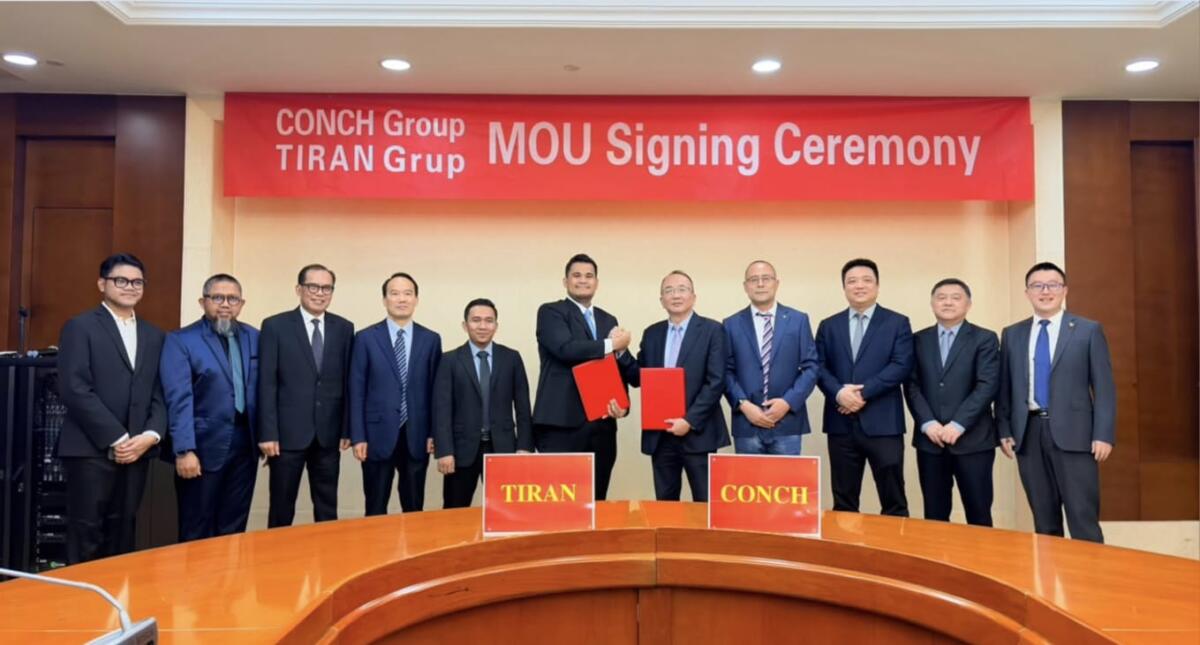
JAKARTA — Investment prospects in Indonesia are considered strong by global partners. The Rp15 trillion corporate deal between PT Tiran Nusantara Grup and Conch Investment Holdings (Hong Kong) Ltd is one indication of this. PT Tiran Nusantara Grup’s public relations officer, Rezki Mulyadi, said the partnership underscored international partners’ confidence in Indonesia’s investment climate and the capacity of its domestic industry.
Rezki said the company was committed to developing downstream industries, which are expected to employ 5,000 people and strengthen economic self-reliance. The value of the partnership is expected to grow gradually.
That confidence is also reflected in Conch’s track record. The company, which is under the Government of the People’s Republic of China, has invested Rp30 trillion in Indonesia. Its partnership with Tiran continues its long-term commitment to the country.
The agreement was signed in Anhui, China, on Friday, 9 October 2026, by Tiran Nusantara Grup Operations Director Andi Karyadi and Conch Director Li Xin, in the presence of Tiran Nusantara Grup President Commissioner Andi Amar Mar’uf Sulaiman. The planned projects include a lithium battery anode-material plant, a plastic packaging plant, a wind power plant and a waste-to-energy plant.
The ownership structure of each joint venture will be determined according to the nature of the projects undertaken by Conch and Tiran.
Tiran Nusantara Grup has its roots in research by Andi Amran Sulaiman, now the Minister of Agriculture, into rat infestations. The research led to a rat-control innovation called Tiran, an acronym for Tikus Diracun Amran (‘Rats Poisoned by Amran’). In 1995, Amran registered patents for innovations including Tiran 58PS and Alpostran. He now holds seven patents for agricultural innovations, mainly in pest control. The products are used by millions of Indonesian farmers and marketed in Japan, Malaysia, Vietnam, Thailand and other countries.
The business, which began with a Rp500,000 loan, became the precursor to Tiran Nusantara Grup in 2004 and began actively investing across sectors in 2007. The group now comprises 45 companies with thousands of employees across mining, energy, trade, plantations, logistics and industrial estates. Dozens of cargo vessels, hundreds of dump trucks and heavy equipment support the distribution of raw materials and products between regions.
Rezki said all companies in the group were owned by Amran. He added that its main rat-poison business had been closed after Amran was first appointed Minister of Agriculture in 2014, in order to maintain professionalism, while its other business lines continued to expand.
Amran’s career subsequently moved from business into government. He was first appointed Minister of Agriculture in 2014, returned to the post in 2023 and was appointed again in President Prabowo Subianto’s administration in 2024.
Having been appointed Minister of Agriculture three times, Amran is one of the business figures repeatedly entrusted with leading a technical ministry.
The article says that, through Amran, President Prabowo achieved his goal of making Indonesia self-sufficient in rice, a drive that began in 2025 and continued into 2026.
Agriculture Minister Amran Sulaiman achieved the self-sufficiency target in just one year, the article says.
Ministerial salary, private jet and action against cartels
Tiran Group public relations officer Rezki Mulyadi said Amran did not take his ministerial salary or allowances. The funds were said to have been given to orphaned children, students at Islamic boarding schools and other groups receiving assistance.
Amran has also reportedly used a private jet or chartered aircraft for official travel at his own expense. The stated reason was to save time and allow work schedules to be completed more quickly, rather than to use state funds.
“So the costs of the Agriculture Minister’s activities are covered personally through his companies,” Rezky said.
Since taking office as minister, Amran has stopped all his businesses that are related to or overlap with the Ministry of Agriculture, Rezki said.
“His children and family have even been forbidden from going near, let alone getting involved in, projects that overlap with the Ministry of Agriculture,” Rezki said.
With such strict boundaries, Amran has no conflict-of-interest burden when taking action against corrupt officials at the ministry and food cartels, the article says.
Rp1 trillion mosque project through AAS Foundation
According to Rezki, Amran Sulaiman established the non-profit AAS Foundation to help orphans, provide scholarships and disaster relief, and build a mosque costing around Rp1 trillion.
The mosque is reportedly being built on the outskirts of Makassar. It will have capacity for up to 20,000 worshippers and is designed not only as a place of worship but also as a centre for education and community activities.
Rezki said Tiran Nusantara Grup had also stated that Amran provided scholarships for orphans, people with disabilities, university students and students from Palestine. The company’s release also cited disaster assistance in Palu, Aceh and other affected areas. In addition, the company is working on a 17-storey hospital.
Some time ago, Tiran Nusantara Group delivered humanitarian aid to Türkiye through its Tiran Peduli social initiative. Through the Hasanuddin University Alumni Association (IKA Unhas), led by Andi Amran Sulaiman, aid was provided to victims of the earthquakes in Türkiye and Syria, as well as to Palestinians.
Just a 2% stake in Bayan
The 2% stake in Bayan Resources Tbk was acquired through a corporate action by a Tiran Nusantara Group subsidiary, PT Pelayaran Samudra Lamappepening. Bayan, previously predominantly controlled by foreign interests from Singapore and South Korea for 22 years, has now returned to Indonesian ownership, following Jhonlin Group’s acquisition of 30.25% of the shares.
Before the acquisition, Bayan Resources’ largest shareholders were founder and controlling shareholder Low Tuck Kwong with 40.22%, his daughter Elaine Low with 22%, PT Sumber Suryadaya Prima with 10%, and five South Korean companies holding a combined 20%.
Following the acquisition, data from the Indonesia Stock Exchange for October 2026 showed the ownership structure as follows: PT Liqinlin Baratama, 30.252%; Elaine Low, 22.002%; PT Sumber Suryadaya Prima, 10%; Low Tuck Kwong, 8.3%; five South Korean companies, 20%; and several other shareholders with stakes below 5%, including PT Pelayaran Samudra Lamappepening with 2%.
Tiran Group’s entry into Bayan Resources did not happen suddenly. Information from Bayan Resources said Low Tuck Kwong had previously offered BYAN shares to several parties.
Datuk Low did not offer BYAN shares to just one prospective buyer. The shares were reportedly offered to several parties before some of Datuk Low’s stake was eventually transferred to those who agreed to the transactions. “Agriculture Minister Amran has never met or communicated with Datuk Low; this is a corporate action,” said Rezki, Tiran Group’s public relations officer.
Source: jawawa.id (https://jawawa.id/newsitem/no-need-to-be-surprised-tiran-groups-stake-in-bayan-is-just-2-while-chinas-conch-invests-rp15-trillion-1794311424)
Originally published by kabarika.id (https://kabarika.id/berita/2026/11/10/gak-perlu-kaget-investasi-tiran-group-di-bayan-hanya-2-dengan-conch-tiongkok-malah-15-t/?amp=1), translated from Indonesian