
No Mining Degree, No Oil Business: Bahlil Reveals How He Steers the Energy Ministry
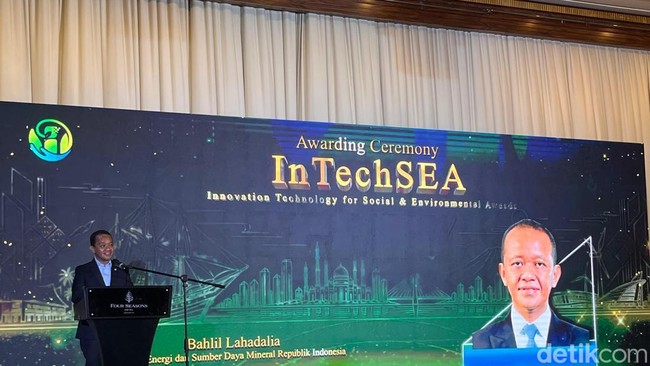
Jakarta, CNBC Indonesia – Energy and Mineral Resources (ESDM) Minister Bahlil Lahadalia has revealed that he has neither a mining education background nor any business experience in the oil and gas sector. Nevertheless, this has not prevented him from leading the Ministry of Energy and Mineral Resources.
Bahlil said he has often stated at various academic forums that he is not a mining graduate. In fact, before becoming Minister of Energy, he claimed he never owned a business in the oil sector.
“In several speeches at academic forums, I have always said that I did not study mining. I have also never in my life had a business in the oil world. What’s more, my campus isn’t even on Google. So imagine – it doesn’t exist, I never studied oil, never did oil business, and my campus isn’t on Google either. So I’ve fallen down the stairs and been hit by the ladder as well,” he said at the InTechSea 2026 event in Jakarta, quoted on Tuesday (15/9/2026).
Even so, Bahlil believes such circumstances can actually push a person to produce innovations and ideas that are not always found in academic theory.
He went on to recount his experience as Investment Minister/Head of BKPM during the Covid-19 pandemic. At that time, nearly every country faced uncertainty and had no clear formula for attracting investment amid the pandemic.
Bahlil said he searched for academic references on strategies to attract investment under such conditions, but found no theory or book specifically addressing investment strategy in the pandemic era.
“So the concept was, when the moment comes, use your wits. At that time. And, praise be to God, despite the Covid pandemic – my experience – when I became Investment Minister in 2019, the BKPM head, a Harvard graduate, left me a legacy of roughly Rp 790 trillion in total investment. I left the Investment Ministry in 2024 with our total investment having reached Rp 1,700 trillion. That’s more than 100% above target, and that was during the Covid era,” he said.
Now, assigned as Energy Minister by President Prabowo Subianto, oil imports remain a major challenge. Domestic oil production currently stands at around 600,000 barrels per day (bpd), while consumption reaches 1.6 million bpd. That means Indonesia imports roughly 1 million barrels per day.
“Now, back to this oil matter. Ladies and gentlemen, this oil business is frightening yet delicious. Why? Out of the total 1.6 million barrels per day, we clearly have to import 1 million barrels. The Strait of Hormuz has been closed. Twenty to 25% of the supply to our domestic market comes through the Strait of Hormuz,” he said.
“When it closed, there were two concerns. One is supply certainty, the second is price. Oh, how our brains had to spin. I asked several oil experts from ITB and elsewhere, the real specialists. I said, if this happens, what do we do? Oh, they gave me studies, thick ones. I felt sick before I even read them, let alone found a solution,” he said.
“So what I want to say is that managing a country in an era like this – reading books is important, but you must draw conclusions quickly. Don’t just keep reading books. If you keep reading books, you’ll never finish,” he said.
“This is a parallel challenge. The country seeks supply, and prices must be suppressed. But ladies and gentlemen, because I used to be a businessman, I know that wherever there is difficulty, there is also profit.
I always used to think, as a businessman: wherever people struggle, that’s where I go in. Because few people enter there, opportunities are plentiful. So back when I was a businessman, I always sought hardship. Because if things are easy, there will be many people there. If it’s hard, there are few. We sought a formula, then we shifted our crude away from the Middle East to several other countries – in Africa, in Angola, wherever we could look. That’s now clear,” he explained.
“The problem is price. Ladies and gentlemen, prices have now reached US$106 per barrel. Right now. The national average from January to September is around US$85–90 per barrel. Our state budget target is US$70 per barrel per day. So imagine how much our subsidy costs, ladies and gentlemen. Our brains had to spin again,” he said.
“I said to the President: Sir, this energy matter concerns the basic needs of the many. We must be able to formulate policies so that even amid extraordinary global conditions, we can promise certainty on prices. Ladies and gentlemen, we racked our brains in every way possible – I couldn’t possibly tell you everything, because if I did, there wouldn’t be enough time. By the time I finished, you could probably make two books out of it,” he said.
“The bottom line, ladies and gentlemen, is that we now obtain crude from several countries, including Russia. When I negotiated with the Russian Energy Minister, people asked: what about other countries, the superpowers and so on? I said Indonesia is an independent country – we uphold a free and active political stance, and we also uphold a free and active economic stance. Therefore, no single country may intervene in or dictate to the Unitary State of the Republic of Indonesia. What matters is that the goods exist and are cheap. That’s what matters most,” he explained.
“So whether it comes from that sea, this sea, or that sky, it doesn’t matter. What matters is that the goods exist and the price is low. And up to now, praise be to God, we have committed, ladies and gentlemen, that subsidised prices – subsidised prices – until 31 December, whatever the world price may be, we will not raise them. Because that is indeed what we are doing,” he concluded.
Source: jawawa.id (https://jawawa.id/newsitem/no-mining-degree-no-oil-business-bahlil-reveals-how-he-steers-the-energy-ministry-1789451538)
Originally published by CNBC Indonesia (https://www.cnbcindonesia.com/news/20260915110339-4-767968/tak-sekolah-tambang-gak-punya-bisnis-minyak-ini-dia-pegangan-bahlil), translated from Indonesian