
No Longer Relying on Debt, Entrepreneurs Build Healthier Businesses
Debt often serves as fuel for business expansion. However, when growth becomes too dependent on liabilities, capital that was once an engine of growth can turn into a burden that threatens the survival of the enterprise.
This is reflected in the experiences of a number of Indonesian entrepreneurs who have faced extreme problems, ranging from Rp350 billion in debt, 800 bounced cheques, Rp140 billion in financing, to US$15 million in receivables. Interestingly, these problems did not always end in bankruptcy.
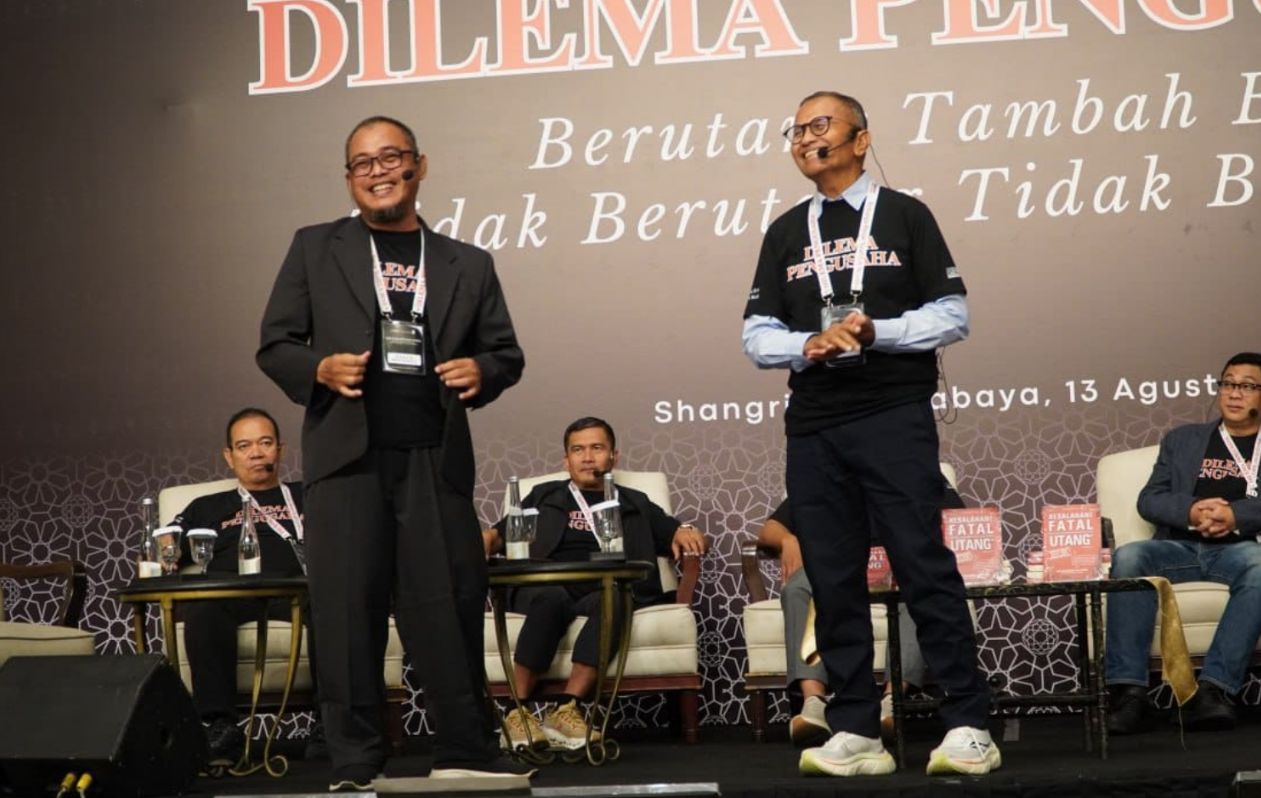
After reducing or stopping their reliance on debt, they rebuilt their businesses through efficiency, asset sales, strengthening production, market trust, partnerships and more measured financing. These experiences emerged in a talk show in Surabaya, East Java, hosted by entrepreneur and former State-Owned Enterprises Minister Dahlan Iskan.
One of the speakers, Tri Dawang, an information technology systems entrepreneur, once believed that debt was necessary for a business to grow. However, after all his obligations were paid off, he found that the business continued to grow with more disciplined management without continually adding debt.
A similar experience was shared by Mulyono, an entrepreneur from Sragen who runs Turrima Agrobiotech. For about 17 years, his business appeared to be growing, but was in fact heavily dependent on debt. After joining the SyaREA World extended family in 2017 and following sharia coaching, his debts were settled in 2018. His business continued to grow and even penetrated African and Middle Eastern markets.
In Africa, Mulyono spent around Rp2 billion on fertiliser trials over two years without payment. After his product proved to increase rice production by up to 40%, market trust grew and opened new business opportunities.
Syaikhul Hadi, an agricultural production facilities entrepreneur from Ponorogo, once held distribution rights for products from around 55 companies and opened branches in various regions. That expansion caused his liabilities to balloon until, at the most difficult point, he issued 800 bounced cheques. In 2018, Syaikhul stopped relying on banks and began settling his obligations. He sold products in the warehouse and offered assets to pay bills gradually.
After the debts were settled, his experience as a distributor became capital to transition into becoming a fertiliser producer as well as a seller.
These stories show that getting out of debt does not always mean retreating. Deleveraging can actually be the starting point for building a healthier business model.
Eka Nugraha, a telecommunications entrepreneur from Bogor, once had debts of up to Rp350 billion. A year after joining the SyaREA World extended family, his debt was reduced by about half and the business gradually developed without returning to dependence on bank debt.
Meanwhile, Fauzi Priambodo, an entrepreneur from Surabaya, faced financing that increased from around Rp2 billion to Rp140 billion. To break the cycle, he sold 20 minimarket outlets that were productive assets.
Dahlan Iskan considered the decision an important part of saving the business. “Like a car that is speeding, it must be braked. If it is not braked, it could go into a ravine,” said Dahlan.
According to him, entrepreneurs must dare to choose between maintaining the scale of the business or saving the health of the enterprise.
Zainur Nurochman once faced receivables of around US$15 million that were difficult to collect. Rather than spending all his energy chasing them, he chose to shift focus to rebuilding his contractor business and agricultural ventures. He let go of some of the losses. “A person’s task is limited to effort,” he said.
According to Zainur, the ability to accept losses and rebuild a business is part of an entrepreneur’s resilience.
These experiences do not mean that all financing should be avoided. Khalid Bawazier, an entrepreneur from Surabaya, said that financing can still be used as long as the transaction structure, contract, repayment capacity and risks are properly calculated.
According to him, the problem is not simply whether financing exists or not, but whether the transaction is carried out through the correct mechanism and in accordance with sharia principles. “The first capital of a great entrepreneur is not money, but calmness and trust,” he stressed.
These various experiences show that business growth is not always synonymous with business health. Increasing turnover, number of branches, assets and projects do not necessarily indicate a healthy business if they are not accompanied by cash flow capable of meeting obligations.
In the end, a business is not only judged by how fast it grows, but by how healthily it is able to survive, weather crises and be passed on to the next generation.
Source: jawawa.id (https://jawawa.id/newsitem/no-longer-relying-on-debt-entrepreneurs-build-healthier-businesses-1786791020)
Originally published by Media Indonesia (https://mediaindonesia.com/ekonomi/922164/tak-lagi-andalkan-utang-pengusaha-bangun-bisnis-lebih-sehat), translated from Indonesian