
No Longer Chasing Profits, It Is Time for Investors to Survive
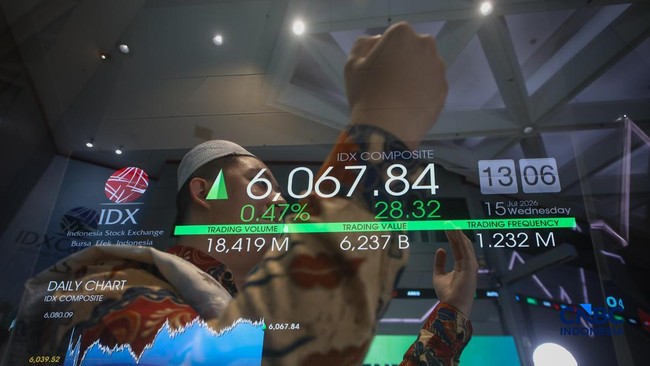
Global financial markets are once again sending uncomfortable signals to Indonesian investors. Almost simultaneously, the rupiah remains under pressure against the US dollar, the Jakarta Composite Index (IHSG) is weakening, and gold prices have begun to decline, although they are still growing positively on an annual basis. World oil prices are volatile due to rising geopolitical tensions in the Middle East.
At first glance, this series of events appears to stand alone, yet they all stem from the same source of global risk. Domestically, the resignation of the Bank Indonesia Governor adds further uncertainty.
The weakening of the rupiah reflects strengthening demand for the dollar as the world’s primary currency when uncertainty rises. At the same time, rising oil prices increase the threat of global inflation, reinforcing expectations that the Federal Reserve will keep interest rates higher for longer. This condition reduces appetite for risky assets, drives stock market corrections, and simultaneously increases the appeal of gold as a hedging asset.
This relationship aligns with the international macroeconomic view that goods markets, financial markets, and foreign exchange markets influence one another within a single integrated system, rather than moving separately.
The change in direction of all these indicators actually conveys a more important message than mere daily price fluctuations.
Investors are now facing a shift in market regime, where almost every investment decision is influenced by geopolitical risk, global monetary policy, exchange rate movements, and perceptions of asset safety. In such a situation, chasing the highest possible returns can actually increase vulnerability to shocks that arrive without warning.
An investor’s strategy is no longer about how to achieve the greatest short-term profit. The strategic choice is to answer the question: if all instruments move in conflicting directions, where should Indonesian investors allocate their funds?
Protecting Wealth
Exchange rate volatility, interest rates, commodity prices, and capital flows are not isolated phenomena. Shocks in goods markets, credit markets, and foreign exchange markets will propagate through economic actors’ expectations. When geopolitical conflict drives up oil prices and strengthens the US dollar, global investors simultaneously adjust their asset composition to reduce risk, not merely to chase profit.
This behavioural shift marks what the author calls the Wealth Preservation Era, a phase in which the primary investment objective shifts from maximising returns to preserving the purchasing power of wealth. The concept is highly relevant in the current situation. In essence, investors are not choosing between equities, gold, or the dollar, but rather seeking the combination of assets best able to preserve wealth amid rising global uncertainty.
A portfolio management perspective also shows that no single asset outperforms across all economic cycles. Changes in interest rates, exchange rates, and international capital flows will alter the attractiveness of each investment instrument. Therefore, effective risk management does not rely on the ability to predict market direction, but on the ability to manage exposure to various sources of risk.
Gold is not always the best investment either. The precious metal does serve as a hedge when uncertainty rises, but it often loses momentum when the economy returns to stability. The US dollar is also not a permanent answer, because its strength is heavily influenced by monetary policy and global economic dynamics. Equities do not automatically become cheap merely because the index has corrected, since a falling price does not necessarily reflect fully discounted risk.
Portfolio management theory places diversification as the primary instrument for facing uncertainty. In the current market regime, the most rational strategy is not to pick a single asset as the winner, but to build a combination of assets capable of balancing risks against one another when market direction changes rapidly and is difficult to predict.
Surviving Today, Winning the Next Cycle
To navigate the current situation, Indonesian investors need more than just recommendations to choose a particular instrument. Far more important is building an investment framework capable of withstanding changes in the global economic cycle.
Financial markets always move through phases of expansion, slowdown, and recovery. Therefore, the ability to recognise changes in the economic regime must precede the desire to chase short-term profits.
This framework demands a change in how portfolios are constructed. Until now, many investors have built their investments based on assets that are currently popular or posting the highest price gains.
Such an approach becomes increasingly vulnerable when sources of risk arrive from multiple directions at once. Portfolios need to be built based on their sources of risk, namely exchange rate risk, interest rate risk, inflation risk, geopolitical risk, and economic slowdown risk. Diversification is not merely about spreading funds, but about spreading exposure to various sources of uncertainty.
Liquidity must also be viewed as part of investment strategy, not merely as unallocated funds. Investors with adequate liquidity room will have greater flexibility to respond to market changes without being forced to sell assets when prices are under pressure.
At the same time, gold should be positioned as a hedging instrument to maintain portfolio stability, not as the ultimate goal of the entire investment. Stock market corrections should not always be avoided either, but can be exploited selectively when a company’s fundamental quality remains strong and its valuation becomes attractive again.
This approach does not promise the fastest returns, but it offers more sustainable opportunities. Investors who are able to control risk typically have greater room to enjoy the recovery when global sentiment improves again.
The history of financial markets has repeatedly shown that wealth is more often built by those who can endure turbulent periods. Smart investors do not rush to chase fleeting profits. In the world of investing, strategic resilience is often the key differentiator between merely surviving and truly winning the next cycle.
Source: jawawa.id (https://jawawa.id/newsitem/no-longer-chasing-profits-it-is-time-for-investors-to-survive-1786701157)
Originally published by CNBC Indonesia (https://www.cnbcindonesia.com/opini/20260814134226-14-759360/bukan-lagi-mengejar-untung-saatnya-investor-bertahan-hidup), translated from Indonesian