
No-Fuss Farming: Rice Grown in Used Containers in Ponjong Makes Pest Monitoring Easier
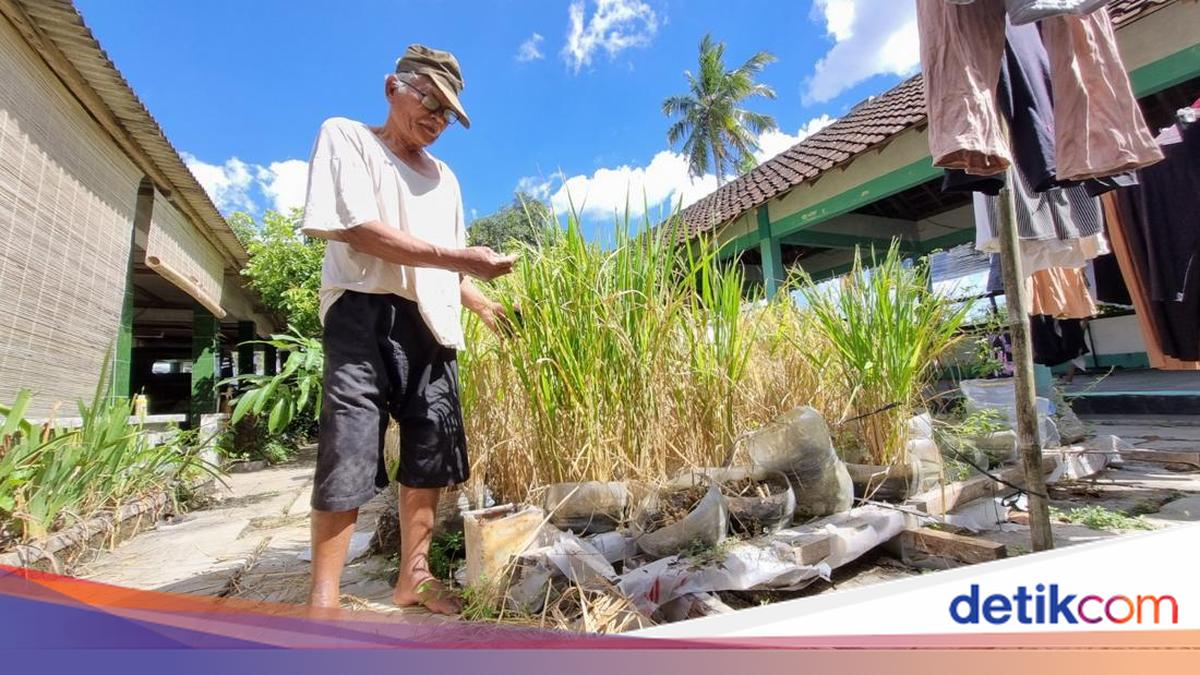
Suhantara, an 82-year-old resident of Susukan II, Genjahan, Ponjong, Gunungkidul, has revealed a series of advantages to growing rice using recycled gallons and cans. Besides not requiring a hoe or plough, pest attacks from rats and leafhoppers are much easier to monitor.
"There are many advantages to planting rice using gallons, used cans, and old buckets," Suhantara said when met at his home on Tuesday.
Firstly, he explained, starting does not require a large outlay. In detail, he mentioned that people only need to buy used gallons. If they have unproductive land, they can take the soil from there, and rice seeds can be produced independently.
"At most, you just add the cost of fertiliser, both manure and chemical fertiliser. As for water, everyone has access to water, and you don’t even need to water them every day. So this method of planting rice in gallons is very, very affordable," he said.
Furthermore, planting rice in gallons eliminates the need for hoeing and ploughing. Growers can also monitor their plants directly.
"Another advantage is that pests and diseases can be monitored directly. For instance, if there are leafhoppers or rats, we can know immediately and take action," he stated.
Suhantara also revealed that the used gallons can be reused repeatedly. The growing medium can also be used twice.
"There is no need to hoe. Once the medium is dry after harvesting, you just turn it over, add fertiliser, and it can be replanted. Moreover, the gallons are durable and not single-use," he said.
Suhantara has developed what he calls ‘scrap rice fields’, cultivating rice in used gallons and cans in his yard. Each gallon can produce hundreds of grams of dry unhusked grain at harvest.
He explained that the idea originated when he harvested rice from his fields in 2025.
"I brought the dry grain home and some of it spilled on the ground. The spilled grain grew into seedlings," Suhantara recounted.
He noted that the rice variety was Inpari-24. He was inspired to plant the seedlings in several used cans. The plants were given fertiliser and cared for.
"I watered the seedlings in the cans regularly and they grew well. Because they grew well, I had the idea to enlarge the container, since the cans were small," he said.
From there, the bespectacled grandfather tried buying used gallons in bulk. He chose gallons because they can be split into two.
"I bought about 100 gallons, I think, at a price of Rp 2,000 per gallon. Then I filled these gallons with any soil, added manure and a little chemical fertiliser, and planted the rice seeds," he said.
After that, Suhantara watered them thoroughly. He then placed the gallons in an open space to get sunlight.
"So it’s actually like planting rice in a paddy field, only this uses gallons. When the water runs out, you water it again until full. Because I use used gallons and cans, I call it a scrap rice field," he said.
Watering is done when he returns from farming in the fields, usually in the late afternoon or evening. However, watering is not done every day.
"Any type of rice seed can be used, nothing special. After three months, the rice can be harvested," he said.
He admitted to having harvested rice from the gallons four times. One gallon can be planted with two to three rice plants.
"The yield from one gallon with three rice plants can produce around 130 grams of dry unhusked grain. For the hybrid variety that was tested, the growth was denser, with one seedling producing up to 30 tillers before harvest time. When harvested, it could yield 300 to 400 grams of dry unhusked grain per gallon," he said.
According to his calculations, with just 100 gallons, one could produce 30 to 40 kilograms of dry unhusked grain, provided hybrid rice is used.
"Therefore, I hope many people will follow what I am doing. If you want to learn, please come to my house and we can learn together. Moreover, the cost is cheap; you only need to buy gallons and fertiliser," said the chairman of the Genjahan Makmur Farmers Group.
Suhantara added that currently, eight of his members are already planting rice using gallons in their yards. He hopes this number will continue to increase as it does not require large capital.
Source: jawawa.id (https://jawawa.id/newsitem/no-fuss-farming-rice-grown-in-used-containers-in-ponjong-makes-pest-monitoring-easier-1783421562)
Originally published by detikJogja (https://www.detik.com/jogja/berita/d-8563910/anti-ribet-sawah-dari-galon-kaleng-di-ponjong-lebih-mudah-pantau-hama), translated from Indonesian