
No country can advance without self-sufficiency: Coordinating Minister
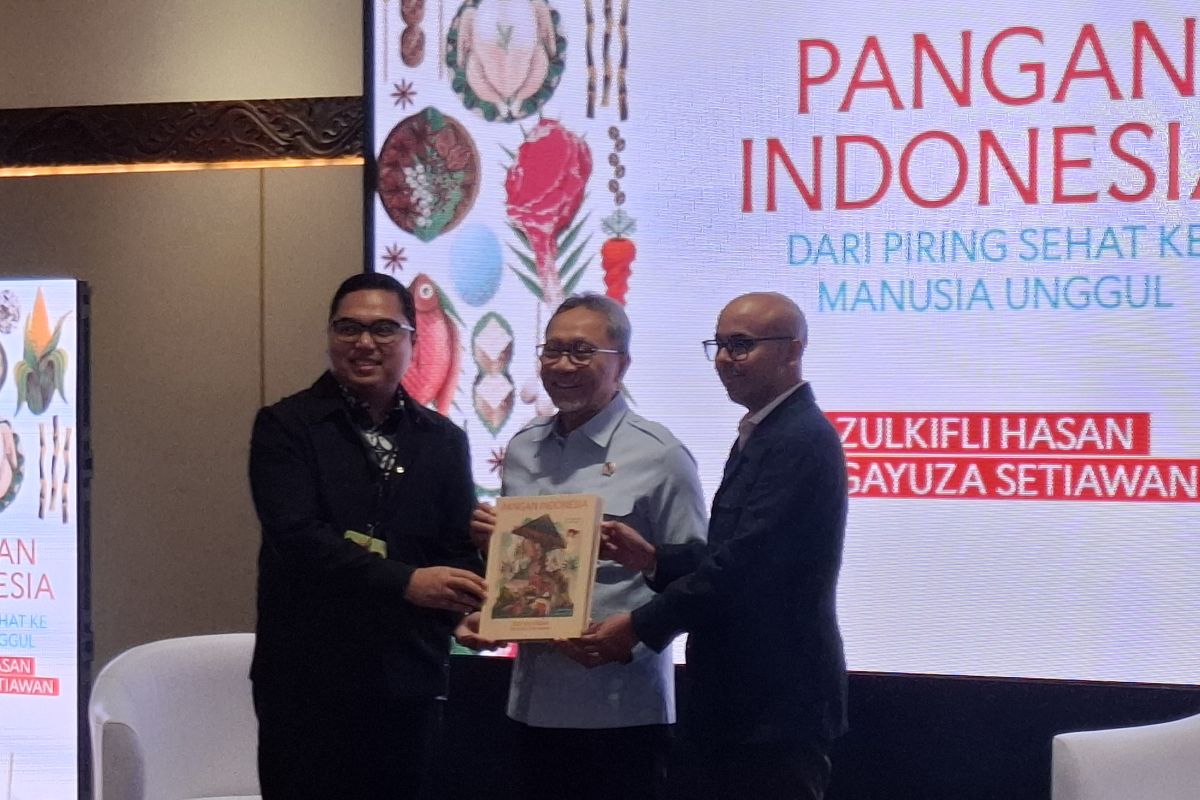
“No country can become advanced without self-sufficiency. Therefore, President Prabowo has said that self-sufficiency is a matter of honor,” Zulhas said in Jakarta on Friday.
According to Zulhas, food issues are not solely about food availability but also about the livelihoods of farmers, fishermen, and livestock breeders who form part of the national food production chain.
He made the remarks at the launch of the book Indonesian Food: From a Healthy Plate to Superior Human Resources, which he co-authored with Presidential Special Assistant for Communications and Policy Analysis Dirgayuza Setiawan.
Zulhas said the book seeks to make complex food issues easier for the public to understand, ranging from government policies to their links with national sovereignty and the country’s future.
“Eating is not simply about having rice and side dishes on a plate. We will begin to understand how important food is, because it concerns our sovereignty, our civilization and our future,” he said.
As part of the government’s national food policy, President Prabowo Subianto said in August 2026 that Indonesia had achieved self-sufficiency in eight food commodities: rice, corn, sugar for domestic consumption, chicken meat, chicken eggs, shallots, large chilies, and bird’s eye chilies.
The government is still targeting self-sufficiency in several other commodities. Prabowo said Indonesia aims to achieve self-sufficiency in garlic within three years, while self-sufficiency in beef and buffalo meat is targeted within five to six years.
On the producer side, Statistics Indonesia (BPS) recorded a national Farmers’ Terms of Trade (NTP) index of 129.19 in August 2026, up 1.05 percent from July 2026.
During the same period, the Fishermen Terms of Trade (NTN) rose 0.50 percent, from 108.49 to 109.04. The increase was mainly driven by several fishery commodities, including tuna, Indian mackerel, marine shrimp, and anchovies.
Zulhas said food producers still need to be strengthened, including fishermen who face limited bargaining power when selling their catches.
“Because fishermen have no bargaining power and no support, no matter how hard they work, when they catch fish they still have little bargaining power. Buyers offer low prices, and if they do not sell, the fish will spoil,” Zulhas said.
The government is also expanding the Red and White Fishermen’s Villages (KNMP) as part of efforts to strengthen the fisheries sector. As of August 2026, 100 fishermen’s villages had been developed, with the government targeting 1,386 villages to be established and operational by the end of December 2026.
Speaking at the same event, Dirgayuza said one of the inspirations for writing the book came from a speech by Indonesia’s first president, Soekarno, on the need to increase food production in order to achieve self-sufficiency and food sovereignty.
“I was inspired, together with Mr. Zul, to write this after reading in full President Soekarno’s speech when he inaugurated the Bogor branch of the University of Indonesia, which is now IPB University,” Dirgayuza said.
He said the idea places consumption and production as two interconnected sides in determining a country’s ability to meet its food needs.
“That speech was very strong mathematically because President Soekarno believed that, ultimately, it came down to mathematics. How much we consume determines how much we need to produce,” he said.
Dirgayuza said the approach subsequently became one of the foundations of the book’s discussion, viewing food not only through production figures but also through the food consumed by the public and where it comes from.
Zulhas said he hoped that discussing food through an approach closely connected to people’s daily lives would broaden public understanding of the importance of food independence to economic sustainability, producer welfare, and Indonesia’s future.
Related news: Indonesia’s food security remains secure amid El Nino, minister says
Related news: Indonesia to export 1,000 tons of premium rice to Malaysia
Translator: Aria, Azis Kurmala