
Ning Wahyu Re-elected to Lead Apindo West Java, Investment and Job Creation Top Priorities
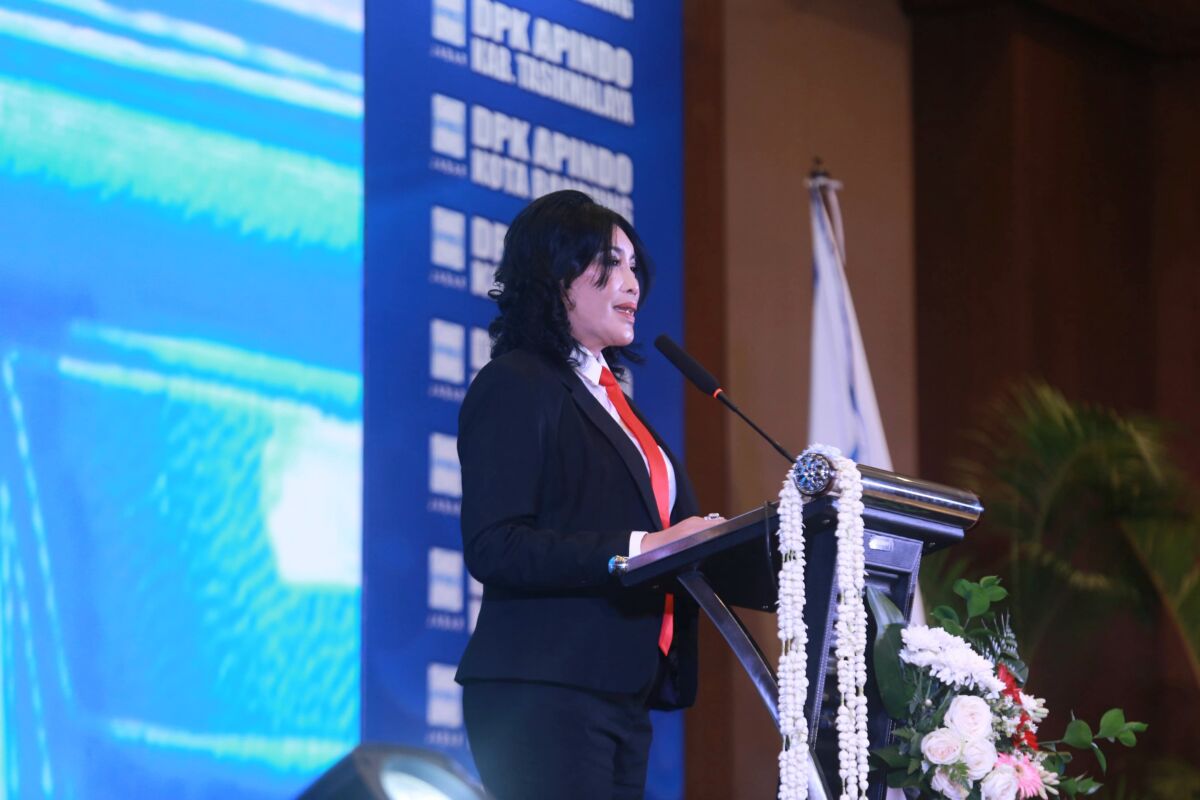
BANDUNG – The Chairwoman of the Indonesian Employers’ Association (Apindo) for West Java, Ning Wahyu Astutik, has affirmed that job creation will be the main focus of her leadership for the 2026-2031 period. This target will be pursued by maintaining a conducive investment climate to attract new investors to West Java, while ensuring existing industries remain resilient amid global economic uncertainty. Ning Wahyu was officially re-inaugurated as Chairwoman of Apindo West Java by Apindo Chairwoman Shinta W. Kamdani at a ceremony held at the El Royal Hotel in Bandung on Friday (26/6/2026). “My priority in this second term is to ensure that jobs in West Java remain available. The way to do this is by continuing to invite investors to come to West Java,” said Ning. According to her, West Java remains highly attractive to investors due to its large population providing a workforce, extensive industrial zones, and a local government deemed responsive in facilitating licensing processes and resolving investment issues. Beyond encouraging new investment, Apindo will also strengthen its role as a strategic partner to the government and as a think tank in economic policy formulation. Strengthening the organisation down to the regency and city levels is also an important agenda, enabling regional Apindo branches to collaborate with the government in driving economic growth. Ning assessed that various measures taken by the West Java Provincial Government have created an increasingly conducive business climate. She appreciated the government’s rapid response to various business issues, ranging from the formation of a team to tackle thuggery, improving human resource quality through job training, to accelerating the resolution of investment obstacles. Nevertheless, she hopes that several issues still concerning business actors, such as electricity supply, water usage restrictions, and land permit certainty, can be resolved promptly. According to her, certainty is one of the main factors investors consider when making business decisions. On the other hand, Ning acknowledged that global economic conditions are beginning to put pressure on several companies, especially industries dependent on export markets. A decline in demand from the United States and the Middle East has led some companies to consult with Apindo regarding steps to sustain their businesses. “There are about four to five companies that have met with me. They are asking for advice on the conditions they are facing,” she said. She explained that consumers in export destination countries are now prioritising spending on energy needs over purchasing consumer products such as clothing and footwear. As a result, export orders have dropped quite significantly, suppressing company production activity. Despite this, Ning stressed that layoffs must be a last resort. Apindo encourages companies to first seek various alternatives, such as reducing working days, cutting overtime hours, or adjusting operational hours so that employees can keep their jobs. “If six working days is too heavy, it could become five or four days. Working hours can also be adjusted. The important thing is that employees keep working even if their income is reduced. That is far better than losing a job,” she said. In addition to weakening export demand, rising logistics costs due to increased fuel prices also pose a new challenge for the business world. Therefore, Apindo is encouraging companies to start expanding their domestic markets so they do not rely solely on exports. Meanwhile, Apindo Chairwoman Shinta W. Kamdani assessed that West Java remains one of the most promising investment destinations in Indonesia despite the global challenges facing the business world. According to her, the narrative of an industrial slowdown due to layoffs needs attention. However, at the same time, various new industrial sectors are also growing, meaning economic opportunities remain wide open. Shinta noted that investment realisation in West Java throughout 2025 reached Rp296 trillion, the highest nationally. This achievement shows that investor confidence in West Java remains very high. Besides being the second-largest contributor to the national Gross Regional Domestic Product with economic growth of around 5.85 percent, West Java also recorded export values of approximately 38 billion US dollars, contributing around 13.5 percent to total national exports. She added that more than 70 percent of West Java’s population is of productive age. Currently, about 55 of the 170 national industrial zones are located in the province, supported by agricultural sector potential with rice production reaching around 9.47 million tonnes and a contribution of more than 20 percent to the national creative economy GDP. New opportunities are also opening up through the development of green investment, such as solar, hydro, and micro-hydro power plants. Despite being optimistic about investment prospects, Shinta reminded that the business community is still awaiting the drafting of a new Manpower Bill. She said the regulation must be able to accommodate the interests of both workers and business actors in a balanced manner. “A new Manpower Bill is currently being drafted. This is an important momentum for us to have a law that is a win-win solution. There must be no party that wins and no party that loses,” said Shinta. On the same occasion, West Java Governor Dedi Mulyadi emphasised that the success of industrialisation depends not only on the amount of incoming investment but also on the ability of all stakeholders to build communication and solve problems together. “When talking about industry, people cannot step on each other or pressure each other. We must talk to each other, and all problems must be solved together,” said Dedi.