
Nine Warning Signs Have Emerged: Is the World Heading for a Crisis?
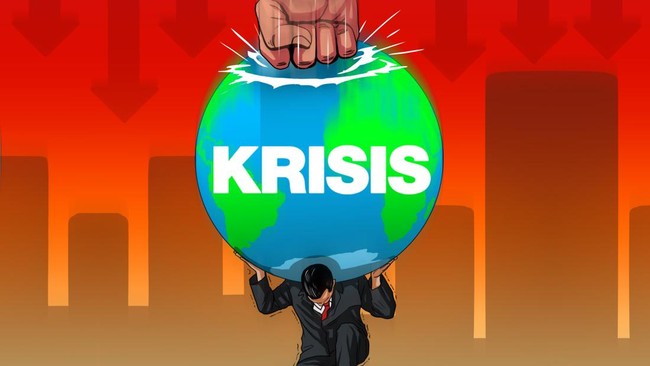
Jakarta, CNBC Indonesia – As October 2026 and the final quarter of the year get under way, the global economy is still grappling with problems that show no signs of easing. New challenges continue to emerge, adding to existing pressures.
The war between the United States and Israel on one side and Iran on the other, which began in late February, has yet to subside. The conflict has disrupted global energy supplies and trade, kept oil prices high and put renewed upward pressure on the prices of goods and services.
At the same time, several central banks have raised interest rates again to curb inflation. This has made borrowing more expensive, while many countries are already carrying very large debts.
The problems do not end there. Increasingly extreme weather threatens food production, while several international trade routes remain disrupted.
These pressures are building as the global economy has yet to recover fully from a series of shocks over the past few years.
CNBC Indonesia has identified nine warning signs suggesting that the global economic outlook is becoming increasingly worrying.
1. The world is becoming more reliant on debt
Debt is one of the biggest challenges facing the global economy. The Institute of International Finance (IIF) reported that global debt reached US$365.5 trillion at the end of the first half of 2026, an increase of more than US$10 trillion in just six months.
The total covers government, household, financial-sector and non-financial corporate debt, and is equivalent to about 311% of global gross domestic product (GDP).
The International Monetary Fund (IMF) has also warned that global government debt is expected to reach 100% of GDP by 2029, up from nearly 94% in 2025.
The United States is a prominent example. According to US Treasury Department data, outstanding federal public debt stood at US$40.33 trillion as at 8 October 2026.
That level of debt means the US government must allocate a very large sum to interest payments. The Congressional Budget Office (CBO) estimates that net interest payments on US debt will reach US$1.143 trillion in the 2026 fiscal year, up from US$1.028 trillion the previous year.
That figure exceeds defence spending of US$916 billion and Medicare health spending of US$1.069 trillion. The situation illustrates how growing debt and interest costs can leave governments with less room to fund public needs.
2. The cost of borrowing is becoming more burdensome
Debt becomes an even heavier burden as borrowing costs rise. In the United States, yields on 10-year Treasury securities moved back above 5% in October 2026.
After nearing 5.3%, the 10-year Treasury yield fell to about 5.09% in trading on Thursday (15 October 2026).
Similar pressure is evident in other developed economies. The IMF reported that average 10-year government bond yields across the G7 rose by more than 110 basis points between February and September 2026.
Higher yields mean governments face greater costs when issuing new debt or refinancing maturing loans. The effects can also reach businesses and households through higher lending rates, potentially holding back investment and consumption.
3. Inflationary pressure
Inflation has again become a threat to the global economy after showing signs of easing. In the United States, annual inflation rose to 3.7% in September 2026, from 3.4% in August.
The Consumer Price Index (CPI) increased by 0.6% month on month, driven in part by a 9.1% jump in petrol prices.
Producer-level pressure was greater. The Producer Price Index (PPI) surged 1.3% month on month in September, its largest increase since March 2022. Producer prices rose 6.3% year on year, up from 5.6% previously.
A similar trend is unfolding in Europe. Eurozone inflation is estimated to have risen to 3.8% in September, from 3.2% in August.
Rising energy prices are one of the main causes. If the trend continues, it could erode household purchasing power and weigh on consumption.
4. Central banks raise interest rates
Renewed inflation has forced several central banks to tighten monetary policy.
In September 2026, the US Federal Reserve (the Fed) raised interest rates by 25 basis points to a range of 3.75%–4.00%. A further increase remains possible, particularly after the latest inflation data showed that price pressures had not eased.
The Bank of Japan (BoJ) also raised its rate to 1.25% in September, its highest level in more than three decades. Meanwhile, the European Central Bank (ECB) increased rates by 25 basis points, taking its deposit facility rate to 2.50%.
Higher rates can help control inflation. However, more expensive borrowing can also prompt households to cut spending and businesses to delay investment. If maintained for too long, such policies risk slowing economic growth.
5. A widening war
Nearly eight months after the United States and Israel attacked Iran on 28 February 2026, the war has yet to end. The conflict has spread, with attacks targeting key facilities in Gulf states.
Yemen’s Houthi group has stepped up attacks on Saudi Arabia, including on King Khalid International Airport in Riyadh and Saudi Aramco energy facilities. According to the Saudi-led coalition, Riyadh airport came under 20 attacks during October, leaving 17 people dead and 333 injured.
On Thursday (15 October 2026), the Houthis also attacked the presidential palace complex in Aden, Yemen, killing five people.
The widening war is forcing countries in the region to spend more on defence and infrastructure recovery. Insecurity could also disrupt investment, tourism and international trade.
One of the biggest consequences of the protracted conflict is the disruption to global energy supplies, particularly oil, a vital resource for many countries.
6. High global energy prices
The war with Iran has kept global oil prices elevated through mid-October 2026. On Thursday (15 October 2026), Brent crude settled at US$105.92 a barrel, while West Texas Intermediate (WTI) stood at US$97.97.
Although prices have fallen from their peak, Brent remaining above US$100 a barrel continues to weigh on economic activity.
The International Energy Agency (IEA) reported that global oil stocks had fallen by about 509 million barrels compared with their level at the end of February 2026, before the war began.
Supplies of other fuels have also been disrupted. Global diesel exports in September were down by about 700,000 barrels a day compared with the same period a year earlier.
High energy prices can raise transport and production costs, which may ultimately be passed on to consumers through higher prices for goods.
Pressure on oil supplies is harder to address because several energy shipping routes in the Middle East are still not fully secure.
7. Global energy trade routes remain unsafe
Disruption to global oil supplies is closely linked to the state of energy trade routes in the Middle East.
The Strait of Hormuz, which carried about a fifth of the world’s oil supply before the war, remains under security threat. An IEA report on Wednesday (14 October 2026) showed that oil flows through the strait reached 10.9 million barrels a day in September.
That volume has begun to recover, but has not returned to pre-war levels.
Saudi Arabia is also seeking to divert some oil shipments through its East-West pipeline network to Yanbu port on the Red Sea. However, the pipeline was itself targeted in an attack. Ships bound for Asia must also contend with threats from the Houthis near the Bab el-Mandeb Strait.
The situation leaves global oil distribution routes vulnerable to further disruption, with the risk of additional shipping costs for energy-importing countries.
8. The Panama Canal is constrained
While war has disrupted trade routes in the Middle East, one of the most important waterways in the Americas is facing a different adversary: water scarcity.
The canal, about 82 kilometres long, connects the Atlantic and Pacific oceans. Each ship that passes through uses fresh water from Gatun and Alhajuela lakes to operate the system.
The problem has emerged as rainfall becomes less frequent. Rainfall in the Panama Canal watershed from May to August was about 34% below average, while inflows to the reservoir lakes fell by around 44%.
The Panama Canal Authority has therefore begun reducing ship traffic. The daily transit limit was cut from 36 to 34 vessels on 4 September, then lowered again to 32 from 15 September. From October, the number of ships allowed through was planned to fall to about 29.5 a day.
The Panama Canal carries about 5% of global trade and around 40% of US container traffic.
As the number of ships is reduced, queues grow longer. Goods arrive later and shipping costs rise. Some vessels have to carry less cargo to pass through the canal at lower water levels.
Another option is to take the longer route around the southern tip of the Americas or use alternative routes. The additional distance requires more fuel, making this an increasingly expensive choice.
9. Weather and harvests pose further threats
Alongside war and economic challenges, the world faces the threat of an El Niño phenomenon that is expected to strengthen towards the end of 2026.
In a report on Thursday (8 October 2026), the World Meteorological Organization (WMO) warned that sea-surface temperatures in the tropical Pacific could reach very high levels between October and December.
The phenomenon is expected to peak in December 2026, with the probability of it persisting until February 2027 approaching 100%.
El Niño can alter global rainfall patterns, bringing drought to some regions and floods or excessive rain to others. Agriculture is among the sectors most at risk, as both drought and flooding can reduce harvests.
The threat is compounded by higher costs for fertiliser, fuel and transport facing farmers. If food production is disrupted, the prices of staples such as rice, maize, sugar and vegetable oils could rise.
Taken together, these issues show that the global economy is under pressure from multiple directions, from debt and inflation to war and the threat of extreme weather, all of which could hinder the global recovery.
Source: jawawa.id (https://jawawa.id/newsitem/nine-warning-signs-have-emerged-is-the-world-heading-for-a-crisis-1792137053)
Originally published by CNBC Indonesia (https://www.cnbcindonesia.com/research/20261016111444-128-776814/9-tanda-bahaya-ini-sudah-muncul-dunia-menuju-krisis), translated from Indonesian