
Nine State-Owned Logistics Firms Consolidated Under PT Pos, Targeting Rp3,600 Trillion Market
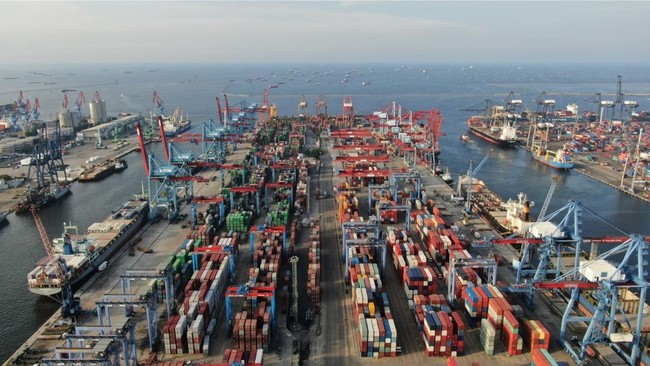
The government, through the Ministry of State-Owned Enterprises (BUMN) and the Danantara Indonesia Investment Authority (BPI Danantara), is undertaking a transformation by consolidating logistics companies from various BUMN subsidiaries and sub-subsidiaries. These logistics business lines will ultimately be housed under PT Pos Indonesia (Persero).
President Director of PT Pos Indonesia, Daud Joseph, stated that this step is one of four main pillars in the portfolio management of Danantara Asset Management (DAM) and has been incorporated into the company’s Long-Term Plan (RJPP) as a priority programme for the 2026 Work Plan and Budget (RKAP).
He explained that there are currently around 15 state-owned logistics entities operating separately, leading to business fragmentation, duplication of functions, and limited business scale. This situation has resulted in state-owned logistics firms holding a relatively small market share of less than 3%, despite possessing assets and networks spread across various regions of Indonesia.
“Because they operate independently, their business scale is also very limited. Out of the Rp3,000 trillion logistics market, these companies only capture less than 3%. It is very small,” he said during a hearing with Commission VI of the House of Representatives (DPR) in Jakarta on Monday.
“Their businesses also overlap; they occupy the same routes, compete for the same customers, and in terms of capability, they sometimes cannot complement each other when one is full on the outbound journey but empty on the return. So each moves in its own field independently.”
Significant opportunities arise from the national logistics industry’s growth, estimated at around 6% per year, particularly in the freight forwarding and warehousing sectors. He detailed that the national logistics market value was recorded at approximately Rp2,800 trillion in 2022, rising to Rp2,913 trillion in 2023 and Rp3,048 trillion in 2024. The market is projected to grow to Rp3,190 trillion in 2025, Rp3,372 trillion in 2026, and reach Rp3,617 trillion by 2027.
Daud explained that on 1 July 2026, seven state-owned logistics companies will merge into PT Multi Terminal Indonesia (MTI) as the initial stage of forming a logistics holding under Pos Indonesia. The seven companies include PT Multi Terminal Indonesia (MTI) and PT Prima Indonesia Logistik (PIL) under Pelindo, PT Pos Logistik Indonesia (Poslog) owned by Pos Indonesia, PT Sarana Bandar Logistik (SBL) owned by PT Pelni, PT KBN Prima Logistik (KPL) owned by Danareksa, PT Varia Usaha Dharma Segara (VUDS) from SIG, and PT Krakatau Jasa Logistik (KJL), which is part of Krakatau Steel.
In the initial phase, the share ownership will consist of 73% Pelindo, 9% Pos Indonesia, and 17% held by the five other companies. By 2027, all company shares will be fully under Pos Indonesia. In the second phase, the consolidation will be expanded to include cargo owner-based companies, namely PT Semen Indonesia Logistik (Silog), which supports national cement distribution, and PT Pupuk Indonesia Logistik (Pilog), which supports the distribution of fertilisers and their derivative products. “This means there will eventually be nine state-owned logistics companies merged under PT Pos Indonesia,” he stated.
Joseph added that the merger of BUMN logistics entities and their subsidiaries will create broader synergies across their distribution networks. Companies that were previously strong only in certain regions will be able to utilise the networks of other companies to expand their service reach to various areas in Indonesia. “So the number, which today stands at only 78 cumulative points, can later increase to around 150 or even 160 business lines,” he added.
Furthermore, this consolidation is expected to reduce national logistics costs. Previously, each link in the logistics chain was run by a different company, each taking its own profit margin. “After being merged into one company, the profit margin will be singular. This will cut the duplication of profit margins and lower overall logistics costs. If we look at the far-right column of the table, the value is Rp2.38 trillion, that will be the revenue size of this combined company. From this Rp2.38 trillion, it will be able to generate a profit this year of approximately Rp100 billion,” he concluded.