
Nine Skywatching Events in November 2026, Including Three Meteor Showers and a Supermoon
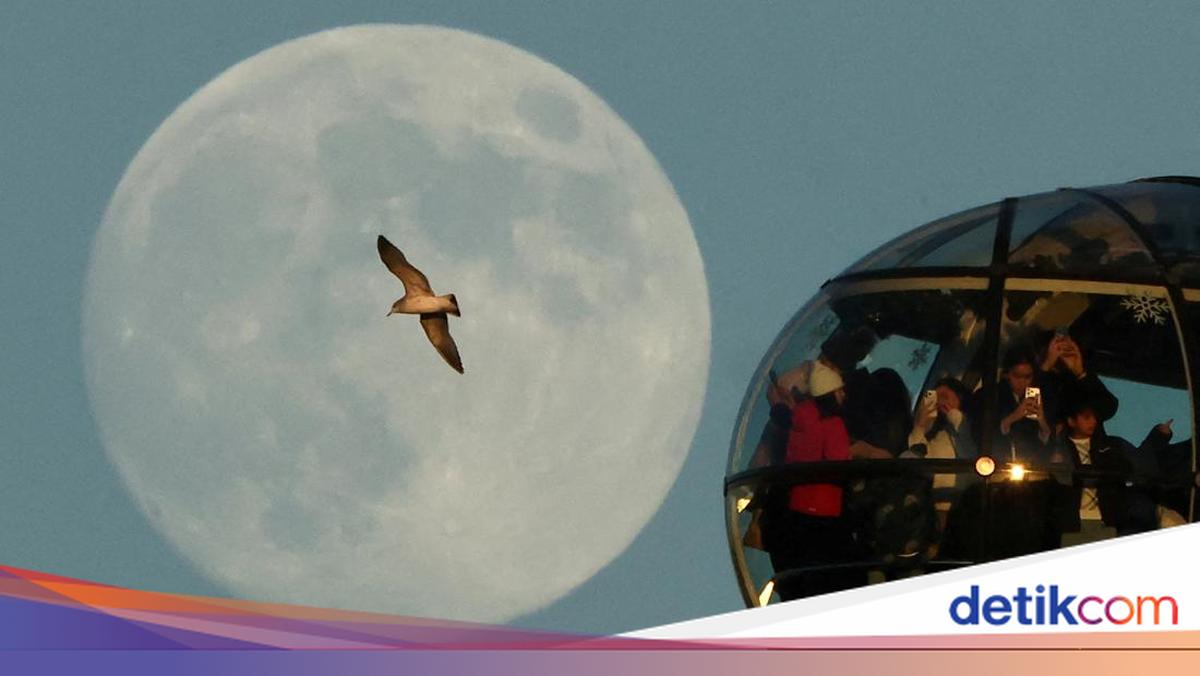
Several astronomical events will adorn the skies throughout November 2026, from multiple meteor showers and apparent close approaches between the Moon and planets to a supermoon.
According to detikEdu, three meteor showers are expected to reach their peak this month. Other events include the New Moon, a planetary parade, Mercury at its greatest western elongation and Uranus at opposition.
Summarised from National Geographic, here are nine celestial events scheduled to take place in November 2026.
- Moon-Mars-Jupiter conjunction (2–3 November)
The start of November will feature a conjunction of the Moon, Mars and Jupiter on 2–3 November 2026. The three celestial bodies are expected to appear close together above the eastern horizon at around midnight.
On 2 November, their angular separation is expected to be only about six degrees. As the night progresses, the Moon and the two planets will appear higher in the sky until just before sunrise.
- Southern Taurids meteor shower (4–5 November)
The Southern Taurids are expected to peak on the night of 4–5 November 2026. This is a low-intensity meteor shower.
Under dark skies, observers may see around five meteors an hour. Although the numbers are modest, the Southern Taurids are known for bright fireballs streaking through Earth’s atmosphere.
- New Moon (9 November)
The New Moon will occur on 9 November 2026, offering a good opportunity to observe deep-sky objects.
The Orion Nebula and the Andromeda Galaxy are among the objects worth looking for. Both are easier to see under dark skies, without interference from moonlight.
- Northern Taurids meteor shower (11–12 November)
Also part of the Taurid family, the Northern Taurids are expected to peak on the night of 11–12 November 2026. Like the Southern Taurids, they produce around five meteors an hour.
The shower is known for its striking, bright fireballs. Viewing is best after midnight, when the constellation Taurus is highest in the sky.
- Planetary parade (14–16 November)
A planetary parade will be visible before sunrise from 14–16 November 2026. Mars and Jupiter will appear close together in the southern sky.
Their angular separation will be only about one degree, roughly the width of a little finger held at arm’s length. Mercury and Venus will also appear above the south-eastern horizon before sunrise.
Uranus will also be in the November sky, but observers will need a telescope or good-quality binoculars to see it.
- Leonids meteor shower (17–18 November)
The Leonids are another astronomical event not to be missed. The shower runs throughout November and is expected to peak on the night of 17–18 November 2026.
The Leonids are known for fast-moving meteors that produce bright flashes. Some may also display distinct colours as they enter Earth’s atmosphere.
- Mercury at greatest western elongation (20 November)
Mercury will reach its greatest western elongation on 20 November 2026. Elongation is the angular distance at which a planet appears from the Sun when viewed from Earth.
At its greatest elongation, Mercury will be at its widest apparent separation from the Sun, making it easier to observe. Optical equipment should be used to protect the eyes while viewing.
- Supermoon (24 November)
A supermoon will be one of November 2026’s most striking events. It is expected on 24 November and will be the first supermoon since January 2026.
This supermoon is known as the Beaver Supermoon, or Beaver Moon. It occurs when the Moon is closer to Earth than usual.
In these conditions, the Moon can appear up to 30 per cent brighter and 14 per cent larger than when it is at its farthest point from Earth, known as apogee.
- Uranus at opposition (25–26 November)
Towards the end of November, Uranus will reach opposition on 25–26 November 2026. Opposition occurs when a planet is on the opposite side of the sky from the Sun as seen from Earth.
This position makes the planet more favourable for observation. A telescope or good-quality binoculars are recommended for viewing the ice giant.
Source: jawawa.id (https://jawawa.id/newsitem/nine-skywatching-events-in-november-2026-including-three-meteor-showers-and-a-supermoon-1793562626)
Originally published by detikBali (https://www.detik.com/bali/berita/d-8733955/9-fenomena-langit-november-2026-ada-3-hujan-meteor-dan-supermoon), translated from Indonesian