
Nine Indonesian Provinces with the Worst and Most Hazardous Air Quality
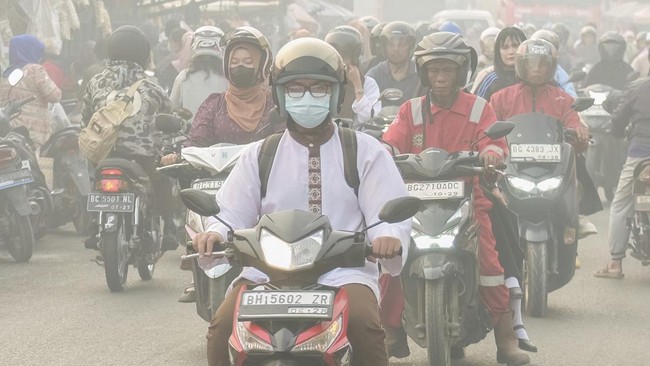
Jakarta, CNBC Indonesia — The Ministry of Environment/Environmental Control Agency (KLH/BPLH) has reported worsening air quality in several parts of Indonesia amid forest and land fires. Some areas in Sumatra and Kalimantan have recorded air quality in the hazardous category.
Edward Nixon Pakpahan, the ministry’s Director of Air Quality Protection and Management, said air quality had declined in several provinces according to monitoring of fine particulate matter (PM2.5). The situation is a concern for the government because it could endanger public health.
At a press conference on the latest response to forest and land fires, broadcast on the official YouTube channel of the Coordinating Ministry for Political and Security Affairs on Wednesday (14 October 2026), Edward outlined air quality conditions across Indonesia. In Sumatra, West Sumatra was reported to have unhealthy air quality.
Riau, meanwhile, had reached the very unhealthy category. Conditions were worse in Jambi, where air quality ranged from very unhealthy to hazardous.
“Jambi Province has reached a very unhealthy air-quality status, and PM2.5 levels are even hazardous,” Edward said at the press conference, as quoted on Wednesday (14 October 2026).
Most areas of South Sumatra have also experienced deteriorating air quality, ranging from unhealthy and very unhealthy to hazardous. Similar conditions have been reported on the island of Kalimantan.
Edward said most areas of West Kalimantan had recorded unhealthy air quality, with some reaching hazardous levels. Central Kalimantan has drawn particular concern because of high levels of air pollution.
“Air quality across Central Kalimantan is hazardous for PM2.5,” he said.
Most areas of South Kalimantan have also seen air quality ranging from unhealthy to hazardous. According to the KLH/BPLH briefing on Wednesday (14 October 2026), the provinces and regions experiencing deteriorating air quality are:
West Sumatra: unhealthy air quality.
Riau: very unhealthy air quality.
Jambi: very unhealthy to hazardous air quality.
South Sumatra: air quality in most areas ranges from unhealthy and very unhealthy to hazardous.
West Kalimantan: air quality in most areas is unhealthy, with some areas hazardous.
Central Kalimantan: air quality is hazardous.
South Kalimantan: air quality in most areas ranges from unhealthy to hazardous.
Sulawesi: air quality in some areas is worsening, moving from good or moderate towards unhealthy.
Papua: air quality in some areas is worsening, moving from good or moderate towards unhealthy.
Edward did not specify which provinces in Sulawesi and Papua had experienced deteriorating air quality. However, he warned that conditions in both regions also warranted attention.
“The same applies to Sulawesi and Papua. Air quality that was good or even moderate yesterday is now moving towards unhealthy. This is a concern for all of us,” he said.
Edward said monitoring trends from September to 14 October 2026 showed that air quality in several areas was becoming increasingly worrying.
He urged people in areas with unhealthy, very unhealthy or hazardous air quality to reduce outdoor activity to protect their health. The government has also advised local authorities to step up air-pollution response measures and public protection, particularly during the forest and land fire season.
Berton SP Panjaitan, acting head of the National Disaster Mitigation Agency’s (BNPB) Data, Information and Disaster Communication Centre, said efforts to tackle forest and land fires were continuing in several parts of Indonesia. At the same press conference, he said firefighting operations were being conducted on the ground and from the air, involving personnel from various agencies.
The BNPB said the personnel and equipment deployed to several provinces were considered adequate. Field reports indicated that, on average, more than 80% of newly burned land was extinguished each day.
In addition to ground operations, the government has deployed 49 aircraft and helicopters to support firefighting, including through water bombing and weather-modification operations. The fleet can be redeployed flexibly according to fire conditions, weather and visibility in each area.
The BNPB acknowledged, however, that extinguishing fires—particularly in peatland—remains challenging. A fire that appears to have been put out on the surface may still be burning beneath the peat. As a result, fires can re-emerge several days later.
“Monitoring and further firefighting efforts are continuing to prevent new hotspots from appearing,” he said.
The BNPB also stressed that sustained rainfall is an important factor in bringing forest and land fires under control comprehensively.
Source: jawawa.id (https://jawawa.id/newsitem/nine-indonesian-provinces-with-the-worst-and-most-hazardous-air-quality-1791982225)
Originally published by CNBC Indonesia (https://www.cnbcindonesia.com/lifestyle/20261014155535-33-776179/9-provinsi-ri-dengan-kualitas-udara-paling-buruk-dan-berbahaya), translated from Indonesian