
Nickel Export Tap Reopened, Here's How Businesses React
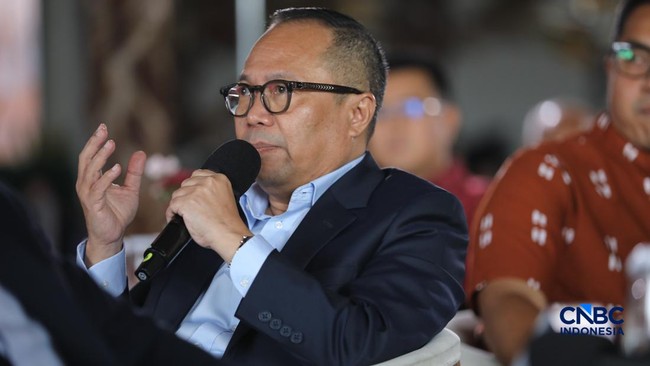
Jakarta, CNBC Indonesia - The Indonesian Nickel Industry Forum (FINI) has welcomed the government’s move to reopen exports of mineral commodities that had been halted for several weeks due to their Rare Earth Element (REE) content.
As is known, the Presidential Staff Office (KSP) has coordinated across relevant ministries and agencies regarding the stalled mineral exports, and it has been agreed that minerals such as nickel, alumina and tin may be exported again, since the REE content within them exists only as a trace mineral rather than the primary commodity.
The policy is seen as providing legal and operational certainty for players in the nickel processing and refining industry.
Chairman of the Indonesian Nickel Industry Forum (FINI), Arif Perdanakusumah, revealed that after the government provided certainty regarding exports, a number of Surveyor Reports (LS) have been issued and shipments of products abroad have resumed.
“Many surveyor reports have already been issued, and many ships that were previously held back have now set sail,” Arif told CNBC Indonesia on Tuesday (4/8/2026).
According to Arif, his side has always supported the government’s commitment to safeguarding the sustainability of critical mineral supplies domestically. At the same time, however, he reminded that exports of primary products from processing and refining industries must not be obstructed.
“This policy is expected to serve as a realistic transitional bridge whilst the national industry continues to build its own technological capability to process and refine REEs in a manner that is both technically and economically viable domestically,” he said.
He also expressed hope that the government can promptly issue clear guidelines and technical threshold standards. At the very least, the regulations must be able to clearly distinguish between “commercial REE products” and “naturally occurring trace minerals with very low content”.
“The thresholds set must be based on current industry facts: technology, economics, and the readiness of testing equipment and so forth, so that national nickel export activities can continue smoothly without being overshadowed by legal uncertainty,” he said.
As is known, the government has confirmed that mining commodities containing Rare Earth Elements (REEs) as trace minerals can still be exported. The export ban applies only to REEs as a primary product, not to REE content found in commodities such as nickel.
Head of the Presidential Staff Office (KSP), Dudung Abdurachman, said the understanding was the result of cross-ministerial and inter-agency coordination to provide legal certainty and align the understanding of all parties in implementing exports.
“We would like to convey the progress of that coordination, in which an understanding has been established that the REE export ban provision applies to REEs as a primary product. So yes, exporting REEs as a primary product is indeed prohibited. But not to the REE content found as a trace element in primary mining products and their derivatives,” Dudung said at the KSP office in Jakarta on Monday (3/8/2026).
According to him, this understanding will serve as a transitional guideline for exporters, surveyors and Customs so that they share the same understanding in carrying out the export process. In addition, the government is also preparing a legal opinion from the Attorney General’s Office to strengthen legal certainty whilst the regulatory refinement process is underway.
Dudung said the results of the KSP’s communication with various relevant parties on 31 July 2026 provided certainty for PT Sucofindo to issue 85 surveyor reports that had previously been delayed due to indications of trace mineral content.
The majority of the delayed surveyor reports came from commodity exporting companies, including alumina, copper, cathodes, and nickel-derived commodities.
Mining products containing naturally occurring radioactive elements can also still be exported, as long as the content is classified as Naturally Occurring Radioactive Material (NORM) and meets safety testing and supervision requirements in accordance with regulations.
“Relevant ministries and agencies will also accelerate the refinement of rules concerning REEs and radioactive elements,” he added.