
Nickel Downstreaming Requires Sustainability, Not Just Investment
The rising demand for critical minerals to support the global energy transition is making sustainability standards a decisive factor in the competitiveness of the nickel industry. No longer relying solely on production capacity and large-scale investment, industry players are now required to prove credible Environmental, Social, and Governance (ESG) management practices to maintain access to international markets.
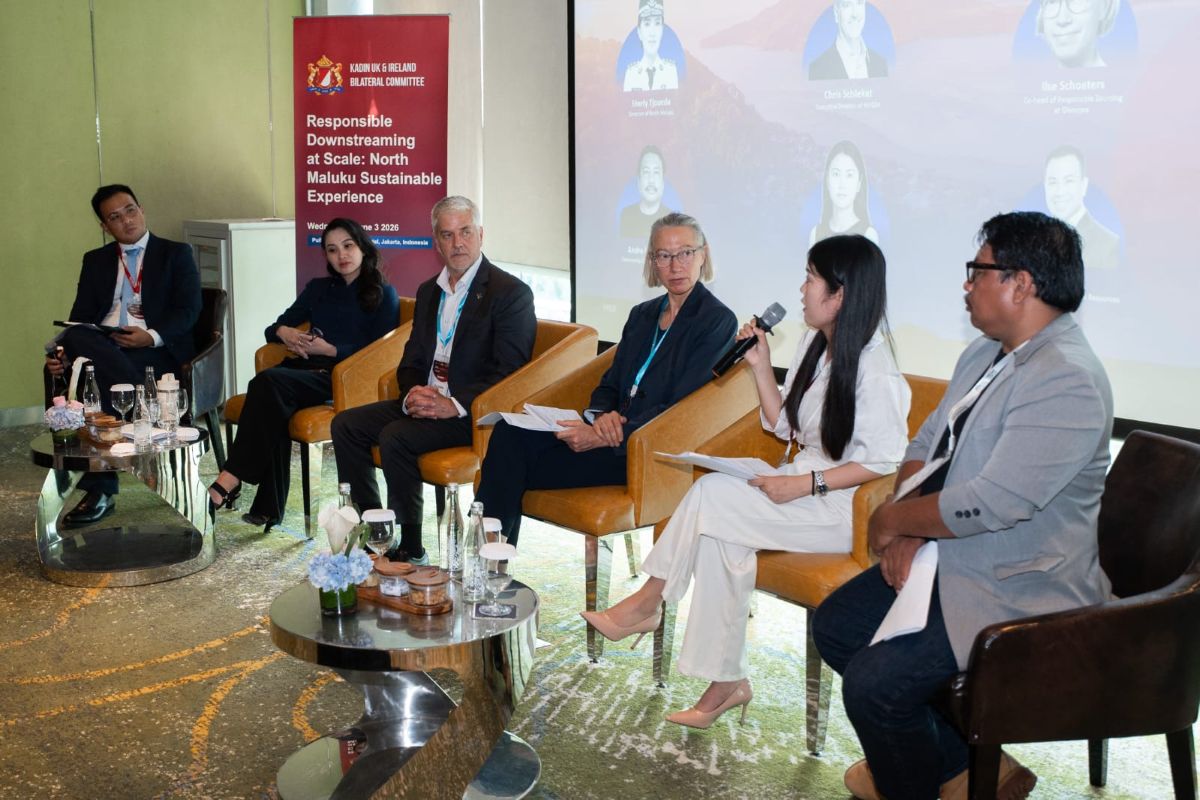
This challenge was a primary focus of the discussion titled ‘Responsible Downstreaming at Scale: North Maluku Sustainable Experience’, organised by the UK and Ireland Bilateral Committee of Kadin (Indonesian Chamber of Commerce and Industry) as part of the Indonesia Critical Minerals Conference 2026. The forum brought together local governments, industry players, international organisations, and various stakeholders in the critical minerals sector to discuss how nickel downstreaming practices in North Maluku can serve as a global reference for responsible and sustainable industrial development.
These discussions are highly relevant given the increasing contribution of downstreaming to the national economy. Realised investment in the downstream sector in the first quarter of 2026 reached approximately IDR 147.5 trillion, with the nickel sector contributing around IDR 41.5 trillion. Ovan Tito, Head of ESDM for the UK and Ireland Bilateral Committee of Kadin, stated that the discussion was part of the North Maluku Sustainability Trip, which previously visited the Indonesia Weda Bay Industrial Park (IWIP) in North Maluku.
According to Ovan, the field visit provided a comprehensive overview of the development of Indonesia’s nickel downstreaming ecosystem, including various industry efforts to enhance sustainability standards. “Many participants arrived with various perspectives and expectations regarding the Indonesian nickel industry. However, after seeing the field operations, the environmental investments made, and the openness of various parties to dialogue, we see an industrial ecosystem operating at a world-class scale that is continuously striving to improve its sustainability standards,” said Ovan.
The impact of downstreaming is evident in the surge of nickel derivative product export values, which jumped nearly tenfold from approximately US$3.3 billion in 2018 to US$34 billion in 2024. This increase reflects the growing added value created domestically. As one of the world’s nickel production hubs, contributing approximately 13-15 per cent to the global supply, North Maluku now holds a strategic role in the international critical minerals supply chain. In the first quarter of 2026, the province’s economy grew by 19.64 per cent, the highest nationally, driven by expanding processing and mining activities.
The Governor of North Maluku, Sherly Tjoanda, emphasised that the success of downstreaming must be measured not only by economic growth and investment but also by the extent to which local communities can directly benefit from industrial development. “Therefore, we are strengthening the education and skills of the community so that more residents of North Maluku can take on larger roles in the industry. We are also encouraging the development of vocational education and polytechnics relevant to the needs of the industrial sector, so that in the future, more local people can fill strategic positions,” she said. Sherly added that industrial development must go hand-in-hand with improving the quality of education, healthcare, infrastructure, and economic opportunities for local residents.
Amidst increasing global attention to ESG aspects, Executive Director of NiPERA, Chris Schlekat, assessed that the ability to demonstrate verifiable sustainability practices will be a key factor in determining future market access for the nickel industry. “In the future, global market access will be increasingly determined by the ability of producers to demonstrate verifiable environmental, social, and governance practices. Therefore, it is important for the industry to refer to credible, relevant, and science-based standards so that claims regarding these practices can be measured objectively,” said Chris.
A similar view was expressed by Ilse Schoeters, Co-head of Responsible Sourcing at Glencore. According to her, the development of Indonesia’s nickel industry is progressing much faster than many other mineral-producing countries. “The Indonesian nickel industry is developing at an extraordinary pace. In less than a decade, industrial zones and complex value chains have grown very rapidly. We see companies that have already shown progress in integrating ESG into their operations, while others are still in the process of building the necessary systems,” she noted.
Meanwhile, Andre Barahamin, Community Outreach Coordinator at IRMA, emphasised the importance of transparency and independent audits to strengthen public, investor, and global market trust in responsible mining practices. “Transparency is not about creating space for mutual blame, but about providing a common foundation for all stakeholders to understand the progress made and the improvements still needed. Independent audits can help companies map out improvement steps more clearly while building trust with communities, investors, and the global market,” said Andre.
Through the strengthening of sustainability standards, transparency, and increased local community engagement, Indonesia’s nickel downstreaming is expected to not only serve as an engine for national economic growth but also to strengthen Indonesia’s position as a major player in the global critical minerals supply chain.