
Nickel and Tin Exports Halted Due to Rare Earth Elements, DPR Demands Resolution
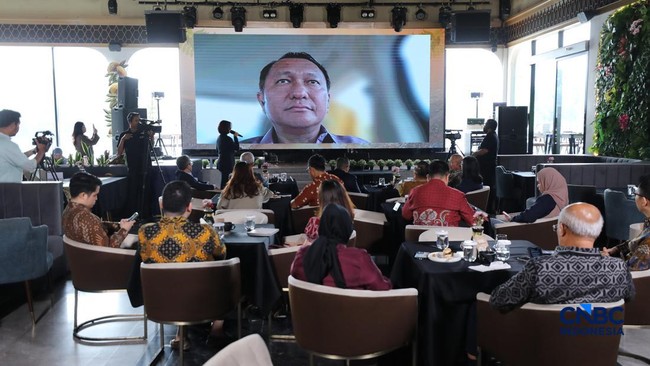
Jakarta, CNBC Indonesia - The Chairman of Commission XII of the Indonesian House of Representatives (DPR RI), Bambang Patijaya, has urged the government, law enforcement, and all stakeholders to convene immediately. This is specifically to resolve the ongoing dispute regarding the halted exports of several mineral products, such as nickel pig iron (NPI), due to governance issues surrounding Rare Earth Elements (REE).
According to Bambang, the current issue is not merely a matter of law enforcement, but is triggered by the absence of clear regulations regarding the governance and threshold levels of REE content in mineral commodities. “The problem we face now is a governance issue. Currently, the government is attempting to control REE raw materials, but the issue is still in its infancy; it is like a BBQ that hasn’t even started burning yet,” Bambang stated during a CNBC Indonesia Coffee Morning event on Friday.
Furthermore, Bambang noted that the situation is exacerbated by conflicts between business actors, where parties are reporting each other’s activities, eventually triggering law enforcement actions in several regions. “This drama has escalated. We saw incidents in Riau Islands involving arrests and such, even though, to my knowledge, inspections had already been conducted in Bangka Belitung,” he added.
Bambang emphasised that the government cannot resolve the issue solely through export bans without considering the resulting economic impact. He argued that there must be a unified perception among ministries, agencies, and law enforcement to ensure that policies do not hinder industrial activity. “The government should sit at one table and clarify the situation, the governance, and the ongoing economic circulation, including the benefits, before making a decision. Otherwise, this will continue. To be honest, a single law enforcement action recently has made everyone fearful,” he said.
In the same event, the Executive Director of the Indonesia Mining Association (IMA), Sari Esayanti, assessed that the current problem is not just about exports, but reflects challenges in the identification, testing, and regulation of by-product minerals naturally found in various mining commodities. According to Sari, mining activities have traditionally focused on primary commodities as per business licences and processing facility designs. In commodities such as tin, bauxite, nickel, and copper, REE are generally only by-products present in very small concentrations.
“Most companies do not yet possess the adequate facilities or technology to economically identify, separate, or utilise these REE elements,” she said. She added that new interpretations regarding the obligation to report or export REE have created uncertainty among business players. “What the industry needs is certainty regarding technical parameters, testing methodologies, and reporting mechanisms, so that all business actors adhere to the same standard.”
Meanwhile, the Chairman of the Indonesian Bauxite Association (ABI), Ronald Sulistyanto, stated that the presence of REE has been known for a long time, but clear governance for handling these elements has yet to be established. “It is a known fact that REE exists. However, how to implement regulations for it is what is needed. We should return to our expertise; mining regulation falls under the Ministry of Energy and Mineral Resources (ESDM). Let’s not look elsewhere,” Ronald said.
He further emphasised that in commodities like bauxite, REE are typically by-products rather than primary products. Therefore, their regulation should be distinguished from primary commodities which have their own specific provisions. Ronald explained that the REE content in processed bauxite products is extremely low because they undergo washing, grading, sizing, and purification into alumina. “This is a cyclical issue we are aware of. Has anyone calculated it? Yes, they have. But it is very small. Is there a specific figure? Yes, though there is still some subjectivity involved,” he concluded.