
Ni Pollok Community Revives 1930s Legong Keraton Lasem at Bali Arts Festival
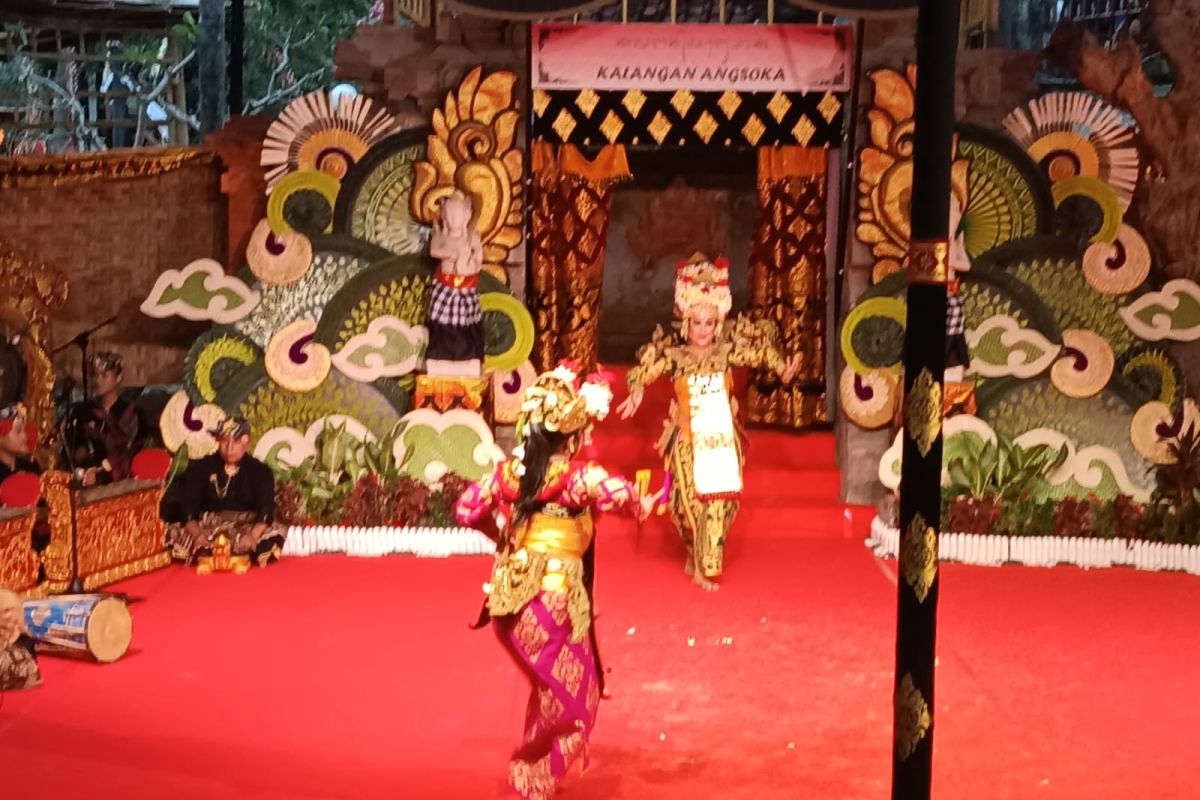
The Ni Pollok Art Community from Banjar Kelandis, Denpasar, Bali, has revived the Legong Keraton Lasem from the 1930s era on the stage of the 48th Bali Arts Festival (PKB) 2026.
“The Ni Pollok Community presents a reconstruction of the classic Kelandis-style Legong Keraton Lasem, an artistic heritage once popularised by the legendary dancer Ni Pollok in the 1930s,” said dance arranger Ida Ayu Gede Sastrani Widiastuti in a statement from the Bali Culture Office in Denpasar on Saturday.
This performance revives the original dance style while maintaining the traditional rules, expressive power, and interpretation of the Raden Panji story, believed to be close to its original form. The figure of Rangda, featured in the Legong Keraton Lasem performance, serves as a symbol of peak magical power and the anger of Raden Inukertapati, embodied through the Rangda character. This element strengthens the mystical atmosphere and brings a powerful ‘taksu’ (spiritual charisma) to the entire performance.
From the opening beats, the 2026 PKB audience—comprising artists, cultural experts, academics, and tourists—remained captivated by the revival of this long-buried Balinese artistic heritage. Beyond the storyline, Ida Ayu Sastrani sought to ensure the performance successfully revived the signature dance techniques of Ni Pollok, known for being energetic yet fluid. Strong body movements, supple shoulders, ‘ngumbang’ footwork, sharp yet subtle ‘seledet’ eye movements, as well as ‘nyregseg’ and ‘nguntang laras’ techniques, were the primary features successfully reconstructed through research and archival documentation.
“The coordinator of the Ni Pollok Community, Kadek Sandra Widari, is a key figure behind this success; she received direct training from Ni Pollok during her lifetime, and subsequently strengthened her understanding of dance techniques through video documentation and in-depth research, allowing the original character of the maestro to be brought back to the stage,” said Ida Ayu Sastrani.
Efforts to preserve this art form received appreciation from art maestro and 2026 PKB Curator, Prof. Dr. I Made Bandem. According to him, the reconstruction is a significant achievement in restoring classical legong aesthetics without losing the inherent sacred values. “They have succeeded in reconstructing and revitalising the Classic Legong Lasem Kelandis; the style has returned to the 1930s era. Congratulations to the dancers and musicians who have brought this artistic heritage back to life,” he said.
According to Prof. Bandem, the uniqueness of the Kelandis-style Legong Keraton Lasem lies in the performance’s conclusion. Unlike general Legong Lasem, which ends with the appearance of the Garuda figure or a ‘gedong’ structure, the Kelandis version features the figure of Rangda. Based on research, the presence of Rangda is not merely a dramatic variation but holds theological and psychological significance that strengthens the narrative arc.
Another 2026 PKB curator, Balinese dance maestro Prof. Dr. I Wayan Dibia, also expressed his impression of the performance. He noted the uniqueness of the arrangement, particularly the ‘janger-nuanced’ musical accompaniment, as the identity that distinguishes this group from other performances. “What I like is the janger-nuanced percussion that is the hallmark of this group; variations like this make the PKB increasingly rich and far from monotonous,” he remarked.
Source: jawawa.id (https://jawawa.id/newsitem/ni-pollok-community-revives-1930s-legong-keraton-lasem-at-bali-arts-festival-1782579115)
Originally published by Antara (Indonesian) (https://www.antaranews.com/berita/5625833/komunitas-ni-pollok-bangkitkan-legong-keraton-lasem-era-1930-di-pkb), translated from Indonesian