
Ngurah Rai Customs Introduces Customs Payment Point for State Revenue Collection
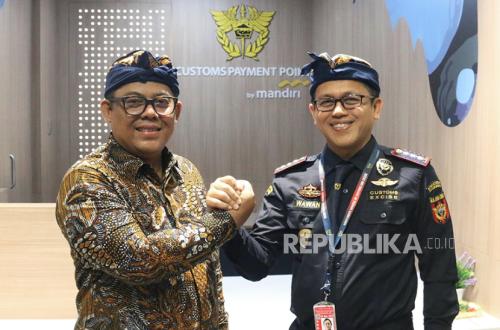
Ngurah Rai Customs inaugurated the Customs Payment Point (CPP) at the International Arrival Terminal of I Gusti Ngurah Rai Airport, Badung, on Tuesday (22/09/2026). This facility was introduced to modernise state revenue payment services and provide convenience for passengers in fulfilling their import duty and Import Duty Related Taxes (PDRI) obligations through banking partners.
The Customs Payment Point is an electronic transaction service point consisting of a physical counter integrated with the State Revenue Module (MPN) to process payments for import duties and PDRI in real time. This service is the result of synergy between Ngurah Rai Customs and Bank Mandiri to support more transparent and accountable state revenue collection.
Through the CPP, payments are made after Customs officers calculate the import duty and PDRI obligations and issue a billing statement as the basis for payment. Passengers then proceed to make the payment at the CPP with the assistance of banking officers available on-site. Once the transaction is successful, passengers receive a State Revenue Receipt (BPN) containing a State Revenue Transaction Number (NTPN), which is then submitted to Customs officers as part of the service process.
This mechanism also clarifies the separation of functions between customs services and payment transactions. Customs continues to perform its customs service functions, ranging from calculating obligations to issuing billing statements and completing services. Meanwhile, the banking sector assists in executing the payment transactions. Consequently, state revenue payments can be deposited directly into the state treasury without passing through a temporary account held by the Ngurah Rai Customs Revenue Treasurer.
The Head of the Ngurah Rai Customs Office, Wawan Dharmawan, stated that the implementation of the CPP also ensures the validity and authenticity of the BPN through the recording of the NTPN in the Directorate General of Customs and Excise (DJBC) system. According to him, this mechanism also encourages cashless payments and improves administrative order in the management of state revenue.
One of the innovations used in this service is the Smart EDC, Bank Mandiri’s latest payment device that supports transactions for Import Duties, PDRI, and administrative sanctions in the form of fines, with direct deposits into the state treasury. Wawan noted that the use of Smart EDC at Ngurah Rai Customs was first implemented nationally on 21 August 2026.
“Its use was first implemented nationally at Ngurah Rai Customs on 21 August 2026 and was officially inaugurated on 22 September 2026,” said Wawan.
He expressed hope that the presence of the CPP could increase public trust in Customs services, particularly through the payment of levies that are directly deposited into the state treasury.
“In the future, we hope the Customs Payment Point (CPP) can increase public confidence through the quality of service and the accountability of state revenue transactions, with levy payments being deposited directly into the state treasury,” Wawan added.
In line with this, the Senior Vice President of Government & Institutional at Bank Mandiri, Hendrianto Setiawan, expressed Bank Mandiri’s commitment to continue synergising with the Ministry of Finance to strengthen the management of state finances.
“Bank Mandiri, as an agent of development, is always ready to synergise with the Ministry of Finance in strengthening the state financial management system. We continue to innovate to create services that are easy, fast, and secure,” said Hendrianto.
Through the implementation of the CPP, Ngurah Rai Customs continues to drive the modernisation of state revenue payment services, prioritising ease of use for service users as well as transparent, orderly, and accountable revenue management.