
Next Level Synthesis and the Sustainability of Higher Education Functions in the AI Era
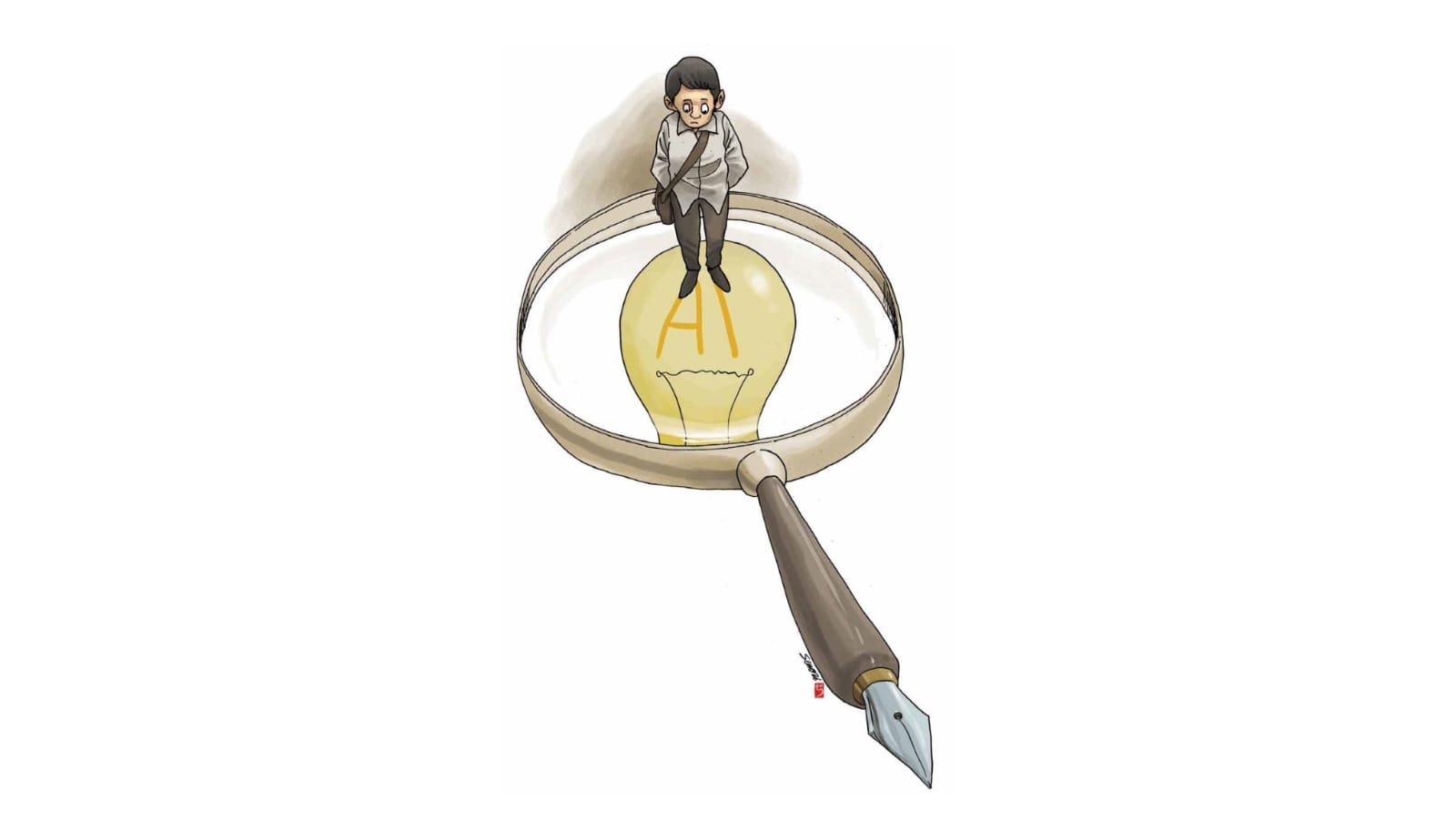
There is a visible trend among students to no longer exert significant mental effort when tasked with developing ideas. Through Artificial Intelligence (AI), frameworks are available within seconds. Initial synthesis—the process of organising and interpreting various pieces of information into a single cohesive idea—can now be performed by machines. The results appear robust, leaving the user with the mere task of assessing whether the output is trustworthy. However, the ability to assess is precisely what is born from the very process of organising that AI has taken over. At this juncture, the sustainability of the function of higher education in producing generations capable of critical and creative thinking is at stake.
AI has long been debated in two poles: as a threat that triggers a decline in thinking capacity, or as a booster of individual productivity. Both perspectives overlook a more fundamental question: what changes in the way people construct ideas and knowledge when machines can perform the initial synthesis?
This question is now a matter of policy. Last March, seven ministers signed a joint decision regarding the use of AI in education. For primary and secondary education, the guidelines are detailed, even including usage zone tables; for higher education, it stops at a framework and basic principles that serve as a reference for university policy formulation. Lecturers are required to implement student learning evaluation models that are free from the negative influences of generative AI, referred to as ‘genai-proof’. The specific implementation is left to individual campuses.
THE SEQUENCE THAT MATTERS
Concerns regarding the decline in thinking capacity are not without basis. A study by Nataliya Kosmyna and colleagues at the MIT Media Lab, which has not yet undergone peer review, recorded the brain activity of 54 essay-writing participants. Neural connectivity decreased as AI assistance increased. In a follow-up session involving 18 participants, the group that transitioned from using AI to working without it still showed low connectivity. What emerged was not understanding, but an ‘illusion of competence’: proficiency on the surface, but conceptually fragile.
However, the same research shows another side. Participants who formulated their ideas independently before using AI showed stronger memory and brain activation compared to those who relied on machines from the start. The tool remains the same, but the impact is opposite. The differentiator is not the AI itself, but the sequence of engagement. This is where a paradigm shift in the use of AI in higher education must be considered.
TWO LEVELS OF SYNTHESIS
I characterise this change with the nomenclature ‘Next Level Synthesis’ (NLS). AI is now capable of taking over the first level of synthesis: collecting and connecting information, organising patterns, and building frameworks of meaning. This produces the initial synthesis. NLS does not simply surrender to this. Instead, individuals formulate their own initial synthesis first, then provide directed prompts to trigger the machine’s synthesis. From there, they move to the next level: pitting their own formulation against the machine’s output, tracing discarded assumptions, and then formulating a new synthesis that does not exist in the machine’s output. In this way, NLS encourages people to always stay one step ahead of AI.
NLS is not merely a renaming of the highest level of Bloom’s Taxonomy—the learning hierarchy commonly used in education—but rather a question of who climbs that ladder and how. Bloom’s taxonomy assumes the ladder is climbed manually: analysis and creation emerge after remembering and understanding. Now, the lower steps are being bypassed by machines. Is it possible for the ability to formulate a new synthesis to grow in someone who has never personally undergone the first level of synthesis? It is difficult to imagine. This ability is not a replacement for the work of organising, but its fruit: only those who have organised manually possess something to contrast against the machine’s output.
WHEN MACHINES ARE WRONG WITHOUT IT BEING VISIBLE
In the NLS stages, what must be anticipated is the potential for AI to make errors in generating the initial synthesis. AI errors often do not appear as errors. For instance, a student asks AI to analyse the impact of minimum wage policy in a certain region. The result is neat, structured, and easy to read. However, the analysis secretly assumes that most workers in that region are in the formal sector, when the reality is the opposite. The machine is not lying; it is simply using a common assumption without stating it. Only someone who has previously constructed their own picture of the regional labour market can catch this error, because only they have something to compare it against.
The same pattern applies to more technical realms. AI is asked to formulate dynamic equations. The result is dimensionally consistent and convincing, but fails to meet boundary behaviour when one parameter is pushed towards zero. Such an error is only recognised by those who have built similar equations from scratch, because the ability to test boundary cases is born during synthesis, not after it. Those who find it tend to go further: tracing the physical assumptions that have silently failed and then reformulating the equation.
This issue of error is more complex than the widely discussed ‘machine hallucination’. Hallucination, in the form of fabricated references or non-existent figures, is relatively easy to catch: one simply traces it back to the source and discovers the source does not exist. The examples above are not hallucinations. The machine is not inventing anything; it is merely selecting a common assumption without mentioning it. There is no source to trace to refute it because the error is not in the data, but in the underlying premise.
ASSESSING THE PROCESS, NOT THE RESULT
These invisible errors can have fatal consequences.
Source: jawawa.id (https://jawawa.id/newsitem/next-level-synthesis-and-the-sustainability-of-higher-education-functions-in-the-ai-era-1788130290)
Originally published by Media Indonesia (https://mediaindonesia.com/kolom-pakar/927763/next-level-synthesis-dan-keberlanjutan-fungsi-pendidikan-tinggi-di-era-ai), translated from Indonesian