
Newspapers Die, the Media Rises
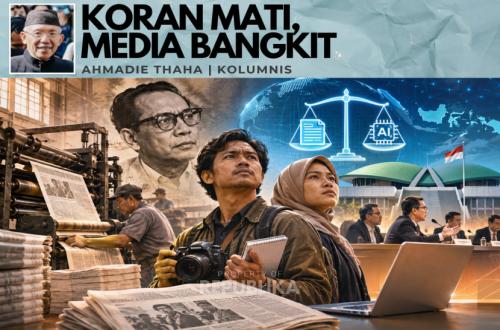
Indonesia’s press is going through a long autumn. Its leaves are falling one by one. Newspapers and magazines that once filled newsstands, waiting rooms, office desks and coffee shops have largely disappeared. Some have stopped printing, some have moved entirely online, and others survive only in the memories of their readers.
The fate of their workers is even more troubling. Journalists, editors, photographers, designers and printing staff have lost their jobs. After spending years sustaining newsrooms, they have suddenly had to seek livelihoods outside the world they once loved. It turns out that journalism can lose sight of its own most important story: the story of redundancies.
The Press Council says that, according to data from the Alliance of Independent Journalists (AJI), more than 800 media workers were made redundant between 2024 and July 2025. The figure does not fully reflect the situation, as some cases have yet to be recorded. The Reuters Institute also noted that AJI reported 549 journalists losing their jobs during 2025.
So when people ask why the quality of journalism is becoming increasingly worrying, we need to consider who can still afford to pay the people who produce it.
Journalism needs working journalists, editors to edit, photographers to report, and companies to pay them. Idealism matters, but it cannot pay a newsroom’s electricity bill.
Against this gloomy backdrop, some people have been willing to take a risk. They have established new media outlets, even reviving the tradition of the printed newspaper. One of the most striking is the daily Swara Indonesia Raya, reportedly printed at a press in Bekasi.
Its name immediately evokes history. The newspaper’s logo displays the word Swara in small lettering, while Indonesia Raya appears much larger. The design seems to revive the name of a legendary newspaper that once made those in power uncomfortable.
Indonesia Raya brings to mind Mochtar Lubis. On 29 December 1949, he founded Harian Indonesia Raya and became its editor-in-chief. He was known as a journalist who fearlessly exposed corruption, abuses of power and other official misconduct. That courage came at considerable risk.
The government banned his newspaper, while Mochtar Lubis himself spent years in detention.
The name Indonesia Raya therefore carries a weighty historical legacy. It recalls a press willing to scrutinise those in power, even at a high cost.
The arrival of Swara Indonesia Raya is certainly intriguing. Its appearance and presentation remind me of Kompas, which continues to maintain a print edition.
I do not know whether the resemblance is intentional. But the emergence of a new newspaper amid the decline of print media deserves attention.
We can only hope that the paper will develop its own editorial identity. A prestigious name and an attractive design merely open the door. The quality of its reporting, editorial courage, rigorous verification and readers’ trust will determine whether a newspaper can survive.
Printing a newspaper in an age when people read the news on their mobile phones is like planting a tree in the middle of a storm. Even so, the courage to plant one deserves recognition.
The real issue is much bigger than the fate of one newspaper. We are facing a transformation in the economics of information that is shifting the centre of power in the media industry.
In the past, press companies had a direct relationship with readers and advertisers. Newspapers sold copies, carried advertisements and built relationships with subscribers. Today, much of the news journey passes through search engines, social media and other digital platforms.
Journalists work hard to uncover information. Editors check the facts. Photographers take pictures. Newsrooms bear the costs of production. Yet when a story is published, digital platforms also benefit from user traffic, readers’ attention and advertising revenue.
This imbalance has led many countries to reconsider the relationship between press companies and technology firms.
Indonesia has already taken a step through Presidential Regulation No. 32 of 2024 on the Responsibility of Digital Platform Companies to Support Quality Journalism.
Now, discussions on amendments to the Copyright Law open a broader chapter: how should the law protect journalistic works when digital platforms collect, display and distribute them, or even use them to train artificial intelligence?
A Reuters report dated 11 November 2026 brought this clash of interests into the open. Google, Meta and TikTok voiced objections at a parliamentary hearing.
The central issue is whether platforms should be required to pay compensation to news publishers when they display links, snippets or news recommendations. The draft also addresses the use of journalistic works to train AI models.
Source: jawawa.id (https://jawawa.id/newsitem/newspapers-die-the-media-rises-1794781241)
Originally published by Republika (https://opini.republika.co.id/berita/tojqrq415/koran-mati-media-bangkit), translated from Indonesian