
New Toll Road Financing Model Requires Stronger Investment Certainty
Efforts to reduce the dependence of toll road development on the State Revenue and Expenditure Budget (APBN) and to enlarge the role of the private sector require the support of a healthy and sustainable investment ecosystem. Regulatory certainty is one of the key factors in keeping investment in the toll road sector attractive, while also providing certainty in long-term planning and investment decision-making for investors.
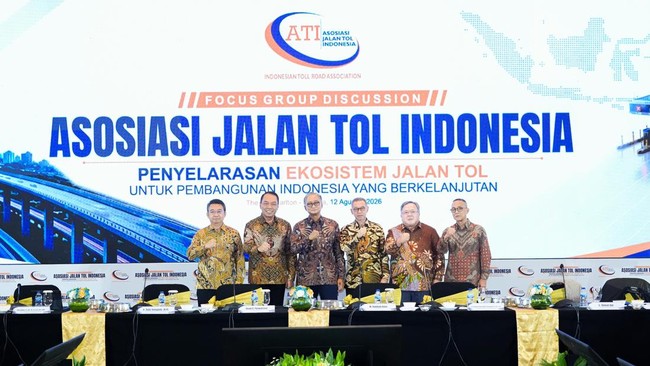
This was one of the main topics of discussion in a Focus Group Discussion (FGD) themed “Aligning the Toll Road Infrastructure Ecosystem for Sustainable Indonesian Development” organised by the Indonesian Toll Road Association (ATI).
The FGD discussed various strategic issues in toll road concessions while opening a space for constructive, strategic and solution-oriented dialogue among stakeholders to align regulatory policies, maintain a viable investment climate, and address the need to promote more sustainable financing models by enlarging the role of private investment and improving the quality of toll road services for the public.
Minister of Public Works Dody Hanggodo emphasised the importance of collaboration among stakeholders in building sustainable toll road infrastructure.
“We cannot walk alone. The government, toll road business entities, the business community, associations, academics, and all stakeholders must move in the same direction. This FGD is a space to unite our steps, not merely to align our views. Because what we are connecting is not just roads, but connecting production with markets, investment with jobs, and growth with prosperity,” said Dody in an official statement on Thursday (13/8/2026).
The discussions in the FGD covered various topics including bankable and sustainable toll road investment, certainty in concessions, consistency with Toll Road Concession Agreements (PPJT), tariff adjustment mechanisms, the application of fair risk sharing principles, and the management of various business changes and dynamics as part of a joint effort to maintain the confidence of investors and financing institutions. Various issues such as toll road integration, utilisation of toll road right-of-way, TIP, and the implementation of MLFF were also discussed collaboratively, taking into account network conditions, service needs, financing structures, and investment sustainability.
Former Head of BAPPENAS and Minister of Finance, Bambang Permadi Soemantri Brodjonegoro, who now serves as Dean & CEO of the ADB Institute, said that toll road development has economic benefits far broader than merely providing transport infrastructure.
“Amidst large development needs and fiscal space that must be managed optimally, private sector involvement is becoming increasingly important. Therefore, we need to build a financing model and concession ecosystem capable of attracting long-term investment, while ensuring that the benefits of toll road development can be felt by the public and the wider economy,” said Bambang.
Meanwhile, former Minister of Finance Chatib Basri, Visiting Scholar at Harvard CID and Visiting Professor in Practice at the London School of Economics, offered his response. In his view, given the current extremely tight APBN conditions, private sector participation in infrastructure development and financing will become very important.
“It is very possible that our APBN has no room, not only to finance infrastructure, but also to provide fiscal incentives for businesses. Therefore, to attract private interest and participation, what can be done is deregulation, licensing ease, and most importantly ensuring that the government and relevant authorities always fulfil the commitments that have been agreed and are binding in contracts signed with concession holders. Moreover, to attract foreign investors who have the freedom to choose where to place their capital, we must certainly be able to offer something more attractive than other countries,” explained Chatib Basri.
On the other hand, Head of Transport, Real Estate, and Urban Studies at the Institute for Economic and Social Research, Faculty of Economics and Business, University of Indonesia (LPEM FEB UI), Muhammad Halley Yudhistira, also contributed his views in the FGD.
“The development of the toll road network provides large economic benefits, and these benefits increase in proportion to the scale of the network built. However, the current pace of development realisation is still far below the need to achieve that target. Because the capital requirement exceeds public financing capacity, accelerating development depends on the role of the private sector. Therefore, promoting a healthy toll road ecosystem is important so that the private sector’s role can be optimised sustainably,” said Yudhistira.
Currently, the length of the operating toll network exceeds 3,115 km with an accumulated investment value reaching Rp668 trillion and projected to approach Rp1,000 trillion, making the toll road industry play a vital role as the backbone of national connectivity and economic growth. Accordingly, the development of the toll road industry needs to proceed in tandem with improvements in service quality and safety for the public.
Chairman of ATI Rivan A. Purwantono said that the toll road industry has now transformed from merely a provider of physical infrastructure into part of the national transport and development ecosystem, playing a role in public mobility, logistics distribution, economic growth, and regional development. Therefore, improving service quality and road user safety must go hand in hand with the sustainability of the investment climate through the alignment of shared policy directions.
“Our orientation at ATI is to realise a toll road industry that continuously improves the quality of public services, makes a real contribution to economic growth, and is supported by a healthy investment climate and effective governance. Ultimately, with government support and good collaboration, we want to build a toll road ecosystem that creates sustainable value for road users, the state, and industry players. Today’s forum is a first step that we need to follow up concretely, both through the formation of working groups and the holding of periodic Focus Group Discussions. The various valuable perspectives and inputs today are important capital for aligning our steps and strengthening a sustainable national toll road ecosystem,” said Rivan.
The holding of this FGD reinforced ATI’s role as a strategic partner of the government in building a healthy and transparent toll road investment climate. ATI is committed to creating a toll road ecosystem capable of generating sustainable value for road users, the state, and the industry as part of national development.
Source: jawawa.id (https://jawawa.id/newsitem/new-toll-road-financing-model-requires-stronger-investment-certainty-1786614770)
Originally published by CNBC Indonesia (https://www.cnbcindonesia.com/news/20260813155639-4-759028/model-pembiayaan-baru-jalan-tol-kepastian-investasi-perlu-diperkuat), translated from Indonesian