
New Snake Species Discovered on Papua Island Named After American Rock Star Slash
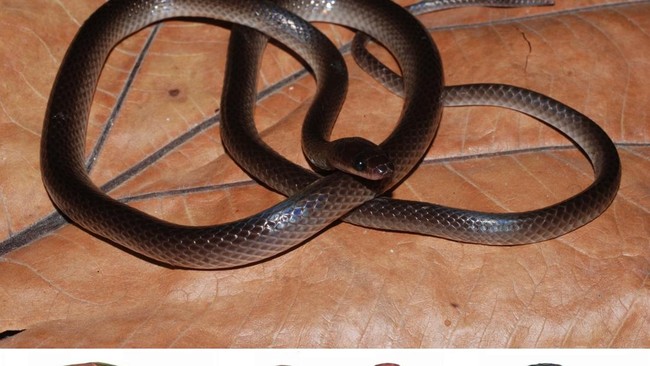
A unique story has emerged from the world of science, this time involving one of the world’s most famous rock guitarists. Scientists have named a new snake species discovered on the island of Papua, specifically in Papua New Guinea, after Slash, the guitarist of the American band Guns N’ Roses.
Researchers from the Field Museum in Chicago, United States, gave the non-venomous ground snake the scientific name Lielaphis slashi in honour of Slash. The reddish-brown reptile, measuring around 71 centimetres in length, is now officially known as Slash’s groundsnake.
Although the species was found on Papua New Guinean soil, the researchers who discovered it are from the United States and therefore had the right to name their find. The naming of animal species discovered by scientists is governed by the International Code of Zoological Nomenclature (ICZN). The person or research team that first scientifically describes a new species and publishes the description in a recognised peer-reviewed journal holds the full right to choose the scientific name (binomial nomenclature) for that species.
Researchers are free to choose a name based on the location of discovery, physical characteristics, the name of a prominent figure, a favourite musician (as in the case of Slash), or even humour, provided it meets the standards of Latin or Greek linguistic rules and is not offensive or insulting.
The name Lielaphis slashi, or Slash’s groundsnake, was not given without reason. The Field Museum described Slash as a lifelong reptile enthusiast and an active supporter of zoos and museums. Slash’s love of snakes has long been evident in his life and music career. In 1994, he even formed the rock group Slash’s Snakepit, which included musicians from Guns N’ Roses, Alice in Chains, and Jellyfish.
In a statement from the Field Museum, Slash said he is a lover of reptiles and amphibians. “I am deeply honoured and humbled that Lielaphis slashi from New Guinea has been named after me,” Slash said. “This is truly exciting. I never imagined a moment like this would come.”
The naming of the snake originated from the interest of Sara Ruane, associate curator of herpetology at the Field Museum and senior author of the study published in the journal Zootaxa. Ruane said her interest in reptiles began in childhood. “In fifth grade, I told my teacher I was going to be a herpetologist when I grew up,” she said.
When she was 12 years old, Ruane received a copy of Reptiles Magazine featuring Slash holding his pet reticulated python on the cover. At that moment, Ruane imagined one day being able to name a snake after Slash. “I thought, I would love to name a snake after Slash. I thought that would be really fun,” she said.
In the magazine interview, Slash also discussed his love of reptiles, museums, zoos, and natural history. Years later, when Ruane had become a scientist and had the opportunity to name a newly discovered reptile species, she remembered that article. “For me, being able to describe and name a species is already a huge honour. It is something most people will never get to do,” Ruane said.
According to Ruane, naming the species after Slash was the perfect complement to the research project. Ruane even accompanied Slash on a tour of the Field Museum when the guitarist visited Chicago. “It felt like talking to someone else who really loves snakes, reptiles, and natural history,” she said.
Ruane also said Slash has an interest in dinosaurs and even knows more about dinosaurs than she does. “If he were not an amazing guitarist, based on my conversations with him, I would say he could be an amazing scientist.”
The discovery of Slash’s groundsnake actually took place quite some time ago. Researchers first found the snake in 2006 when Chris Austin, professor and curator of herpetology at the Museum of Natural Science at Louisiana State University, conducted fieldwork in Papua New Guinea. The island of New Guinea lies north of Australia and is politically divided between Indonesia and Papua New Guinea. The region is known for its extraordinary biodiversity, which remains incompletely studied.
However, researching snakes in the area is no easy task. The dense forests of Papua New Guinea present a challenging terrain for scientists. Researchers must also be cautious because several venomous snake species in the region closely resemble harmless ones. Snakes are also difficult to find because they spend much of their time hiding and remaining still. These conditions mean certain species can escape observation for years.
Physically, the appearance of Slash’s groundsnake did not immediately indicate that it was a new species. Researchers then conducted genetic testing. The results showed that Lielaphis slashi has genetic characteristics distinct from other snakes in the same genus.
Researchers confirmed that Slash’s groundsnake is not considered a threat to humans. The snake is thought to use enlarged teeth at the back of its mouth to catch small lizards and reptile eggs. Unlike constrictors, this snake does not subdue its prey by squeezing. It also does not produce venom capable of seriously harming humans.
Nevertheless, the greatest threat to this species comes from human activity. The forests where Slash’s groundsnake lives face pressure from various industries.
Source: jawawa.id (https://jawawa.id/newsitem/new-snake-species-discovered-on-papua-island-named-after-american-rock-star-slash-1787734317)
Originally published by CNBC Indonesia (https://www.cnbcindonesia.com/tech/20260826123311-37-762329/ditemukan-di-pulau-papua-spesies-ular-baru-diklaim-orang-amerika), translated from Indonesian