
New Republic Established Near Jakarta Immediately Severs Ties with Indonesia
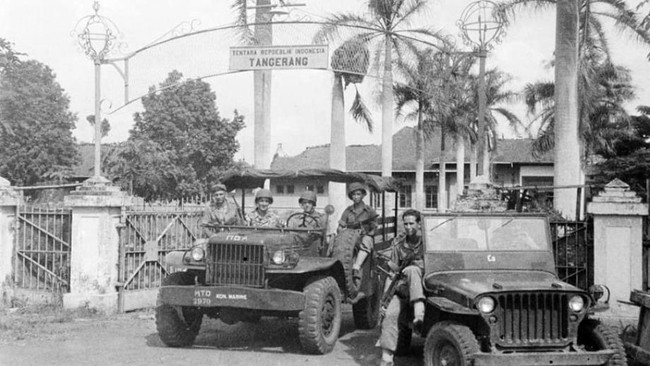
The proclamation of independence on 17 August 1945 did not immediately bring stability to all parts of Indonesia. In Tangerang, for instance, political turmoil even gave rise to a separate government called the Republic of Tangerang, which declared that it had severed ties with the government of the Republic of Indonesia in Jakarta.
The upheaval began in October 1945. One of the triggers was disappointment with Tangerang Regent Agus Padmanegara. According to research titled ‘The Role of KH. Ahmad Khaerun During the Revolution in Tangerang, 1945–1946’ (2019), a number of community groups considered Agus incapable of running the government properly. He was also accused of siding with the Dutch.
That disappointment then turned into a movement to take over the government. On 18 October 1945, in Curug, Tangerang, Ahmad Khaerun coordinated the movement. He even called himself ‘Father of the People’.
The masses then moved towards the residence of Regent Agus Padmanegara. They intended to force Agus to hand over power to the people. However, Agus was not at home.
The regent’s absence did not stop the crowd. The takeover of the government went ahead. The action became known as the sovereignty action. In that action, government officials who had previously worked in Tangerang were removed. Civil servants down to the village-head level were dismissed. The police force was also disbanded.
After the old government’s authority had been seized, Ahmad Khaerun and his group formed a new government.
At a meeting, it was decided that the government of Tangerang Regency would be run by a body called the Dictatorship Body of the Central Council. The body was led by four people: KH Ahmad Khaerun, Sumo, Suwono, and Abas. This government later became known as the Republic of Tangerang.
‘Chaerun appointed himself Regent of Tangerang. Three days later, new officials from the regency down to the ward level were appointed to replace the previous officials. It was also decided that Tangerang would separate from the Republic of Indonesia, and from that moment the Republic of Tangerang was established,’ explained Iip D. Yahya in the autobiography titled Oto Iskandar di Nata: the untold stories (2008).
One decision made the government even more distinct from the government of the Republic of Indonesia. At the meeting, it was affirmed that Tangerang was severing relations with the government based in Jakarta.
In other words, only about two months after Soekarno and Hatta proclaimed independence, a government emerged in Tangerang that chose to go its own way and no longer be under the government of the Republic of Indonesia in Jakarta.
However, Ahmad Khaerun’s government did not run smoothly.
The takeover of the government was followed by a deteriorating security situation. Various groups became involved in disturbances. Conditions that had initially been triggered by government issues developed into chaos marked by robbery, seizure, looting, and even murder.
Anarchism occurred in various places. The new government was unable to create stability in the Tangerang area.
These conditions eventually prompted the military to take action. About three months after Ahmad Khaerun came to power, on 14 January 1946, the People’s Security Army (TKR, now the TNI) under the leadership of Lieutenant Colonel Singih took over the government of Tangerang.
The takeover took place without bloodshed. The authority previously held by Ahmad Khaerun’s government was returned to the Republic of Indonesia.
With that takeover, the brief episode of the Republic of Tangerang came to an end. The government that had declared it had severed ties with Jakarta finally returned to being under the Republic of Indonesia.
Source: jawawa.id (https://jawawa.id/newsitem/new-republic-established-near-jakarta-immediately-severs-ties-with-indonesia-1787115119)
Originally published by CNBC Indonesia (https://www.cnbcindonesia.com/entrepreneur/20260813144523-25-758984/republik-baru-berdiri-dekat-jakarta-langsung-putus-hubungan-dengan-ri), translated from Indonesian