
New Record: Indonesia's Yuan-Denominated Debt Hits All-Time High
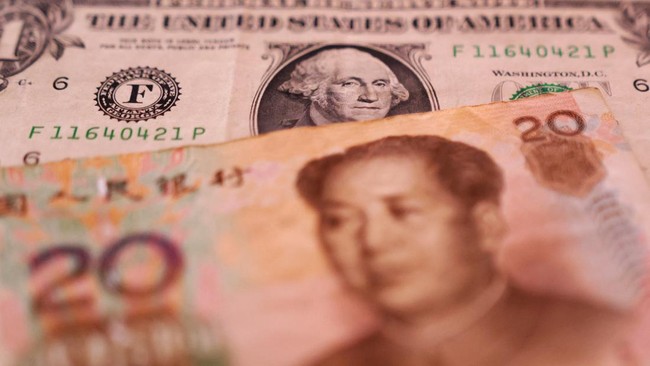
Jakarta, CNBC Indonesia - Indonesia’s external debt from the world’s two largest economies, the United States and China, have both experienced a decline. Nevertheless, the gap in debt value between the two nations remains relatively narrow.
Bank Indonesia (BI) released the Indonesia External Debt Statistics (SULNI) for the June 2026 edition on Monday (15/06/2026). According to the report, Indonesia’s external debt position in April 2026 was recorded at US$439.7 billion, representing a year-on-year (yoy) growth of 1.9%.
This growth was higher than the 1.0% yoy recorded in March 2026. When converted to Rupiah, Indonesia’s external debt position is equivalent to approximately Rp7,773.9 trillion, assuming an exchange rate of Rp17,680/US$.
BI explained that this development was influenced by the growth of external debt in the public sector amidst the ongoing contraction in the private sector’s external debt.
Government external debt in April 2026 was recorded at US$216.4 billion. On a yearly basis, government debt grew by 3.7% yoy, slightly lower than the 3.8% yoy growth in March 2026.
This development in government debt was primarily influenced by a slowing growth in foreign loans. Meanwhile, foreign capital inflows into Government Securities (SBN) continued to record a net inflow, reflecting maintained investor confidence in Indonesia’s economic prospects.
Meanwhile, the private sector’s external debt position in April 20able was recorded at US$193.2 billion. On a yearly basis, private debt continued to contract by 0.7% yoy, which was less severe than the 1.4% yoy contraction in the previous month.
Indonesia’s Debt to the US and China Both Decline
Looking at the two largest economies in the world, the United States and China, Indonesia’s external debt position in April 2026 moved in tandem. Both experienced a decrease compared to the previous month.
Indonesia’s external debt to the US was recorded at US$27.99 billion in April 2026. This figure fell from the March 2026 position of US$28.02 billion.
This means that Indonesia’s debt to the US decreased by approximately US$0.03 billion, or a monthly decline of 0.11%. While the decrease was relatively slim, it still indicates a correction after the US debt position had increased earlier in 2026.
Meanwhile, Indonesia’s external debt to China was recorded at US$25.43 billion in April 2026. This value was also lower than the March 2026 position of US$25.62 billion. Consequently, debt to China fell by 0.74% month-on-month.
Despite both declining, Indonesia’s external debt to the US remains larger than that to China. In April 2026, the difference in debt between the two countries reached US$2.56 billion.
When converted using an assumed exchange rate of Rp17,680/US$, this difference is equivalent to approximately Rp45.26 trillion. With a narrow gap, the US and China remain the two major nations playing significant roles in Indonesia’s external financing structure.
In recent years, financing from China has been closely linked to infrastructure and connectivity projects, including transport, energy, and special economic zone development. Meanwhile, financing from the US is more visible through financial market instruments, investment, and support for high-value-added sectors such as technology, energy, and industry.
Debt in Chinese Yuan Hits Record High
Although Indonesia’s external debt to China as a creditor nation has decreased, Indonesia’s debt position in Chinese Yuan denomination has continued to surge. In fact, its value has hit an all-time historical high.
In April 2026, Indonesia’s external debt in Chinese Yuan denomination was recorded at US$17.24 billion. This value rose from the March 2026 position of US$16.99 billion.
This means that debt in Chinese Yuan increased by approximately US$248 million in just one month. In percentage terms, the increase reached 1.46% month-on-month.
This increase occurs amidst deepening financial cooperation between Indonesia and China.
Recently, Bank Indonesia (BI) and the People’s Bank of China (PBOC) held a High-Level Meeting Joint Work Program in Shanghai, China, on Wednesday (11/06/2026).
In this meeting, both central banks reaffirmed their commitment to increasing the use of local currencies in bilateral transactions.
This cooperation includes strengthening Local Currency Transactions (LCT), exploring the expansion of the Bilateral Currency Swap Agreement (BCSA), and the formation of a Renminbi Clearing Arrangement in Indonesia.
The establishment of this renminbi clearing facility is considered vital as it can strengthen the yuan ecosystem domestically. With more adequate yuan liquidity, trade transactions, investment, and financial activities between Indonesia and China have the potential to become more efficient.
Furthermore, BI and PBOC launched the implementation of cross-border QR payments between Indonesia and China, as well as the participation of Bank Mandiri as a direct participant in the Cross-border Interbank Payment System (CIPS). This step strengthens the payment system connectivity between the two countries and facilitates the settlement of cross-border transactions.
With these various forms of cooperation, the use of the yuan in cross-border transactions and financing is poised to increase further. This aligns with the upward trend in Indonesia’s external debt in Chinese Yuan denomination, which has been rising in recent years.
Source: jawawa.id (https://jawawa.id/newsitem/new-record-indonesias-yuan-denominated-debt-hits-all-time-high-1781650247)
Originally published by CNBC Indonesia (https://www.cnbcindonesia.com/research/20260615141719-128-742962/sejarah-baru-utang-ri-dalam-yuan-china-cetak-rekor), translated from Indonesian