
New PSPK 1-2 Rules Effective 2027: Companies Can No Longer Hide Climate Risks and Emission Footprints
Starting 1 January 2027, companies in Indonesia will face greater demands for transparency on environmental matters. The implementation of Sustainability Disclosure Standards (PSPK) 1 and PSPK 2 means companies will no longer pursue profit alone, but must also account for the impact of climate change on business continuity.
Ahmad Zaki, a lecturer in the Accounting Department at the Faculty of Economics and Business (FEB) of Universitas Gadjah Mada (UGM), said PSPK 1 and PSPK 2 are adaptations of international standards governing corporate sustainability information disclosure. The standards have been approved by the Sustainability Standards Board of the Indonesian Institute of Accountants (DSK IAI) and will begin to be applied in 2027.
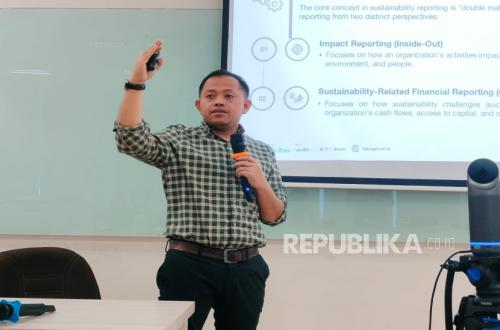
“These rules will change the way companies view environmental issues. The new standards ensure that businesses are not solely profit-oriented, but are also fully responsible for environmental sustainability and the global climate,” he said during the Sekolah Wartawan-EB Journalism event themed ‘Understanding PSPK 1 and PSPK 2: New Sustainability Disclosure Standards’ at the FEB UGM campus on Thursday (13/8/2026).
Zaki said climate change can no longer be treated as an external issue, as its impacts can directly affect operational costs, energy needs, supply chains and business continuity. One example he cited is rising global temperatures, which can increase demand for air conditioning. This in turn leads to higher electricity consumption and operational costs for companies. Similar effects can occur in other sectors when climate change disrupts the availability of raw materials or supply chains.
“All of this is certainly interconnected,” he said.
He explained that under PSPK 1 and PSPK 2, companies are also required to disclose greenhouse gas emissions more comprehensively, including Scope 1, 2 and 3 emissions. This means attention is directed not only at emissions originating directly from company operations, but also at emissions from energy use and the supply chain.
Zaki said these transparency demands will ultimately push companies to incorporate climate risk into their business strategies. In this way, sustainability does not stop at reports or corporate image, but becomes part of decision-making.
On the other hand, the FEB UGM lecturer also noted that sustainability information disclosure is increasingly important because global investors are now more selective in assessing company performance. A company’s ability to identify and manage climate risks can influence market confidence in the corporation.
“Capital market confidence now depends heavily on management’s ability to manage climate risks in a measurable and sustainable manner. Therefore, it is important for companies in Indonesia to start paying attention to this,” he said.
Nevertheless, Zaki said Indonesia already has an emission reduction commitment through various global agreements, including the 2015 Paris Agreement. The implementation of sustainability disclosure standards is one step to encourage the business sector to contribute to that target.
Companies have actually had time to prepare for the implementation of PSPK. Socialisation has been carried out since 2023, the standards were prepared in 2024, and implementation is directed to be effective from 2027. The Financial Services Authority (OJK) has also prepared amendments to POJK 51/2017 to align with PSPK 1 and PSPK 2.
However, the implementation of the new standards still faces challenges, particularly regarding the readiness of professional personnel who can provide assurance on sustainability reports. Moreover, the number of auditors with competence in this field is currently considered limited.
“Locally, we are still very limited in that regard,” he said.