
New professions proliferate in China amid rapid growth of embodied AI
Chongqing (ANTARA) — A range of new career opportunities is emerging amid the growth of China’s embodied artificial intelligence (AI) industry, from training robotic arms to building virtual practice environments for inspection robots.
In September 2026, China’s Ministry of Human Resources and Social Security, together with other government agencies, announced 11 new professions, including embodied AI robot application technicians and digital-twin engineers.
At Sevnce Robotics, which operates in Liangjiang New Area in the southwestern Chinese city of Chongqing, Tang Zixiang works as an embodied AI robot application technician, training robots to carry out various tasks.
Tang adjusts the positions and angles of several knobs to simulate different working conditions, then uses the resulting data to train AI models. He deploys the trained models on robotic arms for further testing and refinement.
Through repeated testing, the robots gradually learn tasks in simulations before applying them in the real world.
“Our job is to help robots move from the testing room to wider real-world application,” Tang said.
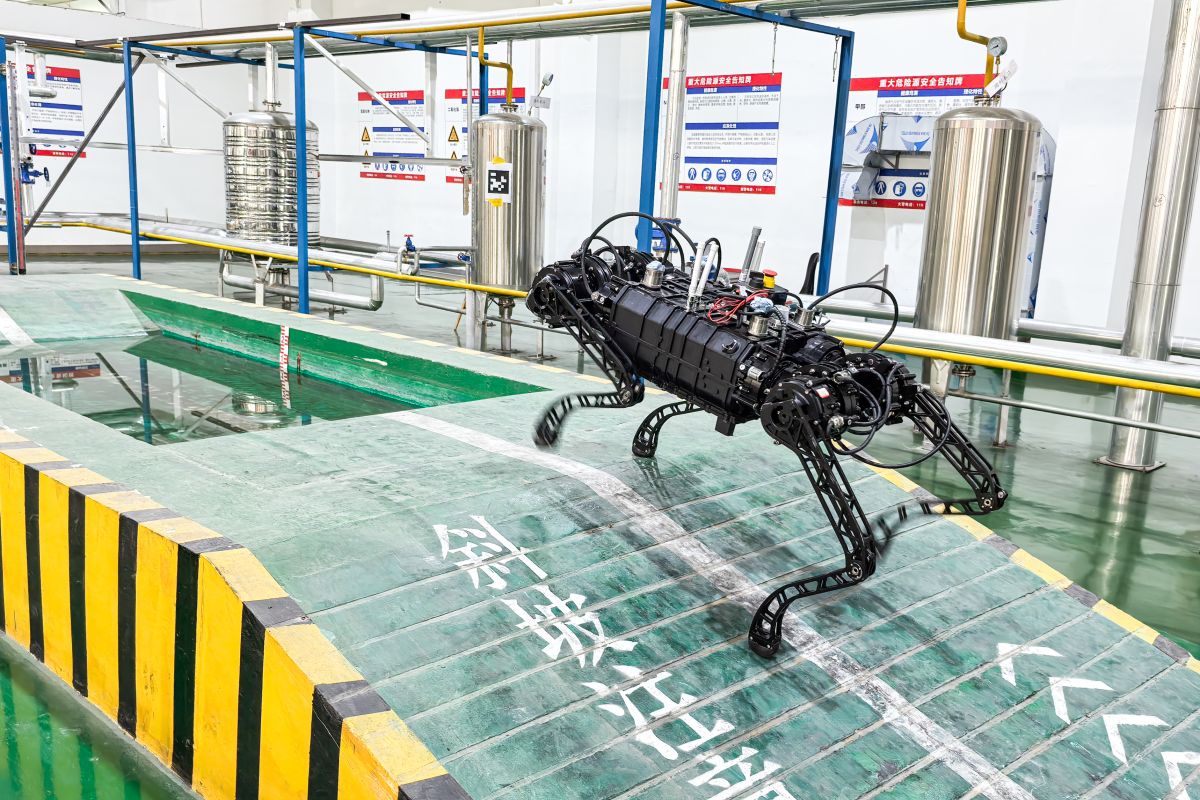
Sevnce Robotics develops specialised robots for the oil and gas, chemical and energy industries. Its machines can replace or assist human inspectors in hazardous environments.
In such settings, robots must be able to operate reliably over long periods. Tang and his colleagues need to balance speed and accuracy requirements, test whether robots can recover from operational failures, and determine when they should stop or require human intervention.
“Our aim is to turn robots working in testing rooms into machines that can operate safely and reliably over the long term,” Tang said.
Alongside embodied AI robot application technicians, another newly recognised profession is that of the digital-twin engineer. Their general role is to help prepare robots for deployment in real-world settings.
Jiang Lei, who works in the field, builds virtual environments where inspection robots can practise their tasks before deployment.
Using three-dimensional (3D) reconstruction, Jiang’s team creates digital replicas of factories, allowing robots to rehearse inspection routes and check whether their cameras can capture instrument readings. Once tasks have been validated in simulations, they can be transferred to physical robots.
Typically, technicians take robots to a worksite, map the surrounding environment, plan routes and set inspection points, Jiang said.
Digital twins allow this work to be rehearsed in simulation, reducing the time required from two or three weeks to just two or three days. The simulations also generate data for testing and training algorithms, cutting the time and cost of collecting data in real-world environments.
As the industrial supply chain becomes increasingly specialised, career opportunities are also opening up to people with a range of educational backgrounds.
Jiang, for example, studied automotive engineering at university and moved from research into autonomous driving to robot development, which requires skills in modelling, programming and 3D simulation.
Tang, who has bachelor’s and master’s degrees in computer science, applies reinforcement and imitation learning to robot training while continuing to study robot kinematics and motion control.
The growth of the embodied AI industry is also increasing demand for specialists in data collection, model training, and the operation, maintenance and configuration of systems.
China’s Ministry of Industry and Information Technology recently reported that the country has more than 400 humanoid robot models, and that 40,000 humanoid robots were produced in the first half of 2026.
Efforts to train workers for the sector are also gathering pace. In early October 2026, Beijing City University (BCU) launched a programme to train highly skilled talent in embodied AI applications and practice. The programme offers an intensive five-day course combining classroom teaching with hands-on work using real robots for industry workers.
Tang said he hoped robots would complement human workers rather than simply replace them.
“I hope robots will take on work that is more dangerous, boring and repetitive,” he said.
Source: jawawa.id (https://jawawa.id/newsitem/new-professions-proliferate-in-china-amid-rapid-growth-of-embodied-ai-1793191955)
Originally published by Antara (Indonesian) (https://www.antaranews.com/berita/5817487/profesi-baru-merebak-di-china-berkat-perkembangan-pesat-ai-berwujud), translated from Indonesian